"Bingo" sounds like a single game, but it's a whole family. A grandmother's ticket in Liverpool has 3 rows and 9 columns; the card in a church hall in Ohio is 5×5 with a free space in the middle; a Neapolitan family on Christmas Eve plays with the same ticket as the English one, but every number has a nickname; and on a Mexican family's table there are no numbers at all, only pictures.
This is part 1 of 5 of our series on the types of bingo. Here you'll find the classification used most around the world: by the number of balls. The other four parts cover the hall variants, the bingo of each country, themed bingo and bingo by occasion:
- Part 1 (this one): the types of bingo by number of balls.
- Part 2: the 12 variants of 75-ball bingo, from hardway to the progressive prize.
- Part 3: bingo around the world, how it's played in 16 countries and cultures.
- Part 4: themed bingo, when the card has no numbers.
- Part 5: bingo by occasion, from drag bingo to the baby shower.
Our starting point was a good article on the Bingotastic site, which compares eight formats by number of balls and simulates how long each one lasts. We took what it offers and went further: it looks at online bingo in the UK; here you'll see how each format is actually played, on paper, at a table.
The three questions that define a type of bingo
Every bingo in the world answers three questions, and it's the combination of answers that gives the type its name:
- How many balls: 30, 40, 50, 52 cards, 75, 80 or 90. The more balls, the longer the round.
- What the card looks like: 3×3, 3×9 with 15 numbers, 4×4, 5×5 with a free space, or a hand of playing cards.
- How you win: one line, two lines, the full card, a pattern agreed in advance, or any 5 numbers.
75
balls: the bingo of the Americas, Brazil, the Philippines and Japan
90
balls: the bingo of the UK, Italy, Spain, India and Australia
80
balls: the middle ground that was born on the internet
30
balls: the fastest bingo there is, 2 to 5 minutes


Gather the ones you love for the next Bingo
See how simple it is to play and host with Bingo Pé Quente.

5 stars on Google PlayFree to start, no sign-up
90-ball bingo: British bingo
Where it's played: the UK, Ireland, Australia and New Zealand (where it's called Housie), India (Tambola), Italy (Tombola), Spain, Portugal, Russia (Loto) and much of Spanish-speaking South America. In Brazil, it was the format of the commercial bingo halls of the 1970s to 1990s: many people over 60 learned the game on it and still call the card a "ticket".
Where it comes from: it descends from the Italian lotto of the 16th century, passed through France as "le lotto" and reached England in the 19th century. In the 1960s, when British law allowed the game in clubs, it became the Saturday-night fixture of working-class families, with halls seating hundreds.
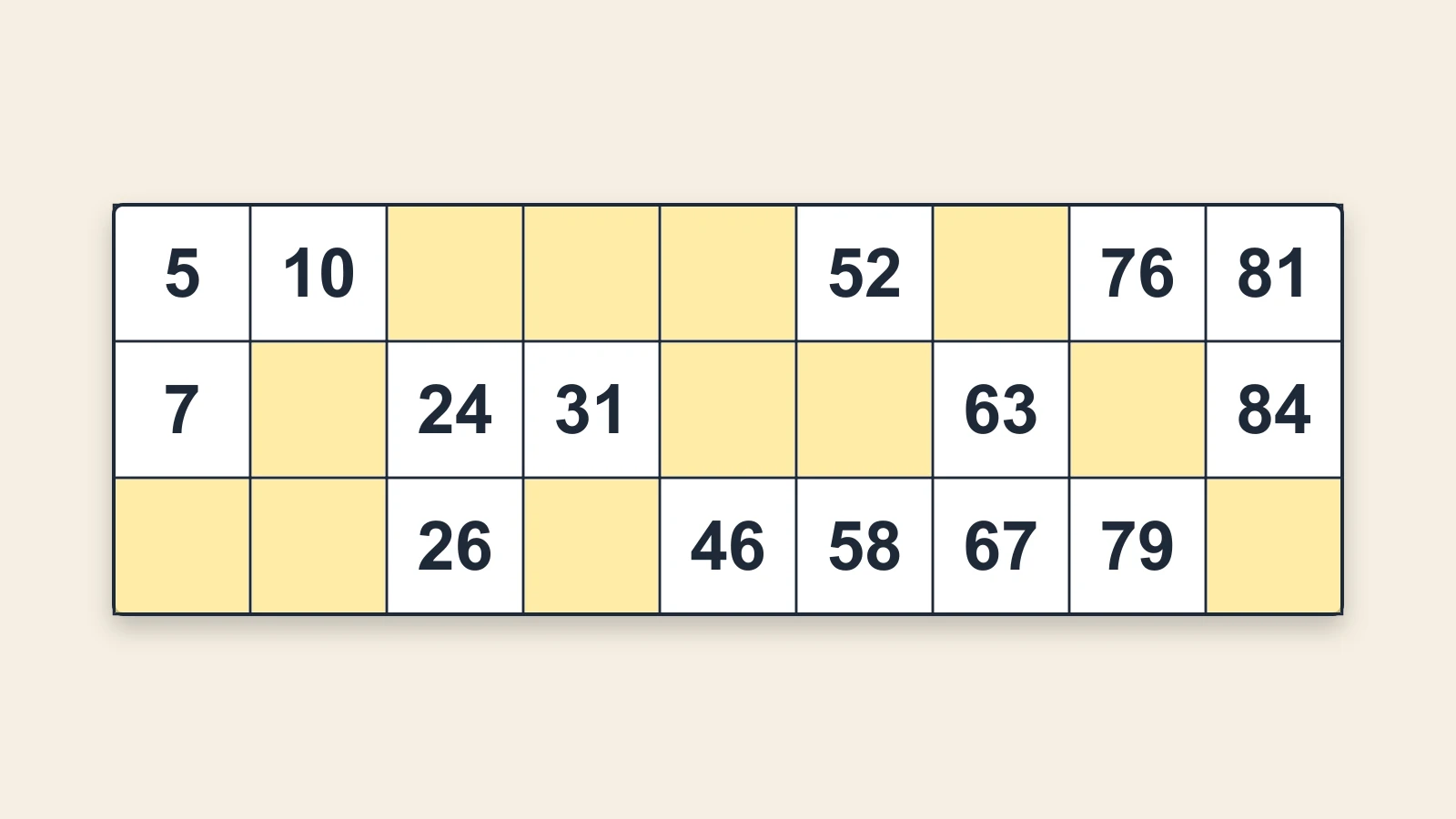
The card: the ticket has 3 rows and 9 columns, with 15 numbers and 12 blank squares: each row has exactly 5 numbers. Each column covers one group of ten: the first runs from 1 to 9, the second from 10 to 19, and so on up to the last, from 80 to 90. Tickets come in strips of 6, and the whole strip contains all 90 numbers with no repeats: whoever buys a strip marks a square on every single ball.
How you win: by progression, always in the same order and in the same round. First one line (the 5 numbers of a horizontal row), then two lines on the same ticket and, finally, the full house, which is the big prize. The game doesn't stop between prizes: whoever gets the line wins theirs and everyone keeps marking.
One line
The 5 numbers of a horizontal row. Comes up around ball 25 to 35 in a full hall.
Two lines
Two of the three rows on the same ticket. Usually between ball 50 and 60.
Full house
All 15 numbers. The big prize, around ball 70 or 80.
How to play, step by step: (1) everyone buys or receives one or more tickets; (2) the caller draws a ball from the cage and announces the number, with the bingo call if they like; (3) whoever has the number crosses it out or covers the square; (4) whoever completes a row shouts "line!" and the caller checks the 5 numbers against the balls that have come out; (5) the game goes on to two lines and to the full house, when someone shouts "bingo!" or "house!"; (6) once the full house is checked, the round is over and the tickets go in the trash: the next round uses new tickets.
The seasoning: the British caller's rhyming calls, some of them from the First World War. "Two fat ladies" is 88, "legs eleven" is 11, "two little ducks" is 22, "Kelly's eye" is 1. Nicknaming numbers is a worldwide tradition, and Brazil has its own list: it's in bingo calls.
80-ball bingo: the middle ground that was born on the internet
Where it's played: British bingo sites and a few apps. It has no hall tradition: it was created online, in the early 2000s, as a format halfway between American 75 and British 90, for people who found one too fast and the other too slow.
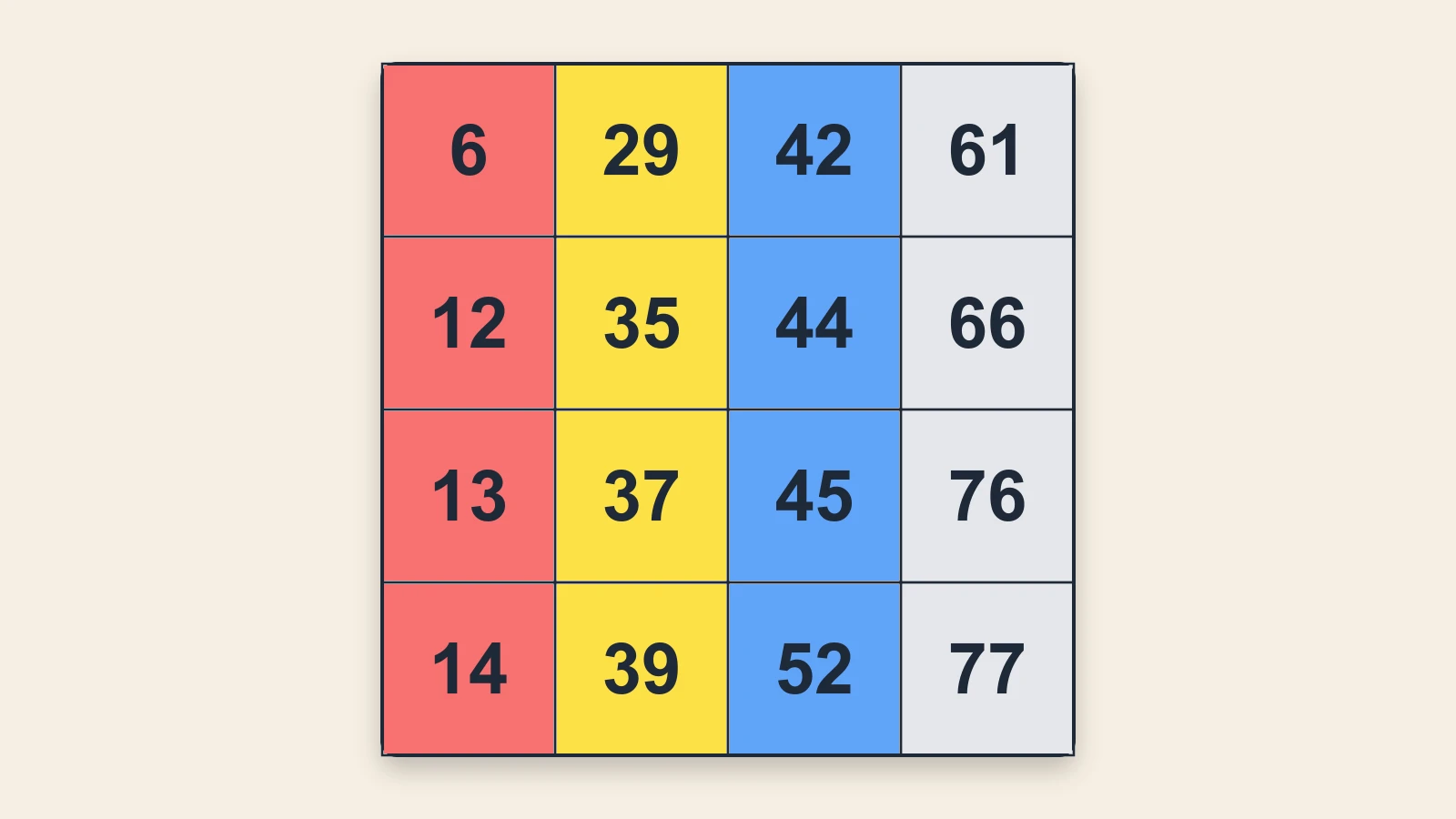
The card: 4×4, 16 numbers, no free space. Each column has a color and covers 20 numbers: the first (red) runs from 1 to 20, the second (yellow) from 21 to 40, the third (blue) from 41 to 60 and the fourth (silver or white) from 61 to 80. The color plays the role of the B-I-N-G-O letter: it sends your eye to the right column.
How you win: much like 75-ball, with patterns. Horizontal, vertical or diagonal lines, the four corners, the center square (the 4 middle squares) and the full card. Many rooms pay several prizes in the same round, in a ladder that ends with the full card. Cards usually come in groups of five.
How to play at home: draw a 4×4 grid, draw 4 numbers from each block of 20 to fill each column, and use 80 slips of paper in a jar. Agree the winning pattern beforehand. A good way to use it: one round of a line, one of four corners, one of the full card.
75-ball bingo: American bingo (and ours)
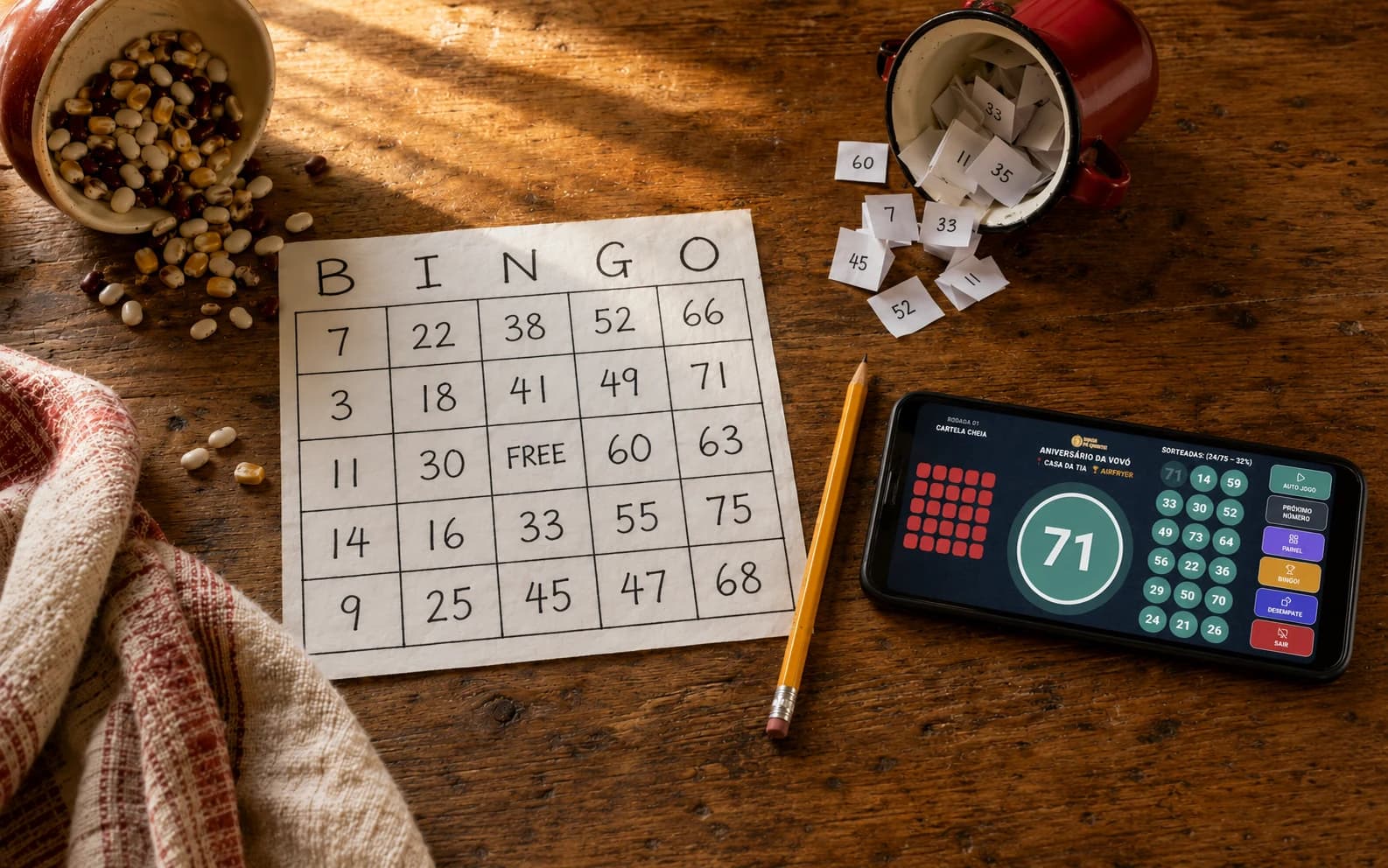
Where it's played: the United States, Canada, today's Brazil, the Philippines, Japan and most of the world's online bingo. It's the Bingo Pé Quente format and the most played on the planet.
Where it comes from: in 1929, toy salesman Edwin Lowe saw a game called "beano" at a carnival in Georgia, where players marked with beans and shouted "beano!". He took it to New York, a player shouted "bingo!" by mistake and the name stuck. Lowe hired a math professor to create thousands of different cards, and American parishes adopted the game as a fundraiser: to this day, church bingo is an institution there. The full story is in the history of bingo.
The card: 5×5 with 24 numbers and a free space in the middle (the FREE). Each column has a letter and a range of 15 numbers: B from 1 to 15, I from 16 to 30, N from 31 to 45, G from 46 to 60 and O from 61 to 75. That's why the caller says "N, 41!": the letter sends your eye to the right column.

How you win: by pattern. Before the round, the organizer announces which pattern the card needs to form: a line in any direction, the four corners, the letter X, the picture frame, a square, a letter of the alphabet, a Christmas tree, or the full card (blackout or coverall). It's the difference in philosophy between the world's two big bingos: 90-ball is a game of progression (line, two lines, full house, always), 75-ball is a game of patterns, with hundreds of them catalogued.
One line
Across, down or diagonal. The fastest pattern.
Four corners
Only 4 numbers, but it takes a while: each corner is in a different column.
Letter X
Both diagonals. The free space is already in the middle.
Picture frame
The whole border, 16 numbers.
Stamp
A little 2×2 square in a corner. In the United States, the postage stamp.
Blackout
All 24 numbers. Comes up between ball 50 and 65.
How to play, step by step: (1) the organizer announces the round's pattern and shows it to everyone; (2) the caller draws and calls letter and number ("G, 52!"); (3) whoever has the number marks it with a bean, a corn kernel, a bottle cap or a dauber; (4) whoever completes the pattern shouts "BINGO!"; (5) the caller checks out loud, square by square, against the balls that have come out; (6) prize handed over, cards are cleared (or swapped) and the next round begins, with another pattern. The most played patterns, with tips on how to recognize each one, are in bingo patterns; the whole game, from scratch, is in how to play bingo.
Swedish 75-ball bingo: five lines, five prizes
Where it's played: Sweden and the sites that imported the variant. It uses the same 75 balls and the 5×5 card, but with 25 numbers and no free space.
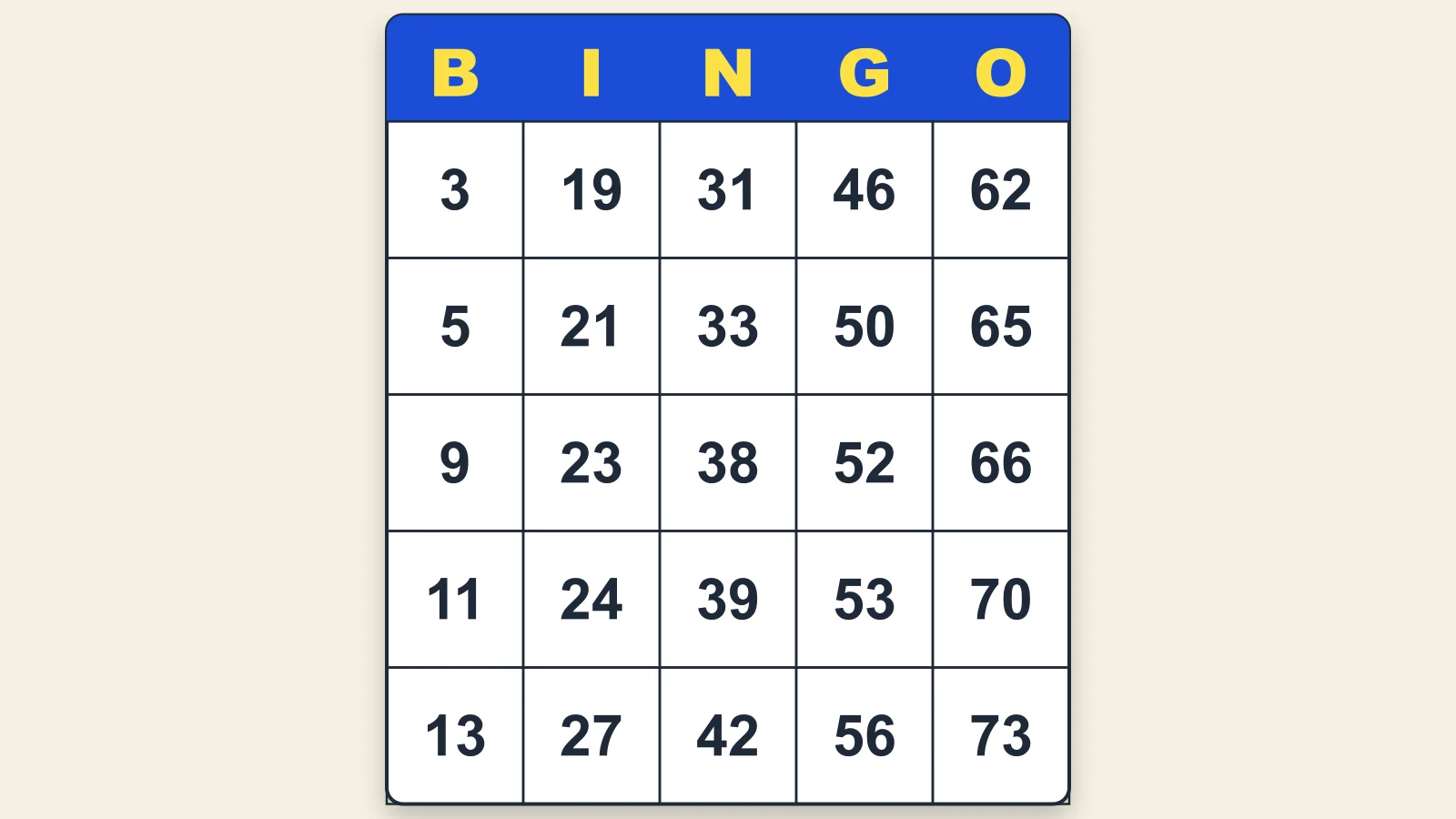
How you win: by ladder, as in 90-ball. There are five prizes in the same round: one line, two lines, three, four and, with all five, the full card. It's 75-ball played with a 90-ball mindset, and it suits anyone who wants several "BINGO!" moments in a single round. In a full hall, the first line comes up around ball 20, and the full card around ball 64.
How to play at home: a regular 75-ball card, with the middle square filled with a number from 31 to 45. Agree the five prizes beforehand, from smallest to largest, and have the caller note down who won each step.
50-ball bingo: two lines and done
Where it's played: a British online niche, under various names (emoji bingo, clover bingo).
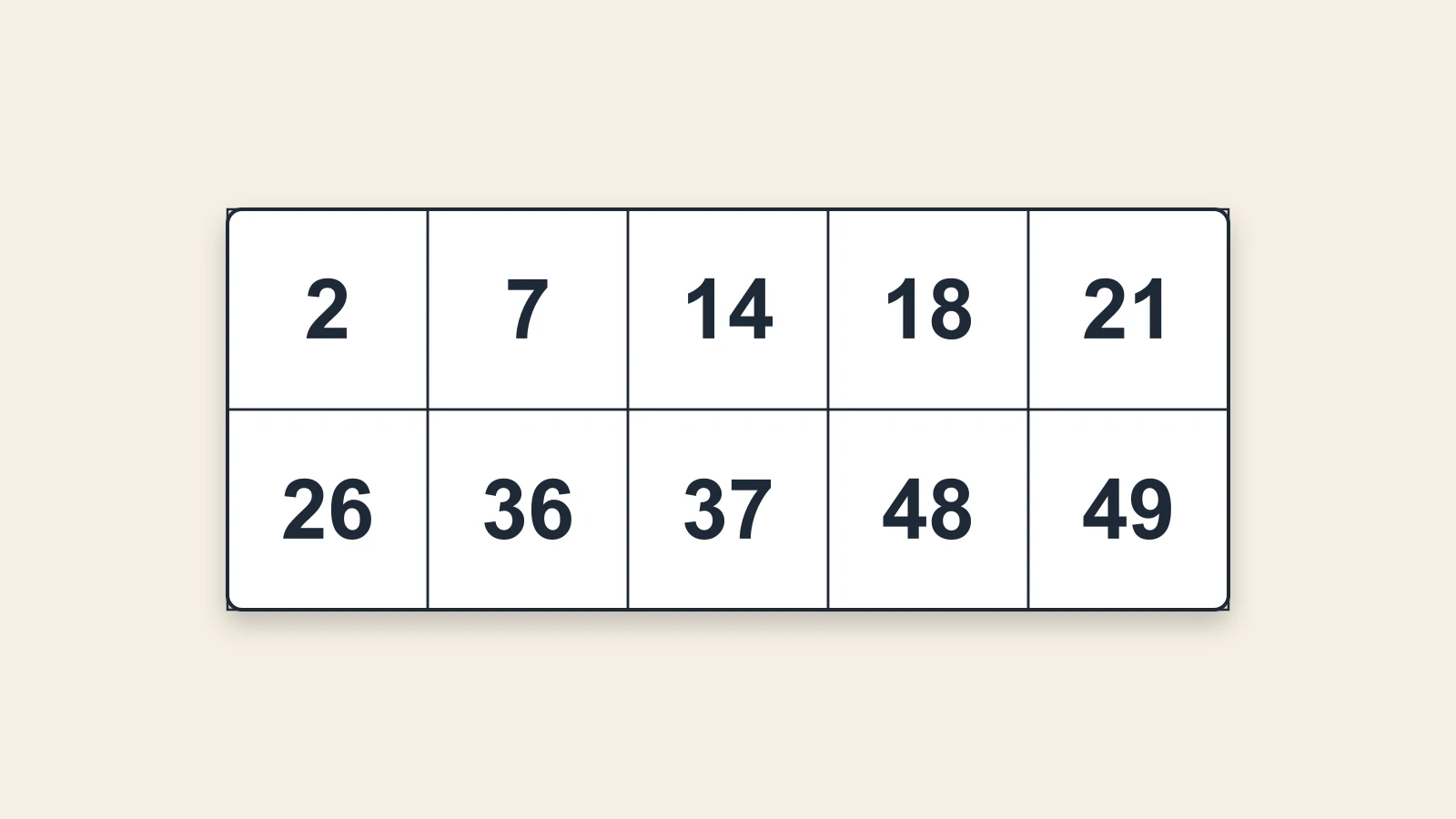
The card: 10 numbers in 2 rows of 5. How you win: first one line, then the full card. A short round, 30 to 40 balls. At home: 50 slips of paper in a jar and hand-drawn two-row cards, with 5 numbers from 1 to 25 in the first row and 5 from 26 to 50 in the second.
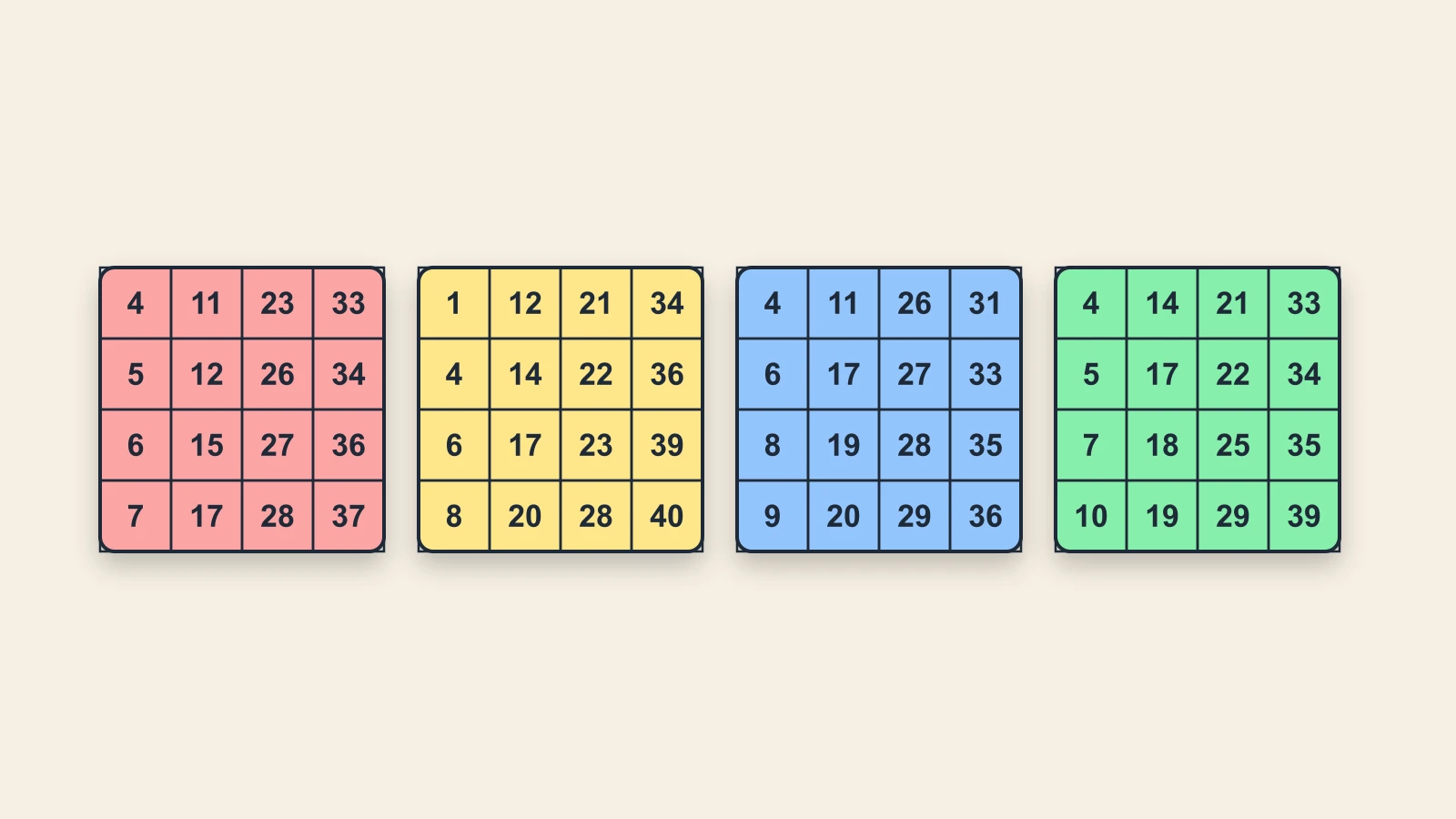
40-ball bingo: four colored cards at once
Where it's played: rarely, on a few sites. The player receives several cards of different colors at the same time, and each color has its own full-card prize. Since there are only 40 balls, the cards are small and the round is quick. It's more of a curiosity than a table game.
30-ball bingo: speed bingo
Where it's played: online, in apps, and at parties that want a 3-minute round between two long ones.
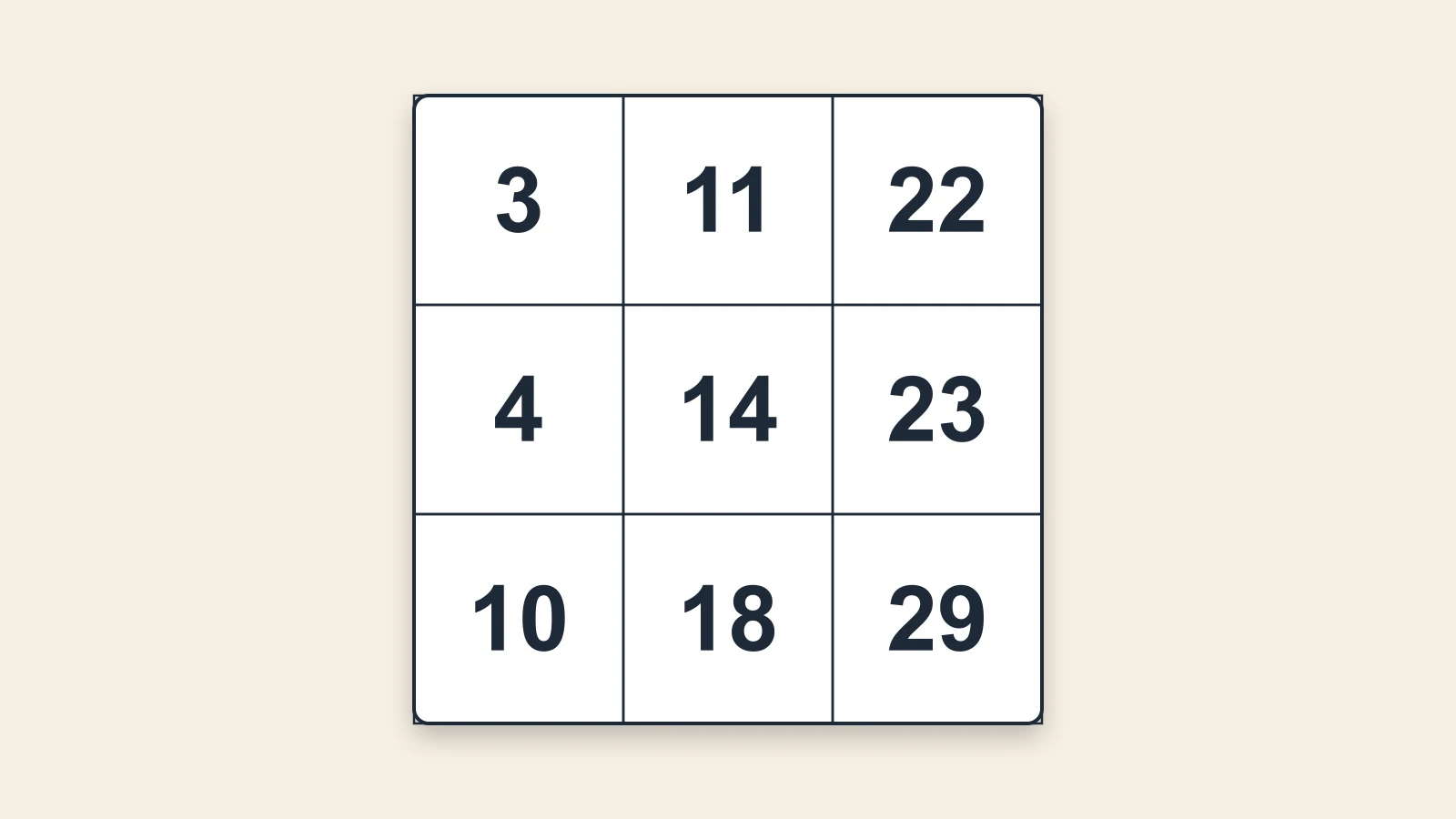
The card: 3×3, 9 numbers, from 1 to 30. How you win: full card only. It's the fastest bingo there is: it comes up between ball 17 and 22 in a full hall. At home: 30 slips of paper in a jar and one 3×3 grid per person, with 3 numbers from 1 to 10 in the first column, 3 from 11 to 20 in the second and 3 from 21 to 30 in the third. It's the right format for small children and for anyone still learning.
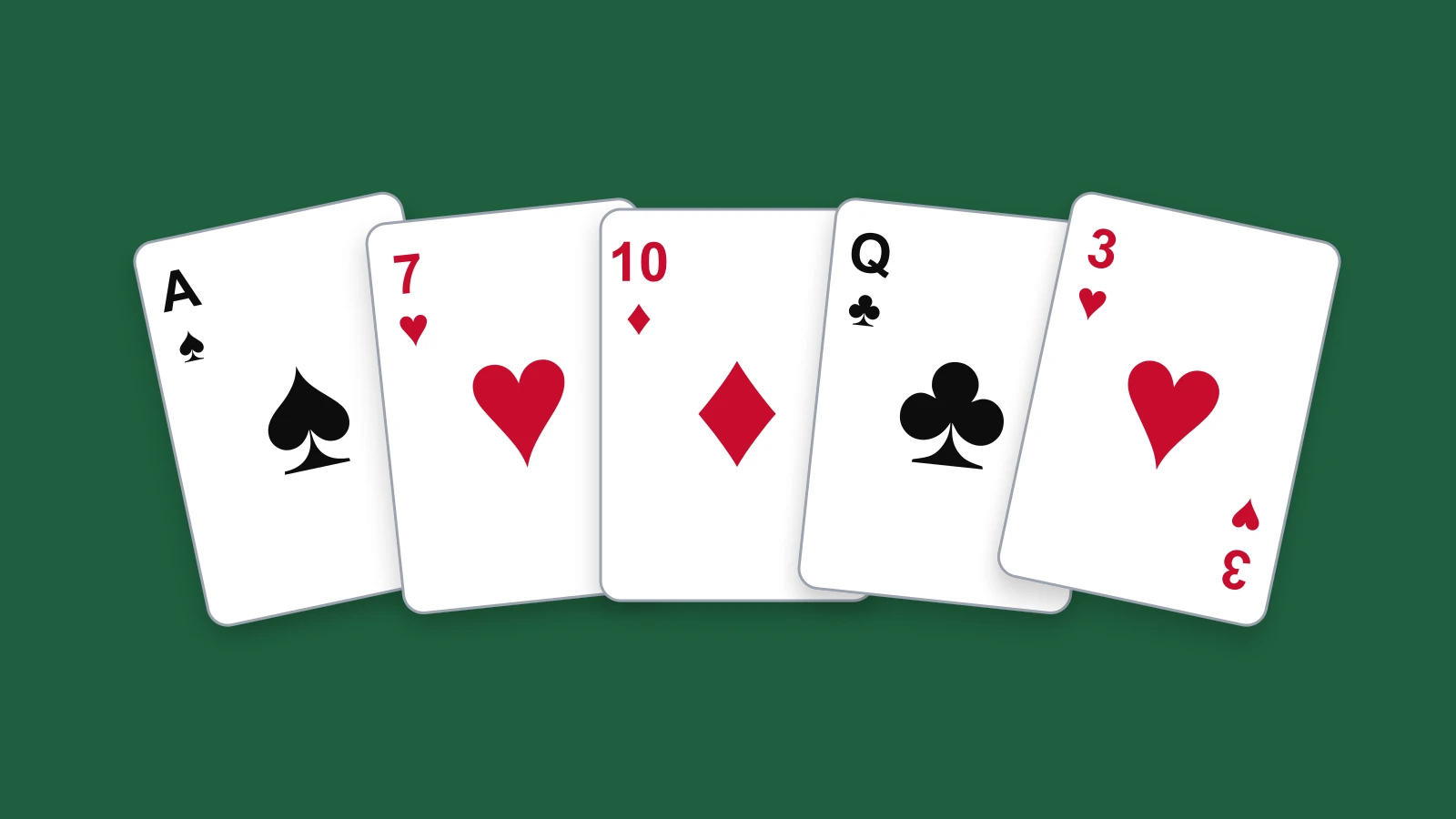
52-card bingo: a deck of cards instead of the cage
Where it's played: online rooms, and at home for fun. How it works: the 52 cards of a deck replace the balls. Each player receives a "hand" of 5 cards (the bingo card), the caller turns over the cards of a second deck one by one, and the winner is whoever has all 5 cards of their hand turned over first. There's only one prize per round. With lots of people playing, it's the format that ends soonest. At home: two decks; one deals the hands, the other is the "cage".
How long each one lasts (a useful calculation for organizers)
The author of the Bingotastic article simulated thousands of rounds and measured how many balls, on average, it takes for the full card to come up. The measure is in balls, not minutes, because the caller's pace changes from room to room. With 100 cards in play:
- 90 balls: full house around ball 67.
- 80 balls: around ball 61.
- Swedish 75 balls (25 numbers): around ball 64.
- 50 balls: around ball 33.
- 30 balls: around ball 20.
- 52 cards: around card 21.
The more cards in the room, the sooner someone finishes. With 500 cards, 90-ball drops to ball 61 and 30-ball to ball 17. With 20 cards, a family table, 90-ball runs to ball 73 and 75-ball with 24 numbers, with the free space, usually closes between ball 55 and 65. For organizers, the lesson is simple: for a long evening with conversation, 90 or 75 balls; to fill a break, 30 balls or playing cards. Duration also depends on the caller's pace: how to train a bingo caller has the balls-per-minute math.
Which format to choose
- A long afternoon, with conversation and several rounds: 75 balls with a different pattern each round, or 90 balls in a ladder.
- Several prizes in a single round: 90 balls (three) or Swedish 75 (five).
- A 3-minute break between rounds: 30 balls or a 52-card deck.
- Small children or anyone still learning: 30 balls, for the 9-square card.
- Anyone who wants visual variety: 75 balls, for the patterns.
Which of these bingos you can play with Bingo Pé Quente (and how)
Bingo Pé Quente is a 75-ball bingo app, that and nothing else, on purpose: the card is the 5×5 with a free space and B-I-N-G-O columns. It draws and calls the balls on the CALLER tab, with a full-screen mode for the TV, and keeps track of your paper cards on the PLAY tab, reading the card with the camera or taking the numbers typed in by hand. Checking the BINGO is still the caller's job, with the card in hand.
- 75-ball bingo with patterns: that's the app's game. Choose the pattern under GAME PATTERN before the round. There are 18 classic patterns in the free tier (a line in any direction, both diagonals, four corners, picture frame, cross, X, square, letters T, L and U, blackout) and the exotic ones in PARTY (the other letters, numbers, diamond, kite, heart, Christmas tree, bell, pumpkin and more).
- Swedish 75 (ladder of lines): yes, with PARTY's multi-prize mode: phase 1 Complete Line, phase 2 Two Lines, phase 3 Blackout. That's three steps instead of five, and the middle square stays free, but the contest is the same: several prizes in a single round, with the app moving from one phase to the next on its own. If the Main Prize is on, it comes with phase 3: whoever completes the blackout within the ball limit takes both.
- 90, 80, 50, 40 and 30-ball bingo, and the playing-card one: no. The app's card is only the 75-ball 5×5. 90-ball bingo did exist in the app and was removed in 2026, as a product decision: one bingo, done well. For those formats, the card is paper and a jar of slips is the cage.
- A short 3-minute round (the spirit of 30-ball): yes, with 75: choose four corners or a line and set the automatic draw to 3 seconds between balls. The round is over in a minute or two.
The app is free to download on Google Play, for Android phones, and the free tier keeps track of up to 3 cards, with unlimited free camera reading. To print 75-ball cards for free, use the site's bingo card generator.
Quick questions
- How many types of bingo are there by number of balls? Eight current formats: 90, 80, 75, Swedish 75, 50, 40 and 30 balls, plus the 52-card one. The two big ones are 90 (British) and 75 (American).
- What's the difference between 75-ball and 90-ball bingo? 75-ball uses a 5×5 card with a free space and you win with a pattern agreed in advance. 90-ball uses a 3×9 ticket with 15 numbers and you win by ladder: one line, two lines, full house.
- What's the most played type of bingo in Brazil? Today, 75-ball, at school fairs, clubs and at home. The commercial bingo halls of the past, closed in 2004, were 90-ball.
- What's the fastest bingo? 30-ball (3×3 card, full card only), which ends in 17 to 22 balls, and the 52-card version with a full room.
- What's the slowest bingo? 90-ball with few cards: at a table of 20 tickets, the full house comes up around ball 73.
- Does Bingo Pé Quente play 90-ball bingo? No. It's a 75-ball-only app, with a 5×5 card and a free space. For 90-ball bingo, the card is paper.
The balls and the card change. The shout at the end is the same everywhere.