
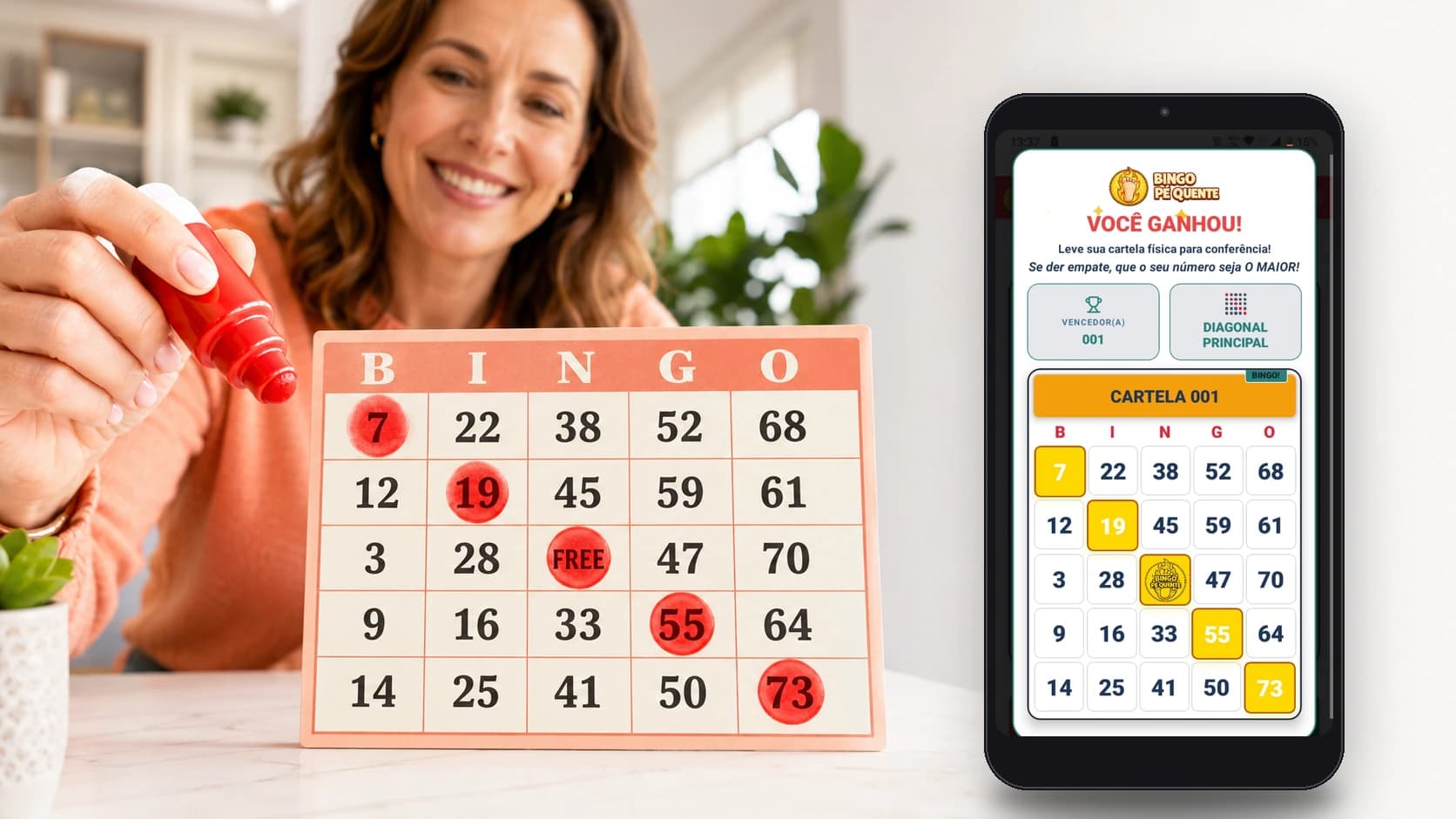
There you are, card in hand, and the caller announces: 'a line wins today!'. Or maybe: 'you only close with a full card!'. What they just said is the round's pattern — the shape you need to complete to shout BINGO. Understanding the patterns is the difference between hoping in the dark and knowing exactly what to chase on your card.
Each round, the host decides which patterns count and what the prize is — and this varies a lot from one bingo to another. In this guide you'll get to know the 10 most played shapes in 75-ball Bingo, how to recognize each one, and the most common ways they come into play. If you've never played, it's worth starting with the step-by-step guide on how to play bingo.
5×5
the size of a 75-ball Bingo card
10
patterns you'll master here
3–4
patterns that can count in the SAME round
1
card that can stay in play the whole event
Winning at bingo isn't just luck with the numbers — it's knowing which shape you're chasing.
A quick recap: what a 75-ball card looks like
Every 75-ball Bingo card has 5 columns (one for each letter of B-I-N-G-O) and 5 rows, forming a square of 25 spaces. The middle square is the FREE space — it counts as marked for everyone, free of charge. That leaves 24 numbers, and it's on these spaces that the patterns are drawn.
With the card fresh in mind, let's go from the easiest pattern to the grand finale of the event.
The line: the opening of the event
'Eyes on your card: the first round is a LINE!' — that's almost always how the event begins.
Horizontal line
A row from left to right. Any of the five counts — and the middle one passes through the FREE space.
Vertical line
A column from top to bottom. Any of the five counts — and the middle one passes through the FREE space.
Diagonal line
From one corner to the other, crossing the FREE space right in the middle.
Shapes and letters: the heart of the party
After the opener, the patterns take shape — from quick corners and squares to letters and the diamond. Most need more balls, so the tension rises:
Four corners
Just the four corners of the card: few spaces, but at the far edges — the thrill is waiting for the last corner to drop.
Center square (window)
A hollow square around the center — the classic 'window'. The FREE space stays out; only the little frame in the middle remains.
Letter X
The two diagonals crossing right in the middle (at the FREE space). Symmetrical and easy to check.
Letter T
The entire top row plus the middle column going down — a capital T.
Border
The whole edge of the card, forming a frame around the center. One of the longest — and prettiest.
Diamond
A narrow diamond hugging the center. Elegant and full of suspense.
And that's just a sample: there are dozens of other shapes — other letters (L, H, U…), heart, Christmas tree, kite, glass, and so on. The rule is always the same: complete the announced shape and shout BINGO.
The ways patterns come into play
Knowing the shapes is half the game; the other half is knowing how they count in your round. The most common setup is to play one single card from start to finish of the event, with the prizes coming out little by little:
- Regular rounds (most of them): 3 or 4 shapes count at the same time — for example four corners, line, column, and diagonal, all together. Whoever completes any one first wins, and each round usually hands out one or two prizes.
- Extra rounds: each one counts just one shape — only the border, only the window, and so on. These extras add up: in some places they reach 15 to 20 prizes over this stage.
- The last round: the full card, the biggest prize, saved for the grand finale.
And there are still other ways to set the patterns:
- One pattern per round — each round counts a single shape, with new cards every game.
- Custom pattern — the organizer can design their own shape, cell by cell: a heart, the event's initial, a figure no one expects.
- Random pattern — instead of a fixed shape, a few cells of the card are drawn on the spot, as a surprise; no one knows in advance where they'll land.
Whoever sets up this whole sequence is the organizer — if you're going to run the game, see how to train a first-time bingo caller.
The grand finale: the full card
When the organizer saves the biggest prize for the end, they call for the full card (the 'coverall'): marking all 24 numbers on the card. It's the longest pattern, the one that holds the hall until the very last ball, and it usually carries the main prize of the event.
Full card
Every space marked (the FREE space comes free). The biggest prize of the event.
'Now everything counts: full card for the top prize!' — and the whole hall holds its breath.
How not to miss the round's pattern
- Check the pattern BEFORE the first ball. Knowing whether it's a line or a full card completely changes what you'll watch for on your card.
- Mark only what matters. In a four-corners round, there's no point fussing over the middle of the card — focus on the spaces in the shape.
- Look at the card as a whole. Many people complete the pattern without noticing. Before each new ball, give the round's shape a quick scan.
- Start with a single card. Tracking the pattern across several cards at once is confusing at first. You can add more later.
Several patterns at once? The app handles it
Here's the trick: in those regular rounds that count 3 or 4 patterns at once, whoever closes any one first wins. Watching them all is hard on one card, and as the number of cards grows, it becomes impossible to track in your head — take a look:
Three patterns counting on the same card, at the same time. Whoever completes any one first wins.
That's exactly what Bingo Pé Quente solves: you mark the balls and the app checks them, tracks every valid pattern of the round at the same time, across all your cards, and warns you the moment any one is about to close — so you never miss a win to distraction. And if you prefer paper, you can print cards for free with our card generator and practice at home. Want to play better? See also the 9 tips to win at bingo.
In the end, each pattern is a different way to reach the same shout of joy. Learn to recognize them, choose where to focus your eyes — and may the next BINGO be yours.