

Every organizer has been here: the hall is set up, the prizes are on the table, the cards are sold — and nobody is there to call the balls. In steps the well-meaning volunteer who has never held a microphone, speaks too softly, rushes, tangles up 16 and 60, and is hoarse by the middle of the third round.
Calling bingo is a technical job, not a gift. It has a speaking formula, a pace measured in seconds, a protocol for when someone shouts BINGO, and voice care. You can train someone from scratch in an afternoon. This guide is that training — the way it is done where bingo happens every week: parish halls, clubs, schools and community centers.
2
beats in the calling formula
20s
between balls, in the first round
2×
times the number is said in every call
0
shouting — shouters lose the voice by round 2
First things first: what the caller actually does
Beginners think the job is reading numbers out loud. It isn't. The caller owns the clock of the party and is the authority in the room: they open the round by announcing the pattern that counts, set the pace, hold the nerves of everyone sitting one ball away, and run the verification without letting it turn into an argument. That is four distinct jobs — and the beginner needs to know there are four.
1. Open the round
Before the first ball, announce out loud the pattern that counts, the prize for the round and how many cards each person is playing. Whoever arrived late needs to hear it again.
2. Call the balls
Say every number in the same formula, at the same volume and the same pace, from first to last. Consistency beats charisma.
3. Run the clock
Speed up when the room is warm, slow down when a lot of people are close to filling the pattern. The caller reads the room and adjusts.
4. Run the verification
When someone shouts BINGO, the game stops and the caller takes over: reads the numbers out loud, confirms in front of everyone and resumes. This is where the party is won or lost.
The calling formula: two beats, always the same
The rule that separates the amateur caller from the professional is almost insultingly simple: the call never changes shape. In the charitable bingo manual of the Minnesota regulator, the game literally begins with the first letter and number called — and the caller is required to make sure the majority of players can see that letter and number during the game. The formula has two beats:
B, seven · B, seven
- Beat 1 — letter and number. Never the number on its own. The letter tells the room which column to search and clears up half of all mishearings.
- Beat 2 — repeat. The same letter-number pair, in the same intonation. The distracted, the four-card player and the hard of hearing all catch the number here.
Notice the call ends on the number. The last sound the room hears has to be the information it needs to mark. Beginners do the opposite — they drop the number and tack on a comment, and the comment erases the number.
Sixteen and sixty sound almost identical from the back of a hall. With the letter in front they become I-16 and G-60 — and nobody gets it wrong.
The pace: how many seconds between balls
This is the question every beginner asks and almost nobody answers with a number. The truth is that there is no correct pace — there is your crowd's pace. Two simple things decide it: how many cards each person is watching, and how long it takes them to sweep all of them looking for a number. A child with one card finds it in seconds; the aunt with four, at the back table, does not. In a classroom 10 seconds is plenty; at the parish party the same interval runs over half the room.
For an ordinary party — all ages, paper cards in hand, one or two per person — this is the ruler that works:
- 20 seconds — the first round of the night, always. Nobody is warmed up, plenty of people are still finding their card, and someone will arrive late. Start slow and win the room.
- 15 seconds — cruising pace. The interval that suits most parties: enough time to search two cards without the round dragging.
- 10 seconds — warm room, one card per person. From the third round on, once everyone has the hang of it, you can tighten up.
- Back to 20 seconds down the stretch. When the pattern is nearly filled and the whole room is one or two balls away, slow down. Rushing at the end is what produces false bingos and complaints.
That ruler is nobody's regulation — it is what practice teaches, and every room ends up finding its own. What the app does is take the stopwatch out of the caller's head: draw speed is an explicit setting, from 3 to 60 seconds between balls, defaulting to 10. Beginners leave it at 20 and tighten up as they gain confidence, without counting seconds while they speak.
When someone shouts BINGO: the 5-step protocol
This is the moment a party can fall apart, and it is the least rehearsed one. The classic beginner mistake is to stop everything and rush over to the person's table. The correct procedure is slow, public and always the same:
- 1
Finish the call in progress. If the shout came mid-ball, the ball counts — the caller completes both beats and only then stops. Anyone who shouts late, after the game has moved on, loses the turn. Agree on this out loud before the first round.
- 2
Pause, and announce the pause. “Draw paused, we're checking the bingo at table 4.” The whole room needs to know the clock has stopped — otherwise everyone stays tense, thinking they missed a ball.
- 3
Ask for the card number out loud. Before looking at any numbers, put on record which card is being checked. That is what prevents a card being swapped mid-verification.
- 4
Read the card's numbers out loud, one by one. Do not verify in silence. Nebraska's state charitable bingo regulation requires exactly this: the winning card's numbers must be stated aloud. Transparency happens through everybody's ears.
- 5
Confirm it or call it false — and resume in the same tone. A false bingo is neither a disgrace nor an accusation: it is part of the game. “Not this time, let's carry on!” and the next ball comes out five seconds later.
Under the charitable bingo rules of Minnesota and Nebraska, a winning card has to be verified by at least one neutral player — not an immediate family member of the person who shouted — and the numbers read aloud by someone from the organization. It is the cheapest rule to adopt and the one that prevents the most arguments.
Worth copying at your party: call someone from the next table over to check alongside you. It costs ten seconds and ends any argument before it starts. On the other side of the counter, the person holding the card has questions of their own — they are in how to know if I won at bingo.
The voice has to last until the end of the party
Two hours on a microphone is the equivalent of a teacher's shift. Speech-language pathologists and ENTs who treat people who work with their voice always repeat the same four pieces of advice — and none of them is expensive:
The caller's vocal survival kit
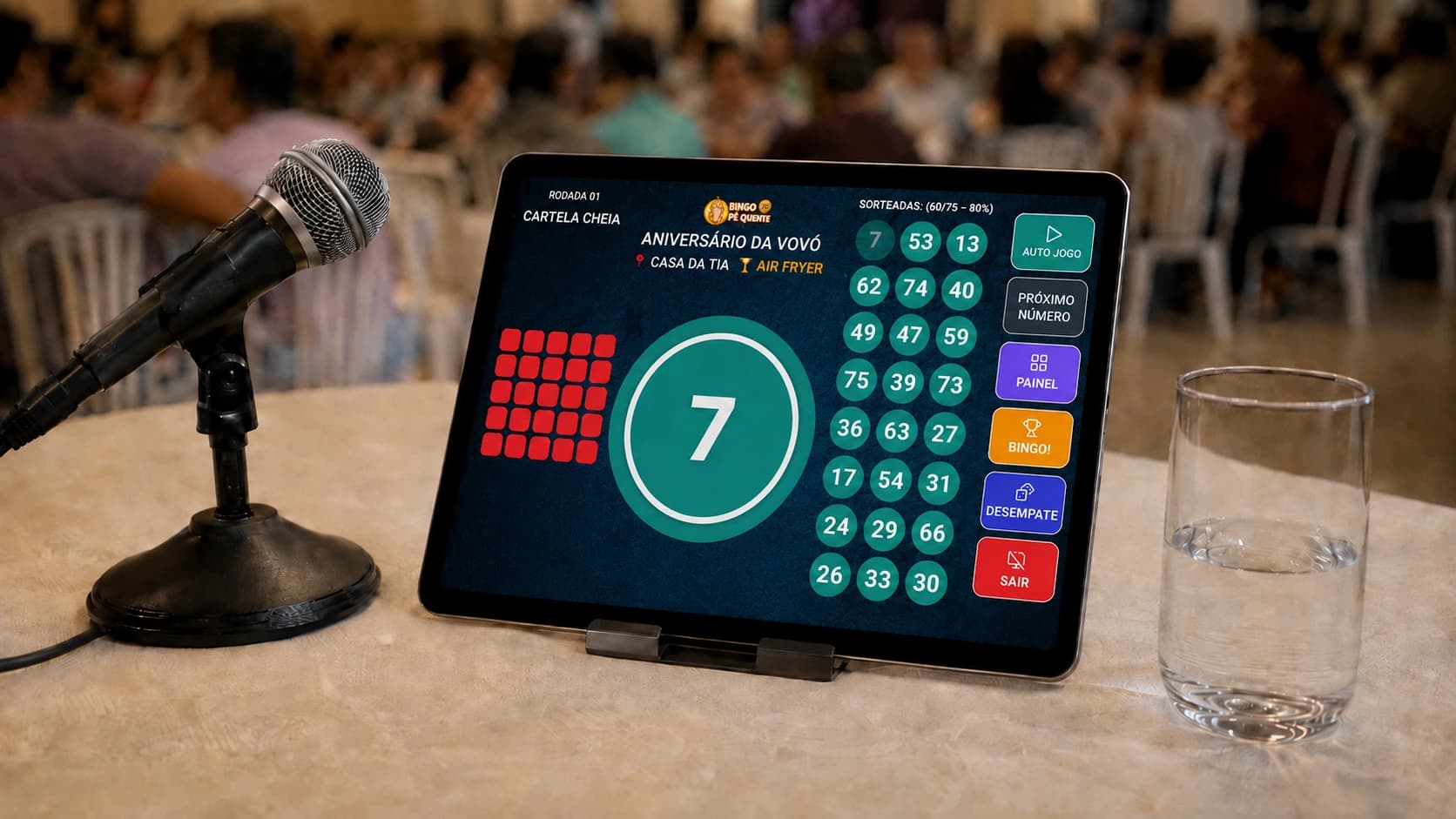
- Water within reach, always. The hydration that counts is the all-day kind, not the emergency sip — water you drink takes more than an hour to have any effect on the vocal folds. The glass on the table is there for something else, just as important: it is what replaces throat clearing between balls.
- Five minutes of warm-up. Before picking up the microphone: lip trills (the “brrr”) or humming for a few minutes. It is the warm-up ENTs recommend before speaking in public, and it heads off the hoarseness that shows up late in the night.
- A microphone instead of force. The medical advice is blunt: in a noisy room, use the microphone — do not raise your voice. Amplification lets a person speak just as long while punishing the vocal folds far less: the loudspeaker does the work. Raising your voice over background noise is the very example the vocal hygiene literature uses to explain what causes injury. If the sound is weak, the problem is the sound system, not the volunteer's throat.
- Hoarseness past four weeks means a doctor. Being hoarse after a party is normal. The American ENT guideline says to investigate hoarseness that has not improved in four weeks — and to bring the appointment forward for heavy voice users, which is anyone calling bingo every week. It is not the moment for more tea.
And the most destructive habit of all, the one nobody notices doing: throat clearing. Repeatedly clearing your throat between balls is one of the behaviors that damages the vocal folds most. Swap it for a sip of water.
The 30-minute rehearsal, the night before
There is no point explaining all of this and then dropping the person on stage. Set aside half an hour with your first-time caller, in an empty hall, and run this script:
- 5 min
The formula alone. Twenty numbers in a row, no audience: “B, seven — B, seven”. The goal is for the formula to become automatic before anything else.
- 5 min
With the clock. The same twenty numbers, now 15 seconds apart. The person needs to feel what 15 seconds of silence actually is — it seems like an eternity and it isn't.
- 5 min
Practice the opening. Announce the pattern, the prize and how many cards each person is playing, out loud, as if the hall were full. Half the confusion in a round starts with an opening nobody heard.
- 5 min
Simulate the BINGO. Someone shouts in the middle of a call. The rookie has to finish the ball, pause, announce the pause and read the numbers out loud. Repeat three times.
- 5 min
Simulate the mistake. The caller read the wrong number. The right move is to announce the error out loud, give the correct number and carry on — that is how regulated bingo requires it to be fixed. Hiding a mistake is what breeds suspicion.
- 5 min
On a real microphone, in the real hall. Sound on, at party volume, with someone listening from the back. Half of a caller's problems are badly adjusted PA problems.
The honest shortcut: let the app call and train the human on what is human
Much of what jams a first-time caller is mental load: drawing without repeating, remembering the letter for each range, controlling the interval, keeping track of every ball already called. None of that is talent — it is bookkeeping. In Bingo Pé Quente, that part leaves the person's head:
The voice that never tires
The app calls the letter and the number — the first beat of the formula — in a male or female voice, with VOICE SPEED set separately from DRAW SPEED. You can have slow speech and a fast game, or the other way around.
With letter or number only
One tap on BINGO LETTER switches between WITH LETTER and NUMBER ONLY. Leave it on WITH LETTER: the letter is what tells the room which column to look in, and it is the cheapest fix for mishearing.
Nobody heard it at the back
The called ball doesn't vanish: in full screen it shows up huge, next to the last few drawn, and the BOARD shows all 75 with every ball already drawn marked. Whoever drifted off checks with their eyes — mirror the screen to the TV and the back of the room sees it too.
You are the one who confirms the BINGO
Someone shouts bingo, you tap BINGO: the app turns off the automatic draw, goes into DRAW PAUSED and shows the round's pattern. It cannot see anybody's card: the verification is yours, and you record CONFIRM BINGO or FALSE BINGO — with the winner's name and card number, if you want to keep them.
The app handles the clock, the draw and the calling. What is left for your volunteer is exactly the part only a person can do: watch the room, feel the pace and run the verification.
The six classic rookie caller mistakes
Calling the number without the letter
Mistake number one, and the easiest to fix. Without the letter, 16 and 60 are the same thing at the back of the hall.
Speeding up without noticing
Anyone who isn't marking a card naturally drifts faster with every ball. A fixed interval in the app settles it for good.
Verifying in a whisper
Walking to the table and checking quietly with the winner. The room saw nothing and spends the next round suspicious. Read the numbers out loud, every time.
Hiding your own mistake
Called it wrong? Announce the error, give the right number and move on. Every regulated bingo requires it — and a crowd forgives an admitted mistake, not a discovered one.
Becoming the show
Charisma helps; a monologue between balls wears thin. The star is the card in the audience's hands, not the microphone.
Shouting because the sound is bad
If you need to raise your voice, the problem is the loudspeaker. Adjust the sound before you start — not the volunteer's throat halfway through the party.
Building a good caller takes one afternoon of rehearsal and about three parties of practice. The payoff is immediate: rounds that move, verifications without arguments, and a volunteer who is willing to come back next year. If your party is a big one, the next step is the setup — see how to take bingo to a big crowd, with a screen and sound that work.
Bingo Pé Quente: the app calls the balls at your pace; your caller takes care of the room.
Sources
- Calling and Displaying the Numbers — Minnesota Gambling Control Board (letter + number rule, visibility, and correcting a caller's error)
- Verifying and Declaring a Winner — Minnesota Gambling Control Board (procedure for verifying the winning card)
- Chapter 35: Charitable Gaming Regulations – Bingo — Nebraska Department of Revenue (reading aloud and verification by a neutral player)
- 316 Neb. Admin. Code ch. 35 § 210 — Conduct of the Game (full text: verification by a worker plus a neutral player, numbers stated aloud, letter and number displayed)
- Bingo Fundraising: The Ultimate Fundraiser's Guide — Donorbox (running a charity bingo and the profile of the caller: speaking clearly and loudly to an audience)
- Voice Care 101: Tips for Maintaining a Healthy Voice — ENT and Allergy Associates (hydration, lip-trill warm-up, microphone instead of projecting, throat clearing)
- Clinical Practice Guideline: Hoarseness (Dysphonia) — American Academy of Otolaryngology–Head and Neck Surgery, 2018 (investigate hoarseness that has not improved in four weeks; expedited evaluation for heavy voice users)
- Demystifying Vocal Hygiene: Considerations for Professional Voice Users — Current Otorhinolaryngology Reports, 2023, open access (amplification reduces vocal fold exposure to phonotrauma; habitual throat clearing as an injury factor; ingested water absorbed in 75 to 120 minutes)