
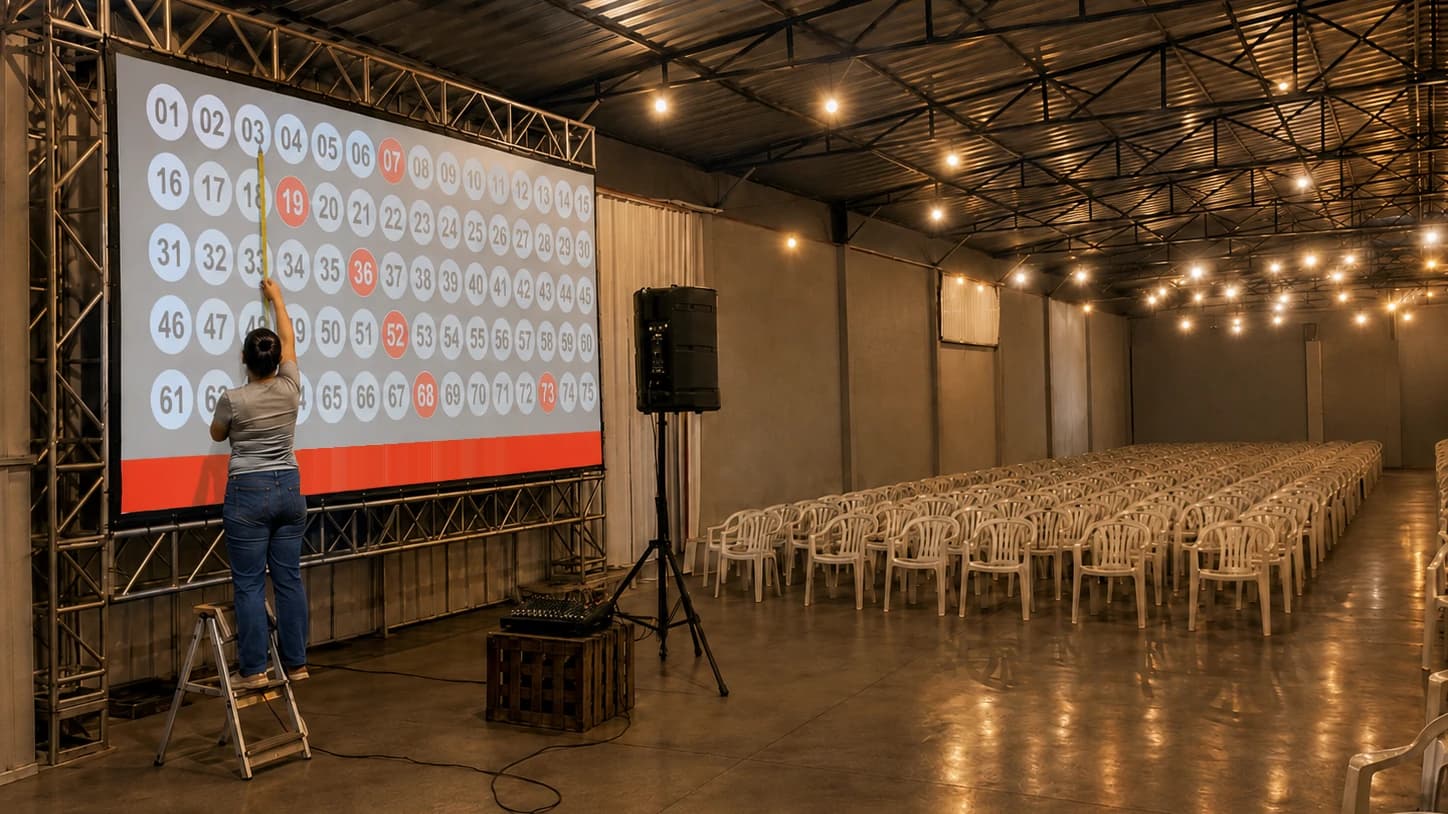
Living-room bingo is easy: everyone hears, everyone sees, and whoever missed a call just asks. From about fifty people on, the game changes nature — the back row can't read the screen, the sound that works up front turns to echo at the back, and every misheard ball becomes an interruption that eats thirty seconds of the party.
The good news is that almost all of this is arithmetic, not luck. The audiovisual industry solved this problem decades ago, and the two calculations that matter for a bingo night fit on a napkin. Here they are — and then the rehearsal that makes them true.
×6
the farthest row, measured in screen heights
÷120
the minimum digit height, from the distance
0.60
the speech intelligibility (STI) target
15m
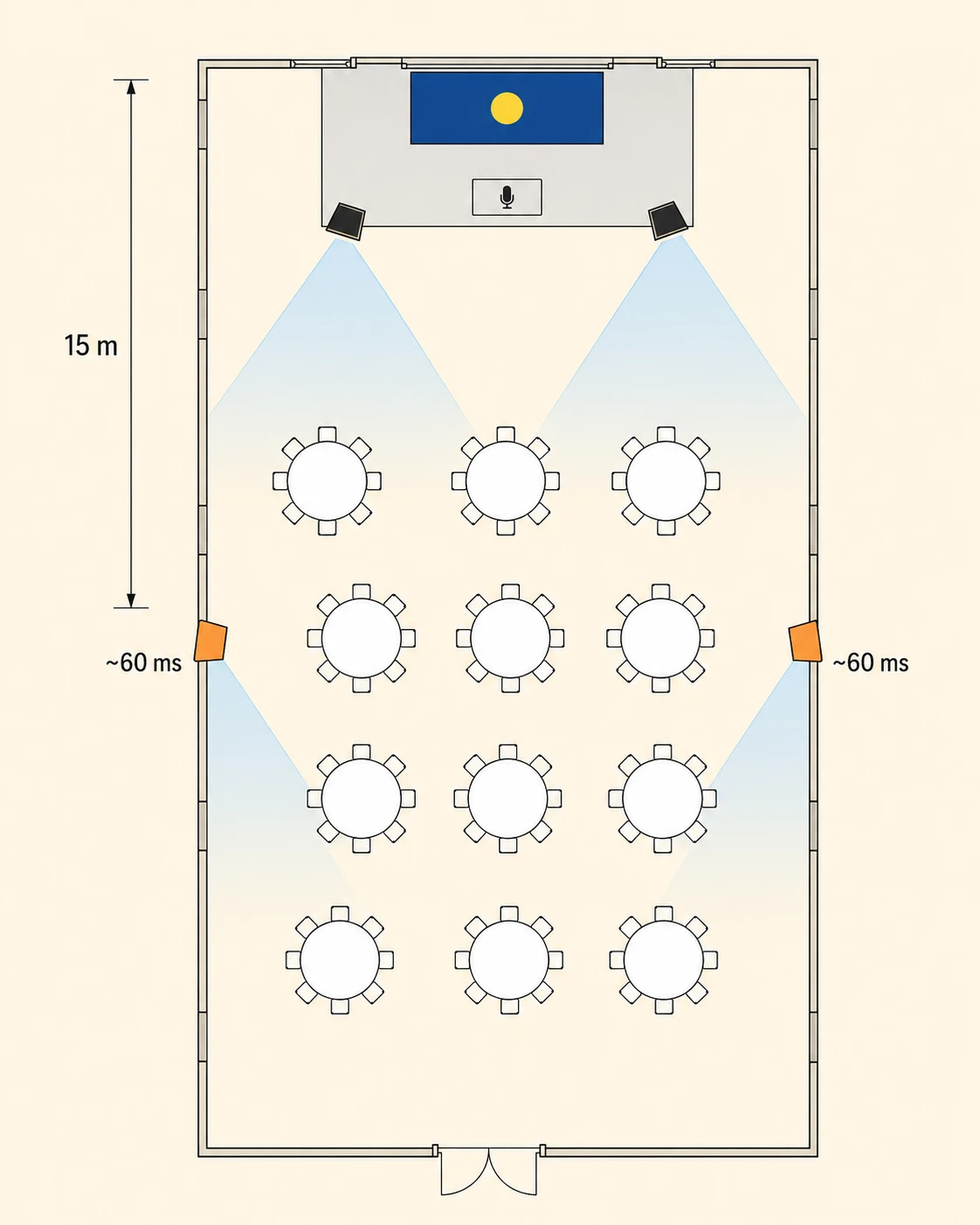
of depth: past that, the sound needs help
Calculation 1 — the screen: the 4/6/8 rule
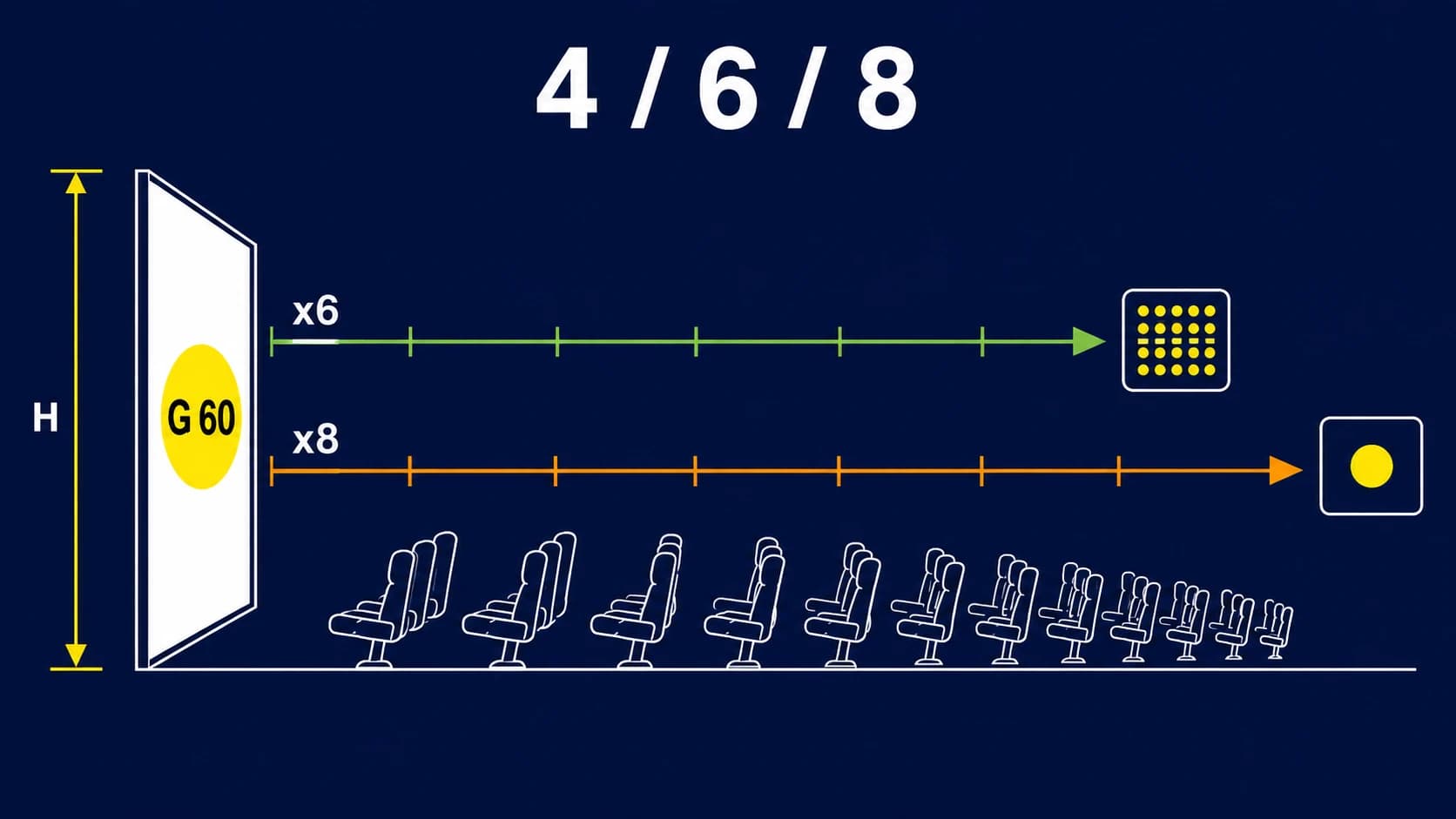
In audiovisual design, what decides screen size isn't the diagonal in inches — it's the image height. The industry's traditional rule of thumb says the farthest viewer must not sit more than 4, 6 or 8 times the image height away, depending on what is on screen:
- ×4 — fine detail. Floor plans, dense spreadsheets, small type. Not the bingo case.
- ×6 — reading. Text and numbers alongside other elements. This is the rule for the 75-number board and the round's pattern.
- ×8 — large image. Video, a photo, one giant number alone on screen. This is the rule for the called ball.
It's worth knowing where the rule comes from, because it changes how you use it: 4/6/8 is a rule of thumb, and in 2016 AVIXA — the body that writes AV design standards — published a standard to replace it, DISCAS (ANSI/AVIXA V202.01). The standard sizes the screen by the size of the smallest element that has to be read, not by the category of content, and it usually calls for larger screens than 4/6/8 does. In other words: the rule of thumb is the optimistic floor, not the ideal — and it's Calculation 2, below, that really decides.
Translating 4/6/8 into what you'll rent or hang in the hall — 16:9 screens, where the height is roughly half the diagonal:
- 55-inch TV (68 cm high) — board readable to ~4 m; the ball alone, to ~5.5 m. That serves a meeting room, not a hall.
- 65-inch TV (81 cm) — board to ~4.9 m; ball to ~6.5 m.
- 75-inch TV (93 cm) — board to ~5.6 m; ball to ~7.5 m.
- 100-inch projection (1.25 m) — board to ~7.5 m; ball to ~10 m.
- 150-inch projection (1.87 m) — board to ~11 m; ball to ~15 m.
- 200-inch projection (2.49 m) — board to ~15 m; ball to ~20 m.
Pace out the depth of your hall before choosing a screen. An adult stride is roughly 70 cm — fifty strides is 35 metres, and no television on earth covers that.
The practical conclusion is uncomfortable and important: at a big party, the 75-number board does not fit on the same screen as the ball. Either you accept that the back half of the room won't read the board, or you split them — giant ball on the main screen, board on a second screen closer to the back. Pretending it works is how the night starts running late.
Calculation 2 — the digit: 1 cm for every 1.2 metres
The 4/6/8 rule sizes the screen. What's left is sizing what's drawn on it. Here the classic signage ruler applies: for comfortable reading, every 2.5 cm of character height buys about 3 metres of distance — a ratio of 1 to 120. In practice:
- Back row at 12 metres → the number needs to be at least 10 cm tall on screen.
- Back row at 18 metres → at least 15 cm.
- Back row at 24 metres → at least 20 cm.
And there's a test that skips the arithmetic entirely, which you can run the night before with a tape measure: put the screen up, measure the actual height of the number on the wall, and multiply by 120. The result, in centimetres, is your screen's true reach. If it comes out shorter than the depth of the hall, either the screen grows, or the number grows, or the back of the room isn't really playing.
Worth remembering what the ruler assumes: high contrast, a clean typeface and light under control. Yellow number on black, no floodlight hitting the screen. A hall with a lamp pointed at the projection loses half its calculated reach — and that loss shows up in no calculation at all.
Calculation 3 — the sound: loud is not the same as intelligible
The most common and most expensive mistake at a big party is thinking bad sound is fixed with volume. In a reverberant hall — a school gym, a parish hall, a sports court — the opposite happens: every extra decibel feeds the reverberation and makes speech harder to understand. The player hears a loud noise and can't tell whether it was I-16 or G-60.
The technical measure for this is STI (speech transmission index), and the measurement method lives in the standard IEC 60268-16. The standard rates the result on a 0-to-1 scale; in practical sound design for speech, the usual target is STI ≥ 0.60, which is where the range considered good begins. You don't need to measure it with equipment: you need to know a target exists, and that the road to it is the opposite of turning up the volume.
Speakers ALWAYS in front of the microphone
Never behind. That single rule eliminates most feedback. If the hall's speakers sit behind the caller's table, move the table — it's easier than moving the speakers.
Cardioid microphone, and a steady hand
Cardioid or supercardioid microphones reject sound coming from behind — which is where the speakers are. And a microphone wandering around the table is half an hour of guaranteed squeal.
Set the gain the night before, not during the party
Raise the volume slowly until the system starts to ring, find the frequency and cut it by 3 to 6 dB on the equaliser. Repeat until you reach party volume without ringing. It takes 15 minutes and transforms the night.
A deep hall needs delay speakers
Past about 15 metres of depth, the back needs support speakers. And they have to be delayed: sound travels roughly 3 milliseconds per metre, so a speaker 20 m from the main one needs about 60 ms of delay — without it, the back hears each number twice.
One last parameter that sums it all up: between the loudest and the quietest part of the hall, the difference shouldn't exceed ±6 dB. If it's deafening at the front and a whisper at the back, the system isn't badly tuned — it's unusable for speech, and no amount of volume fixes that.
Two things that follow local rules
Two items on a big-crowd checklist are not engineering, and both depend on where you are — so treat what follows as the question to ask, not as the answer.
The soundtrack of your party has an owner. Playing recorded music at a public event generally triggers performing rights, even when the event is free and raises money for charity. Who collects changes by country — ASCAP, BMI and SESAC in the United States, SOCAN in Canada, PRS for Music in the United Kingdom. Check your country's rule before the night, not after: sorting it out in advance always costs a fraction of sorting it out later. And there's a simpler way out that costs nothing: the party can run with no soundtrack at all — just the caller's voice, the room's chatter and the shout of BINGO. Nobody misses it.
Accessibility is usually a legal requirement, not a courtesy. Reserved spaces and seats proportional to capacity, room for a companion beside each one, good sightlines to the screen, and accessible routes: most countries require some version of this in venues open to the public. Find out which version applies to your hall.
And here's what no law requires but every bingo thanks you for: the ball has to be seen and heard. A large, high-contrast number on screen, each call said twice, the letter before the number. Accessibility at a bingo night isn't a ramp — it's the shape of the call and the size of the digit. Whoever sees a little less or hears a little less plays along with everyone, and nobody has to announce that they need help.
How the app fits into a big setup
Bingo Pé Quente was designed for the community event — the parish fair, the school fundraiser, the afternoon at the seniors' centre. It is the source of the game that feeds into your setup, not the setup itself: sound, projection and stage are still yours. A mixing desk, stage visual themes and a big-screen banner are a different conversation, for a different kind of tool. What the app brings to the big night is this:
The phone becomes the source for the big screen
FULL SCREEN (TV) mode strips the controls away and leaves only what the audience needs to see: the giant ball, the round's pattern, the last balls called and — when the night is running off a programmed event — the event's name and which round you're on. That's the screen that goes to the projector, mirroring the device to the TV — via Chromecast, Miracast or the TV's own screen mirroring. Test the mirroring the night before, along with the rest of the rehearsal: it's the item that springs the most surprises, and not every Android phone sends video over a cable.
Giant ball, board on demand
The audience screen shows the ball at big-screen size, and the board with the balls already called sits one tap away — you decide when to show it. That is exactly the separation the ×6 and ×8 rules demand.
The voice that calls the ball, at your pace
The app calls every ball out loud — the letter and the number, "I, 22" — in a male or a female voice. On automatic, the interval is yours: 3, 5, 10 or 15 seconds between balls. Nicknames are a Portuguese, Spanish and French tradition; American bingo calls letter and number only, and that is exactly what the app does in English. Run the phone into the mixing desk over a cable and the call comes out of the speakers alongside yours.
Tiebreak in front of everyone
Two people called BINGO on the same ball? TIEBREAK mode draws 1 to 75 without repeating, player by player, on the big screen. Highest number wins — decided in full view of the room, no coin toss.
The round summary comes out ready
The app records by itself the date, the time of the first ball, the time of the confirmed BINGO, the full sequence of numbers, the winning pattern and the total balls drawn. You add the event name, the venue and the prize, and the history exports it as a PDF. It is not minutes and not an accounting record — it is the piece of paper that settles the argument over who called bingo first, because the full sequence drawn is right there.
Programme the event and print the poster
Build the whole night in advance — round by round, with name, pattern and prize — and export a PDF poster with the programme. It works as publicity and as a contract with the audience about what counts in each round.
The app calls the ball and drives the screen. The sound, the projection and the caller are still yours — which is exactly why the setup has to be right.
The 30-minute technical rehearsal
None of the calculations above is worth anything without the rehearsal. Do it the night before, or at least an hour before doors open, with the hall empty:
- 1
Sit in the last chair in the hall. Literally. It's the only measurement that matters and it's free. If you can't read the number from there, nobody can.
- 2
Measure the number on screen with a tape measure and multiply by 120. Compare that with the distance to that last chair.
- 3
Turn the party lights on. Test the screen with the lighting that will actually be on during the game, not with the hall dark. This is where most surprises show up.
- 4
Push the gain to the ring, then cut. Raise it, find the frequency that rings, cut 3 to 6 dB, repeat. Finish with headroom to spare.
- 5
Have someone call ten fake numbers while you walk from the front to the back. If at any point the volume difference jumps out at you, you've found the coverage hole.
- 6
Run one whole round blank, with the app, the screen and the sound all live together. Battery charged, charger plugged in, and someone who knows how to open the BOARD for whoever missed a ball.
One note that runs through all of it: however big the setup gets, a party bingo is still recreational bingo — no wagering, with a symbolic prize, a donated one, or one that goes to the cause. A big screen and concert-grade sound don't change the nature of the game; they only change how many people get to take part in it.
Setup sorted, now you need someone to hold the microphone: see how to train a first-time bingo caller.
Bingo Pé Quente: you build the hall; the app delivers the ball ready for the big screen.
Sources
- Display Image Size for 2D Content (ANSI/AVIXA V202.01:2016) — the DISCAS standard, which in 2016 replaced the 4/6/8 rule of thumb and sizes the screen by the size of the element to be read
- Projection Rules — AV-INFO (the 4/6/8 rule applied to fine detail, reading and video)
- Signage 101: Letter Height Visibility — Signs.com (one inch of letter height for every ten feet of distance)
- Enhancing Speech Intelligibility in Houses of Worship — Ford AV (STI ≥ 0.60 per IEC 60268-16, and why raising the volume makes speech worse)
- Delay Speakers: a Key to Successful Live Sound — Full Compass (delayed support speakers in deep rooms)