
From the little bean on the card to grandma's phone
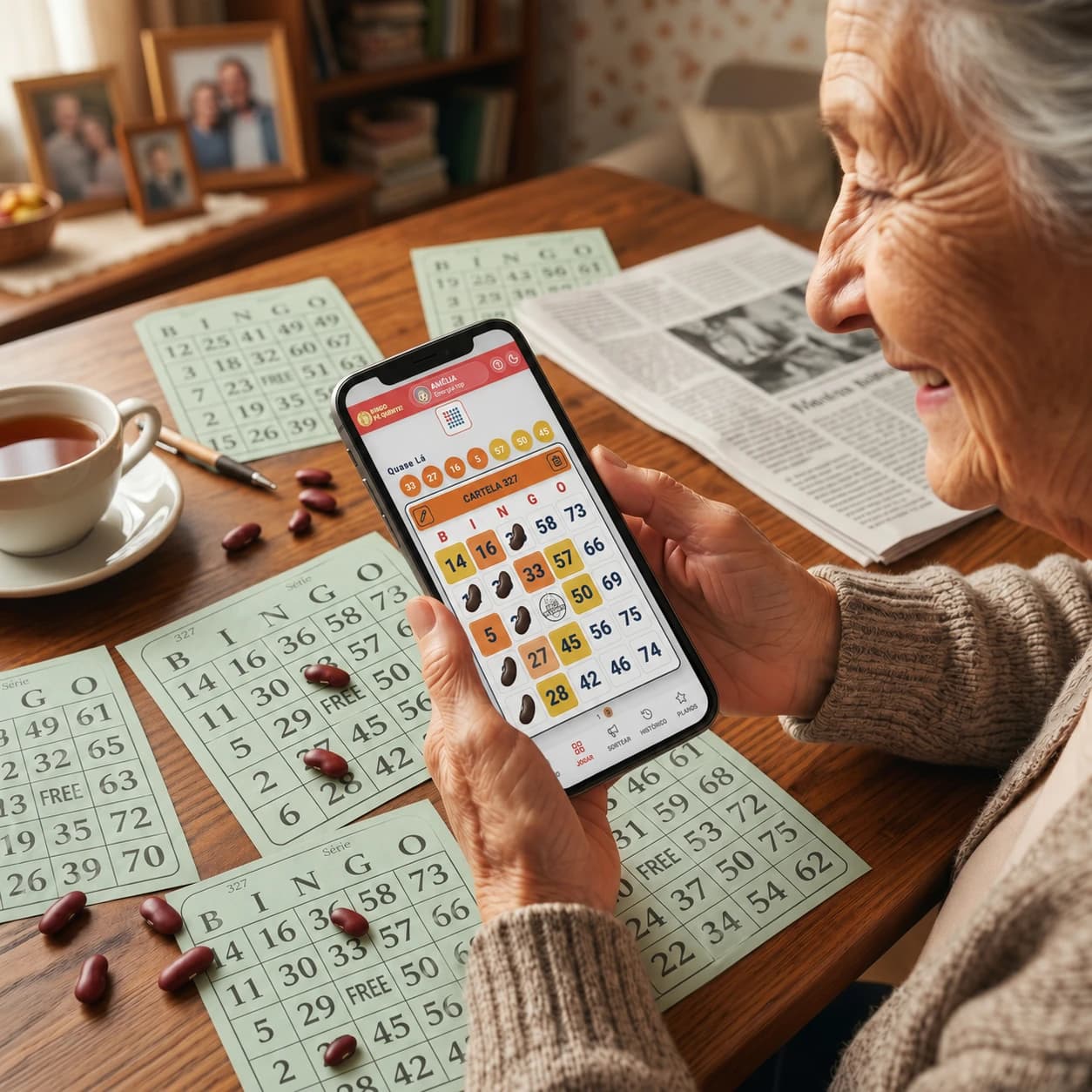
There's a scene almost every Brazilian family keeps in some corner of memory, even without realizing it was special.
The parish-fair hall. Wooden benches. Up front, someone with a microphone and a spinning cage of balls. And that voice filling the room:
— Attention! Twenty-two… two little ducks!
And the whole room laughs. Because everyone knows twenty-two is "two little ducks" — the two 2s look like ducks floating. Nobody taught that at school. We learned it by ear: from an uncle, a grandmother, a lively nun at the church festival.
And it's that afternoon, that voice, and those nicknames that Bingo Pé Quente set out to care for.
Bingo was never about the money
Stop and think: why did bingo cross so many generations? Not for the prize. The prize was almost always a basket, a cake, a chicken, a voucher from the corner store.
What kept everyone in their seat was something else. It was being together. It was the good tension of needing just one number. It was watching the card fill up until you shout "BINGO!" and the whole table turns to look at you. It was grandma winning and pretending it was nothing — but keeping the little token as a keepsake.
Bingo came from far away and long ago; it traveled the world before reaching us. But few places embraced it like Brazil — the June festival, the parish hall, the Sunday table. And here it became one of the few celebrations where grandma and grandpa are the stars. Not the youngest, not the fastest, not the cleverest. Whoever is there, present, card in hand, has the same chance as everyone.
Bingo is fair in that beautiful way: luck doesn't ask your age or your diploma.
The voice is half the party
Anyone who has called bingo knows: the secret isn't reading the numbers. It's the way you say them.
The pause before the ball. The nickname for each number. These nicknames are a treasure no one wrote in a book — they pass from mouth to mouth and change from town to town:
That's exactly where the app went all out. The phone can become the caller: it draws and says the numbers out loud — with a natural voice, male or female, with the classic nicknames and even the sound of the balls spinning in the cage. All calmly, at the pace you choose. No rush, because bingo never was in a hurry. And if the folks in the back can't see, just cast it to the TV and the number shows up huge for everyone.
From the little bean on the card to the phone
Lots of family members ask: "but will it kill the paper card?"
Quite the opposite. The paper card is where it all began — the one marked with beans and corn kernels. We grew up with it. And Bingo Pé Quente was made to continue that story, not to erase it.
Picture dona Maria at the parish festival. Before it starts, she takes one photo of her card — just one — and the phone keeps the 24 numbers for her. From then on, she just listens to the caller and taps the number that came out, and it’s marked on all her cards at once. And when a card closes, it tells her right away — without that dread of missing a number in the middle of the excitement.
And notice the little details: when it's time to mark, the on-screen markers are our usual ones —
 Corn
Corn Bean
Bean Coffee
 Pastel
 Cake
CakePaper and phone at the same party. You choose how to play.
There's a Bingo Pé Quente for every moment
We didn't picture this app at a casino table. We pictured it in real life:
At the care home
Where bingo afternoon is often the highlight of the week.
At the parish festival
At the club, at school — someone calls and you just mark your cards.
On a family Sunday
You running the draw and the gang playing around you.
With those who live far
Children and grandchildren, each on their own phone, playing together even over a video call.
Alone, in your own time
In the waiting room or on the bus ride, a bingo to pass the time.
And whoever organizes can set the event up in advance — "June Festival 2026", "Dona Maria's Bingo" — with prizes, patterns and rounds all ready. Anyone who runs the community bingo knows how much work it is. We wanted to take that weight off your shoulders, so you can enjoy the party too.
"Pé Quente" — because it's about luck and joy
The name was no accident. "Pé quente" is what we call, in Brazil, someone who brings luck — the opposite of "pé frio" (a jinx). It's a word of affection, of the family game table, of celebration. And as your card gets closer, the app heats up with you: it changes color and tells you how much is left, so the excitement rises with each ball.
And we make a point of saying this loud and clear: Bingo Pé Quente is for fun. It's pizza bingo, basket bingo, trophy bingo — recreational, the way it always was at the church fairs. No betting, no cash prizes. It's the joy of everyone at the same table, the laugh of "I almost won", the hug of whoever closed the card.
In the end, it's about being together
Technology changes. The phone gets thinner, the screen gets bigger. But grandma shouting "BINGO!" and the whole table laughing — that's something we never want to change.
Bingo Pé Quente is our attempt to take that afternoon in the hall, that voice on the microphone and those number nicknames we learned by ear, and keep it all inside an app simple enough for grandma to use on her own — and fun enough that the grandkids want to play too.
Because good bingo was always this: people gathered, a voice calling, and luck smiling on everyone.
Bingo Pé Quente — never miss a number again.