
Bingo looks like pure luck, and it is. But behind every round there's some curious math, and it explains things everyone has felt at the table: why the blackout takes so long, why columns tie more often, why the lines through the middle seem to come first.
We've gathered the most interesting numbers of 75-ball bingo here. Some you can work out in your head; the rest came from 20,000 rounds we simulated, with random cards and a draw without repeats, just like the cage. None of them promises to help you win: they're for understanding the game and having something to talk about in the next round.
There are 552 septillion different cards
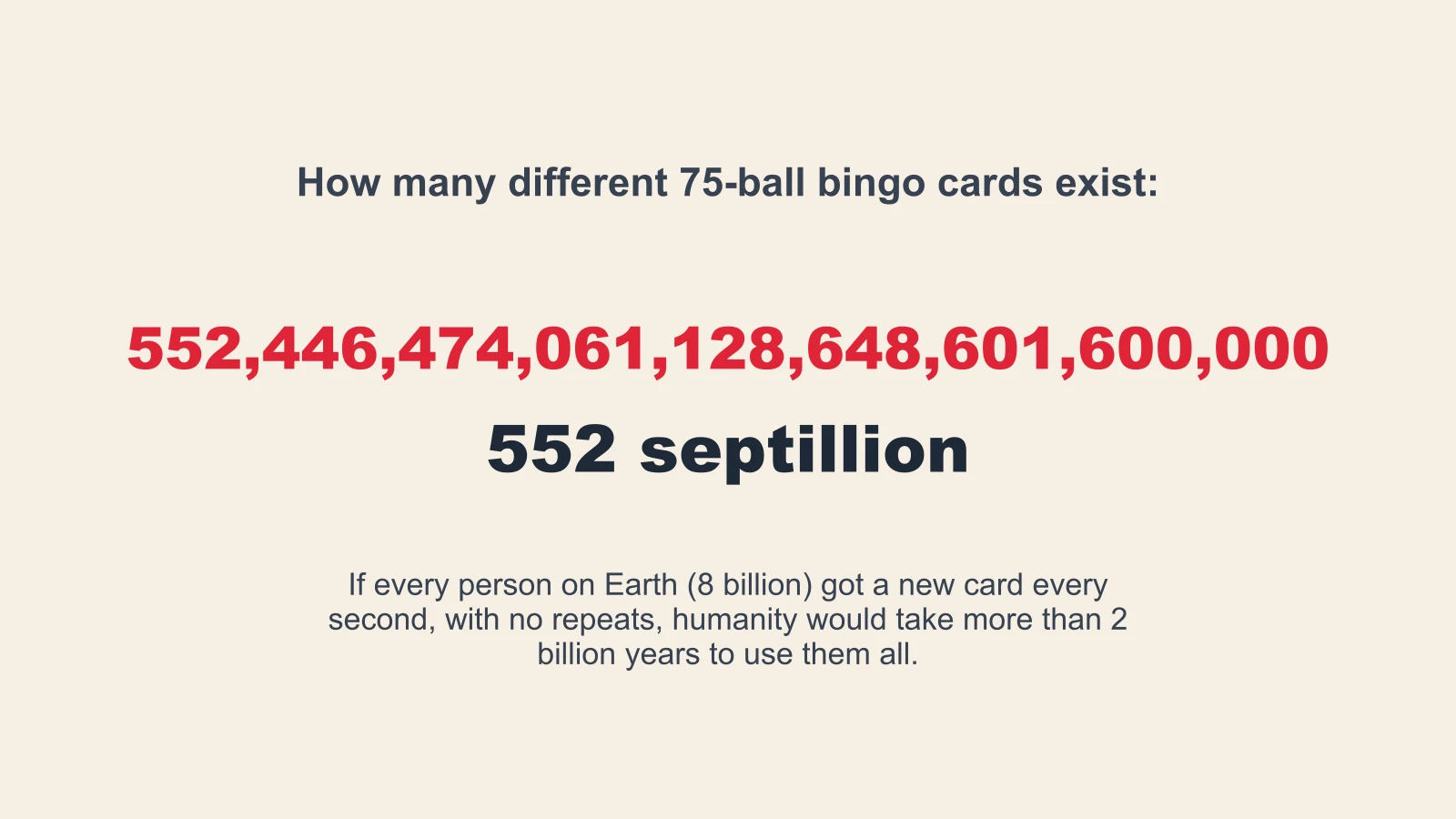
A 75-ball bingo card has 24 numbers, five per column (four in the N, because of the FREE space), and each column takes its numbers from a group of 15. Counting the top-to-bottom order, the total number of possible cards is 552,446,474,061,128,648,601,600,000. That's 552 septillion.
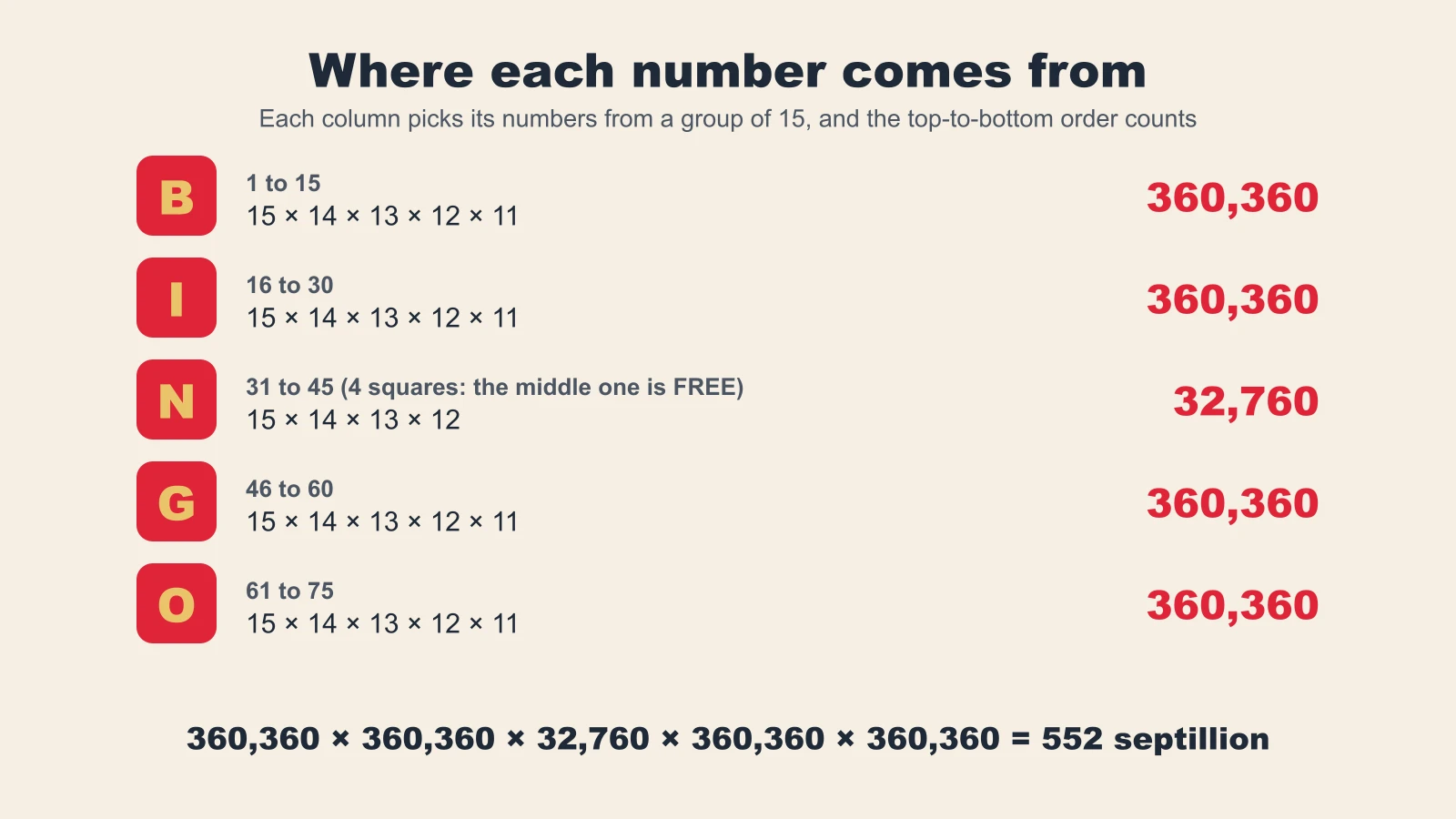
To get a feel for the size: if every person on Earth (all 8 billion of us) got a new card every second, with no repeats, humanity would take more than 2 billion years to use them all. That's why you can print as many cards as you like with the card generator without worrying about two identical ones turning up by chance.


Gather the ones you love for the next Bingo
See how simple it is to play and host with Bingo Pé Quente.

5 stars on Google PlayFree to start, no sign-up
No number is ever "due"
Every table has someone who says: "22 hasn't come out in three rounds, it's due." It isn't. Or rather, it has the same chance as ever. The cage doesn't remember the last round. In any round, every ball has exactly the same chance of coming out by the 30th ball: 30 in 75, which is 40%. For 22, for 7 and for 75.
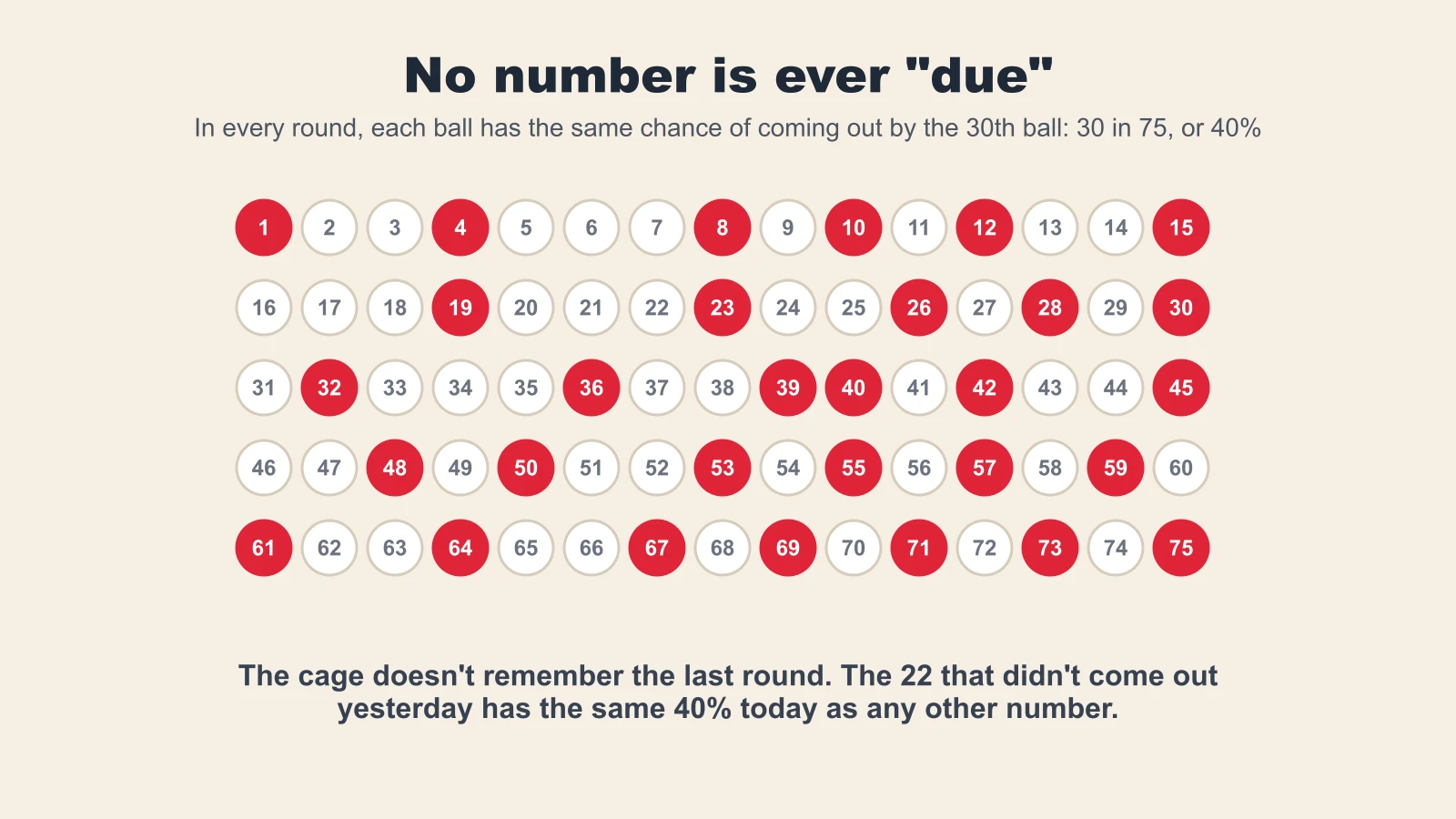
The cage has no memory. A "due" number is only due in the player's head.
The same goes for a "lucky" card and for "the card that never wins": they all have the same chance in every round. That's the beauty of bingo: the grandma who has never played and the uncle who plays every week are on equal footing.
Which pattern lands first at a table of 20 cards
We took a table of 20 cards and measured on which ball someone completes each shape. When any line, column or diagonal counts, it lands on average on the 22nd ball. A single line across lands around the 27th; a column, the 28th; a diagonal, the 29th. Four corners arrives around the 35th, the X around the 51st, the picture frame around the 63rd and the blackout around the 67th.
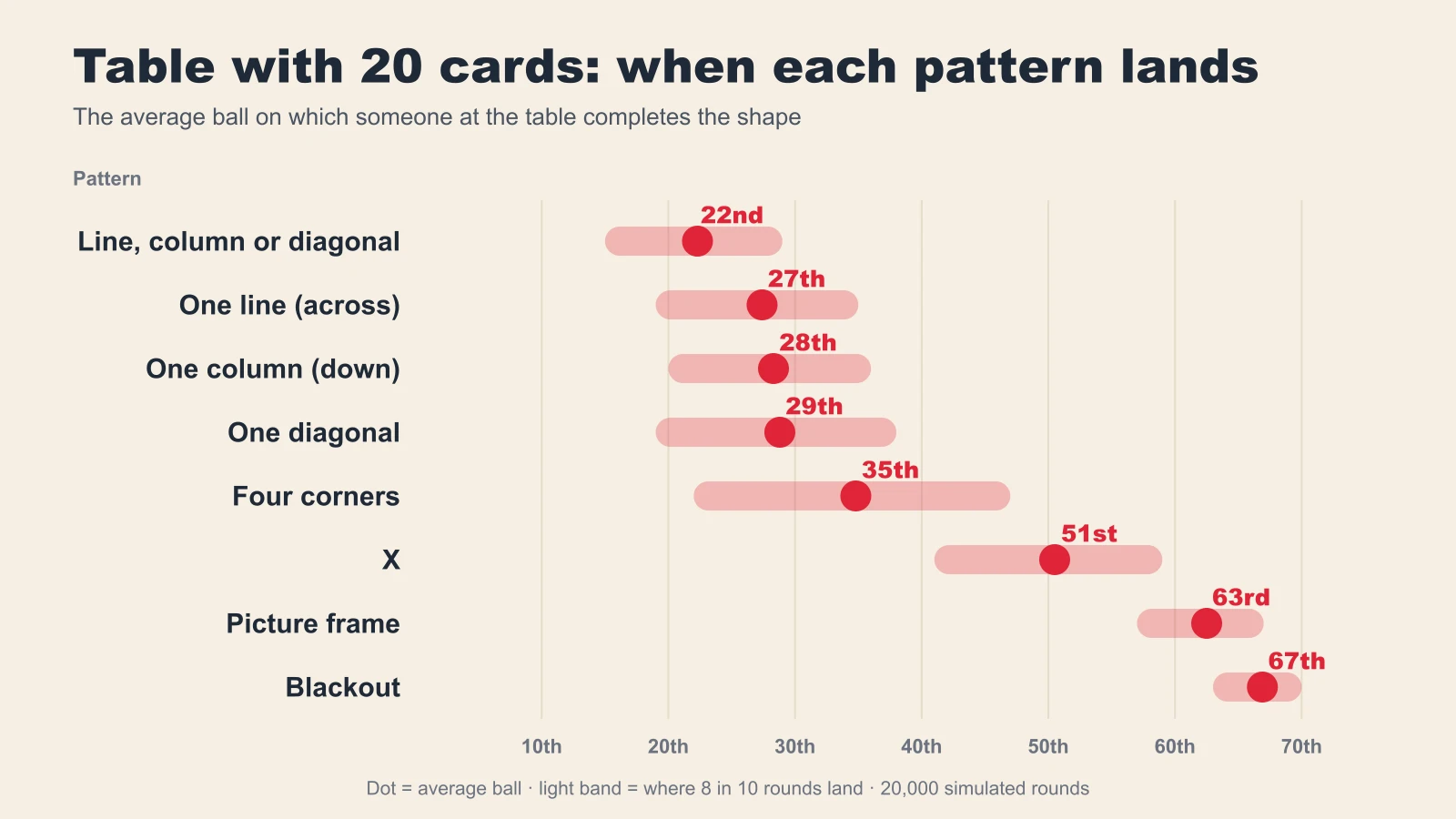
That helps you plan the night: start with a quick pattern, put the medium ones in the middle and save the blackout for the end. Four corners has its own guide, and the other shapes are in the bingo patterns guide.
The FREE space speeds up the game
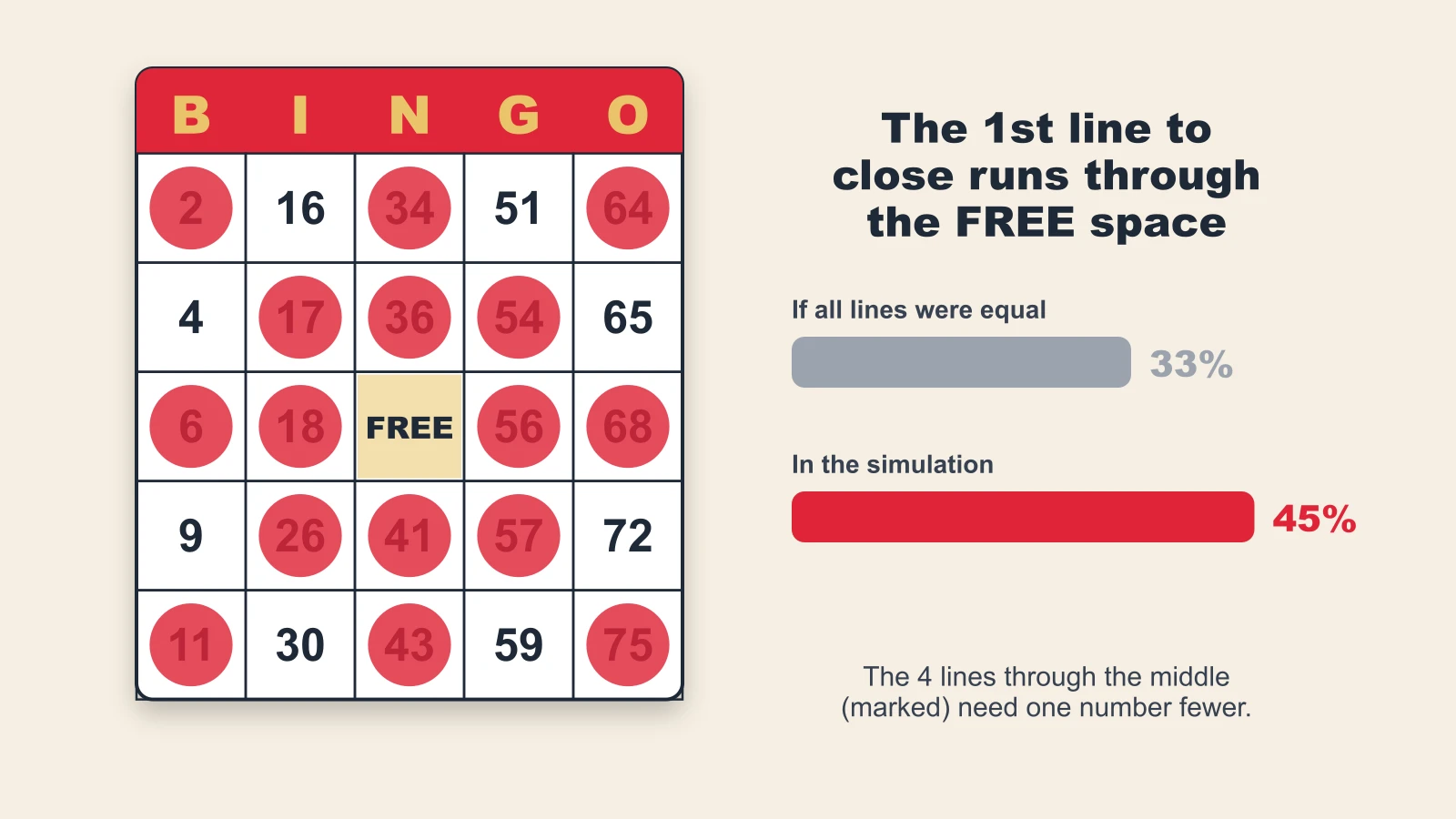
A card has 12 possible lines: 5 across, 5 down and 2 diagonals. Four of them run through the FREE space in the middle (the middle row, the N column and the two diagonals), so they need only 4 numbers instead of 5.
The four lines through the FREE space need one number fewer.
If every line had the same chance, the first one to close would run through the FREE space 4 times out of 12, a third (33%). In the simulation, the first line to close on a card runs through the FREE space 45% of the time. The middle square isn't just there for decoration.
12
possible lines on a card (5 across, 5 down, 2 diagonals)
4
of them run through the FREE space and need only 4 numbers
33%
would be their share if all lines were equal
45%
is how often the 1st line to close actually runs through the FREE space
Columns tie more than lines
At a table of 10 cards, a one-line round ends in a tie 7% of the time. A one-column round, 12%. With 100 cards, it's 13% against 25%.
Why? Every card takes its B column numbers from the same group, 1 to 15; its I column numbers from 16 to 30; and so on. When a column is about to close, the same columns on the other cards are waiting on numbers from the same group. A line, on the other hand, mixes all five columns, so the cards are more different from one another.
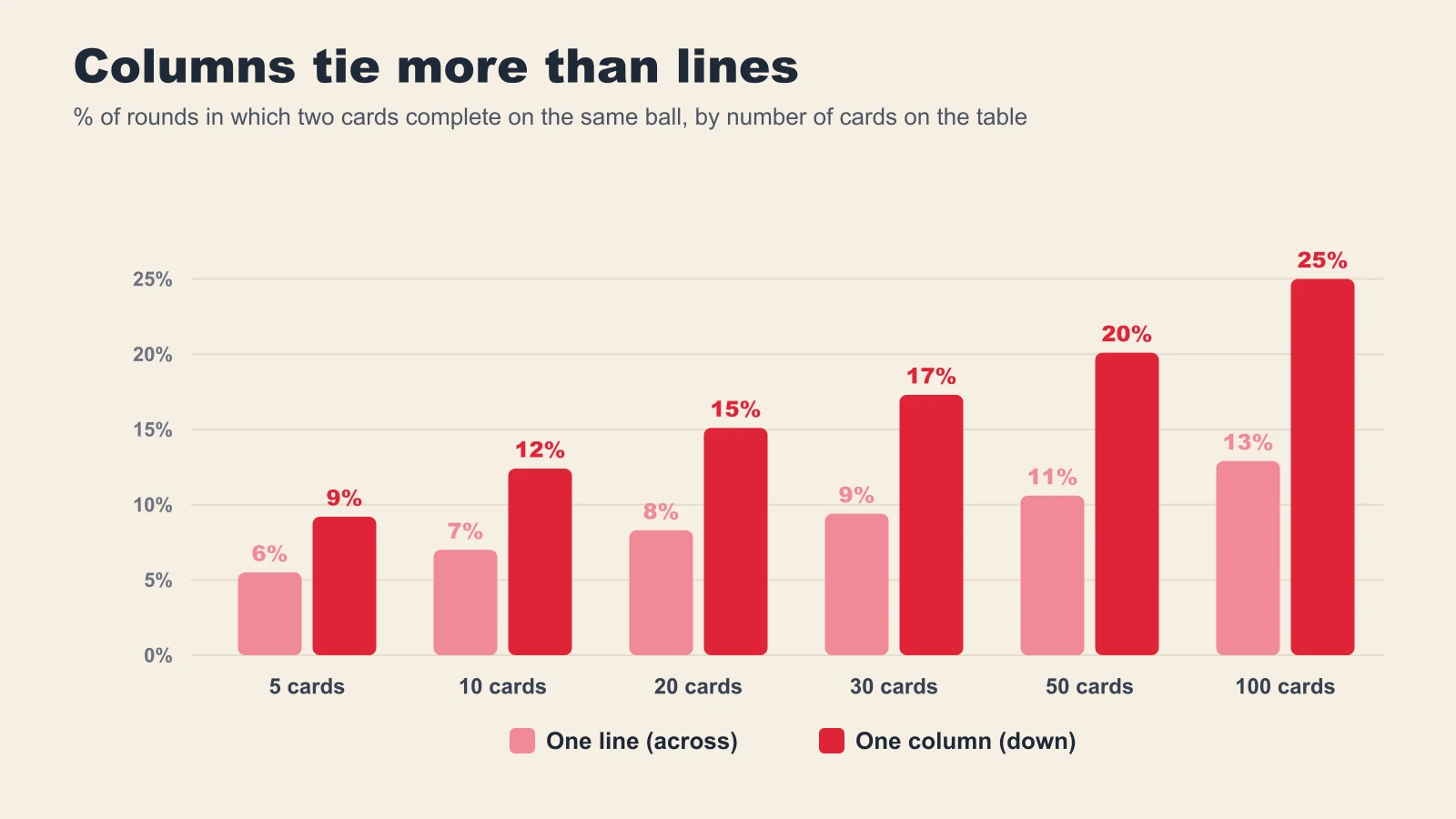
The takeaway: a column round with a full table calls for an agreed tiebreaker. The bingo tiebreaker guide shows the fairest ways to do it.
The blackout almost never lands before the 60th ball
With a single card, the blackout lands on average on the 73rd ball, and you can get close to that in your head: the last of 24 numbers spread among 75 tends to fall around 24 × 76 ÷ 25, which is almost 73. At a table of 10 cards, it lands before the 60th ball in fewer than 1 round in 100. The full numbers and a simulator are in the blackout guide.
How we did the math
The method, in four lines
- Rounds. 20,000 rounds, in 5 batches of 4,000 with different seeds. The difference between batches stayed under 1 ball for every number.
- Cards. 100 random cards per round, all valid (B from 1 to 15, I from 16 to 30, N from 31 to 45 with the FREE space, G from 46 to 60, O from 61 to 75).
- Draw. The 75 balls come out one by one, with no repeats, just like the cage.
- Patterns. The same shapes as in the Bingo Pé Quente app. The full data is in the simulation file, in the sources below.
Quick questions
- How many different 75-ball bingo cards are there? 552,446,474,061,128,648,601,600,000, or 552 septillion, counting the top-to-bottom order of the numbers in each column.
- Is there such a thing as a "due" number in bingo? No. In every round all the balls have the same chance; the cage doesn't remember earlier rounds.
- Which pattern is the fastest? Among the classic shapes, the one where any line, column or diagonal counts: at a table of 20 cards, it lands around the 22nd ball. A line across on its own, around the 27th.
- Does the middle square help? It does. The four lines through the FREE space need only 4 numbers, and the first line to close runs through it 45% of the time.
- Can I improve my chances of winning? Only by playing more cards, and even then every round is still luck. No number, card or seat at the table gives you an edge.
Seventy-five balls, five hundred fifty-two septillion cards and one single rule: in the next round, everyone starts even.