
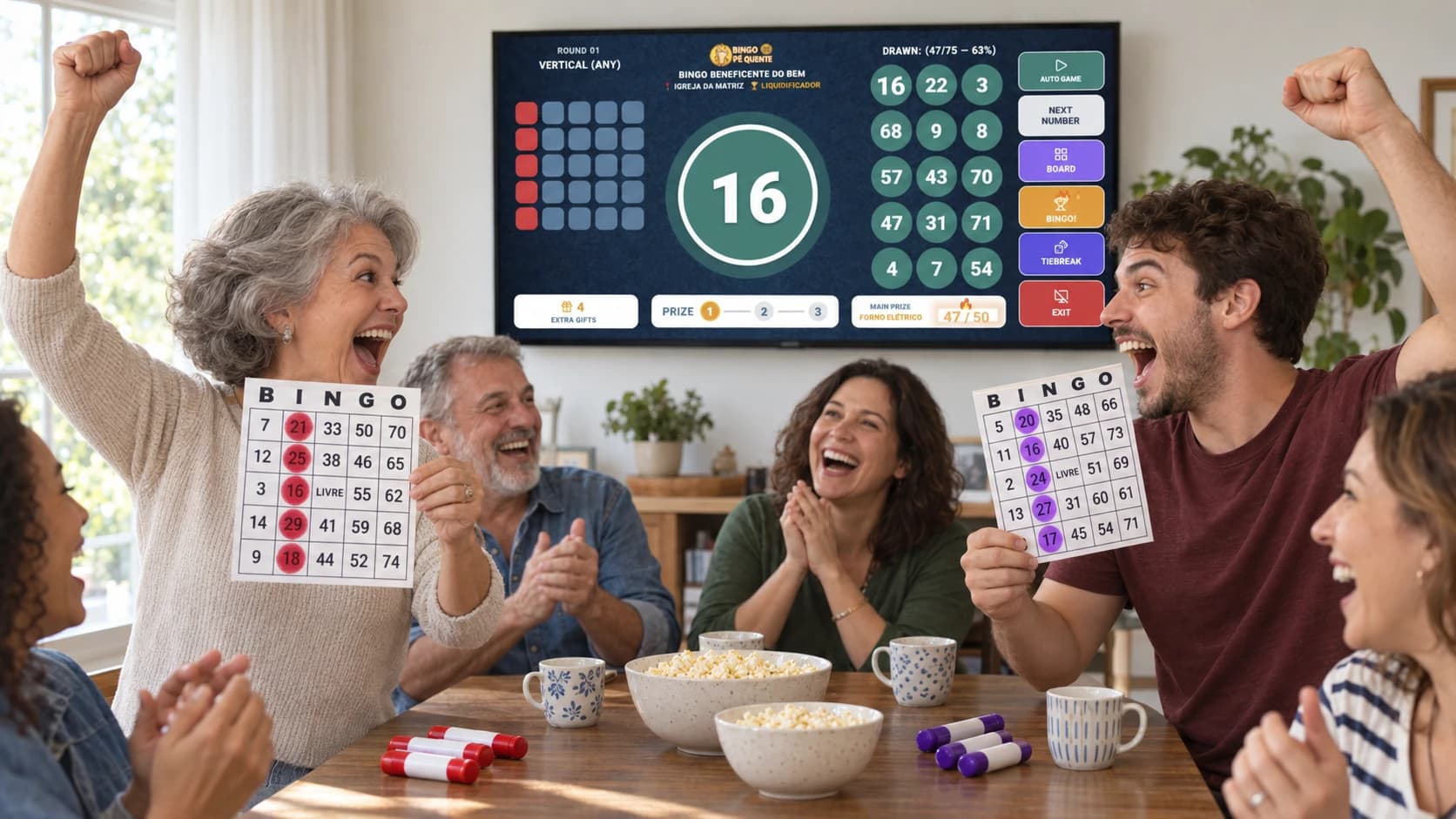
Ball 16 comes out of the cage, the voice calls 'sixteen', and from two sides of the table comes the same shout: BINGO! Two cards, the same column, the same ball. Now comes the question nobody agreed on beforehand: who takes it? The answer changes with where in the world you are — and, more than that, with what was announced before the first ball. We went after official regulations, house rules and party customs in ten countries to draw this map. At the end, we show exactly what Bingo Pé Quente does at that moment.
There is no universal tiebreaker in bingo. There is the rule that was said before the first ball came out — and that is the one that counts.
First: what a tie really is (and what it is not)
A tie is when the same ball completes the round's pattern on two or more cards. That's all. Rhode Island's regulation puts the line exactly there: the prize is divided 'when more than one player is determined to be a winner on the call of the same number'. Across the Atlantic the logic has been the same since Spain's 1979 regulation — 'if there is more than one winning combination, the prize amount is shared among the players who called it' (art. 35.5) — and the autonomous communities, which regulate the game in Spain today, kept the formula. Two things that look like a tie but aren't:
- Who shouted first. American house rules don't measure the shout, they measure the ball. At a bingo hall in Kansas, the posted rules put both things side by side: 'players must bingo on the last number called in the pattern to be a winner' and 'multiple winners will divide the prize equally'. If both cards closed on the same ball, both won — as a regular at the hall sums it up on an American forum, 'doesn't matter who said BINGO first as long as it's called timely'. Speed of voice doesn't decide a prize.
- Calling after the next ball. That isn't a tie, it's a late claim — and the rule is the same in both hemispheres. In American halls: 'once the game is closed or the letter of the next ball is called, no previous bingo will be honored and the game shall continue'. In Indian tambola, a claim made after the next number is 'usually considered invalid'. Brazil is no different, and a charity event in Santa Catarina wrote in 2026: 'after the next ball is announced, no claims about the previous round will be accepted'.
'Sixteen!' — 'BINGO!' — 'BINGO!' Two voices, one ball. That's a tie. One voice now and another after 'forty-one'? That's one win and one late claim.
The world map of the tiebreaker
The world splits into two big camps. Where bingo is regulated and the prize is money, the law says divide. Where bingo is a party and the prize is a thing — a basket, a pan, a gift — the answer is draw for it. And in between there are some delightful inventions.
United States: divide, rounded to the dollar
Charity bingo is regulated state by state, and the rule is almost the same everywhere: when more than one player wins on the same ball, the prize is divided equally. Rhode Island says to round 'to the nearest dollar'; Colorado allows rounding up to the dollar; Arizona says that if the prize is merchandise that can't be split, each winner gets an identical prize or the cash equivalent. Nebraska has the most curious detail: the hall must choose and post whether it divides per player or per card — does someone who closed two cards on the same ball take double or not?
Canada: divide the money, draw for the merchandise
In Ontario, rule 14.5 of the gaming commission says that 'where there is more than one winner of a bingo game, the prize offered must be divided equally amongst all players having obtained a valid bingo'. But merchandise bingo at rural fairs has its own licence — and there every player who closed gets a prize of their own. In Quebec, article 108 of the Règles sur les bingos separates the two cases in plain words: a cash prize 'is shared in equal parts' among the winners, rounded down to the nearest dollar; a prize in goods or services 'is awarded to one of them by a draw, in front of at least 2 witnesses'. In other words: the highest-ball draw became law — witnesses and all.
United Kingdom: split it at the club, dance for it at the club night
At traditional bingo clubs, the terms say the prize 'will be divided equally between all players' or that each one receives the minimum advertised amount. Bongo's Bingo, the bingo party that filled venues from Liverpool to London, settles a tie on the full house another way: 'all callers will be invited onto the stage to compete for the prize — this is usually in the form of a dance-off but can sometimes be a sing-off or musical statues'. The tie became part of the show.
Spain and Portugal: equal parts, in writing
The 1996 Andalusian regulation is direct: 'the appearance of several winning combinations, both on line and on bingo, results in the proportional distribution of the prizes in equal parts'. Portugal, in its 2015 online bingo regulation, uses the same formula in article 30: 'whenever a prize-winning combination is formed simultaneously by more than one player, the prize amount is shared in equal parts among those players'.
Italy: tombola doesn't divide — it burns the line
In the Christmas tombola — ambo, terno, quaterna, cinquina and tombola — the written family rule doesn't talk about splitting a prize; it talks about repeating, and it lands close to what Bingo Pé Quente does: 'whoever wins a prize on a row cannot win the next prize on the same row of the same card'. Someone who made ambo on the first row goes after quaterna on the others. A player can take several prizes in the same game — just not twice on the same row.
Australia and India: share it, and a wrong call is out
In Australian housie, the charity session rules say: 'if there is more than one winner the prize will be shared equally'. Indian tambola says the same — 'if two players claim the same dividend on the same number, the prize is typically shared between them' — and it punishes the false bingo: a wrong claim is a **bogey**, and the ticket may be disqualified. The penalty varies from house to house, which is exactly why the rules say to announce it before the first ball.
Japan: decide beforehand, and settle it with janken
Japanese bingo belongs to year-end parties, weddings and gatherings among friends — it isn't regulated gambling, so there is no official rule; the Japanese Wikipedia says as much. The guides for hosts are what people follow. A party-prize shop tells the MC: 'if several people get bingo at the same time, announce in advance that it will be decided by janken (rock-paper-scissors)'. A Tokyo event venue offers two options: let people choose their prize in the order they finished, or settle the order by janken or a draw. Note the detail: since the prizes are many and different, the dispute there isn't whether you win — it's which prize you pick first.
Brazil: no law, but there's a cage — and the highest ball
There is no national rule here for bingo among friends, at home, at school or at the club: what counts is what was agreed. The manual of a boxed game sold in toy shops settles the matter in one sentence — 'the game is won by whoever fills the card first, and there may be more than one winner' — and stops there. Where someone did take the trouble to write the rule down, it points to the cage: a charity event in Itapema (SC) published, in July 2026, that 'in case of a tie, the tiebreaker will be settled by drawing balls from the cage, as provided in the rules'. That's the highest ball: each tied player draws one, and the highest number takes it. In some places the lowest wins — so confirm the rule of the day.
÷
Divide in equal parts — casinos, clubs and regulated charity bingo
75
Highest ball — a draw in the cage itself, the Brazilian custom
✊
Janken — the Japanese party settles it by hand
💃
Dance-off — Bongo's Bingo turns the tie into a show
Why does the world divide and Brazil draw?
It isn't cultural whim: it's the kind of prize. Where the prize is money, dividing is the fairest answer and the easiest to audit — two people closed, each takes half, nobody needs extra luck. Regulations only get complicated when the prize is a thing: Kentucky calls for 'prizes of equal proportionate value', Arizona offers the cash equivalent as an alternative, Ontario gives one piece of merchandise to each. And Quebec, which can't hand out two of the same, orders what a Brazilian room does by instinct: draw among the tied players, in front of at least two witnesses.
Now picture friends gathered in your living room, the family bingo on a Sunday, the school fair or an afternoon at the club. The prize is one plant in a pot, one board game, one nice mug somebody brought. You don't saw a pot in half, and nobody brought a second one. So you draw for it — and the most honest drawing instrument at the table is right there, in the caller's hand: the cage. The highest ball is the natural tiebreaker for anyone with 75 balls available and a single prize.

'Divide' works when the prize is a number. 'Draw' works when the prize is a thing. The rest is agreeing beforehand.
The five rules that prevent an argument
Anyone who has seen a bingo argument knows it is never about the ball — it is about what wasn't said. Every regulation we read, from Rhode Island to Itapema, converges on the same five decisions. Announce them before the first ball — it works for six friends in the living room and for two hundred people at an event.
Agree on this before you spin the cage
- What counts as a tie. It is only a tie when the same ball completes the pattern on more than one card. Closing on the next ball isn't a tie — it's arriving later.
- How late a call still counts. The win has to be called before the next ball is announced. Once the next number is out, the previous round is closed.
- How the tie is settled. Split the prize? Highest ball? Lowest ball? A fresh draw among the tied players only? Any of them works — as long as it is the same for everybody and said out loud.
- What happens to whoever loses the tiebreaker. Does their card stay in the round? With the same line? This is where most regulations go silent — and where the arguments start. Decide it: the sequence that closed is burned, or it isn't.
- A prize that can't be split. If the prize is a single thing, say from the start that a tie goes to a draw. Nobody feels robbed by a rule they heard before buying the card.
How Bingo Pé Quente breaks a tie
The app was made for the 'draw for it' camp: the table in the living room, friends gathered, the school fair, the club. The prizes there are symbolic — a gift, a basket, a keepsake — and the app itself says so on screen. So it breaks ties the Brazilian way: the highest ball. Only without a ball rolling under the sofa, without 'draw again, I didn't see it', and with the result on record.
One button, on the caller's screen
On the CALLER tab, in the row of controls under the ball, TIEBREAK is the purple button with a die. It is also on the full screen — the one you put on the TV — and there it appears spelled out. Two people shouted on the same ball? One tap and everybody follows along.
From 2 to 20 tied players
You say how many tied and, if you like, the name and card number of each one — that part is optional. In a line round with a big crowd, ten or twenty closing together isn't the exception, it's normal.
From 1 to 75, no repeats — so it never ties again
Each tied player gets a number from 1 to 75 that can't repeat one already drawn. With twenty people and seventy-five balls, tying again is impossible. The number comes from the same secure generator that draws the game ball — the spinning on screen is just suspense.
One at a time, with a drum roll
The app draws player by player: the drum rolls, the number spins, it lands, and the screen says 'Maria drew 58!'. It only moves on when you tap Next player — nothing runs by itself, so nobody misses the moment.
The highest number wins, and the party starts
At the end the winner appears with the number they drew. The See the BINGO! button fires the usual celebration — music, animation, the name on screen.
It goes on record
The round's history keeps 'Tiebreaker · won with #58', and the information shows up in the PDF summary you share afterwards. In a round with several prizes, each prize keeps its own tiebreaker.
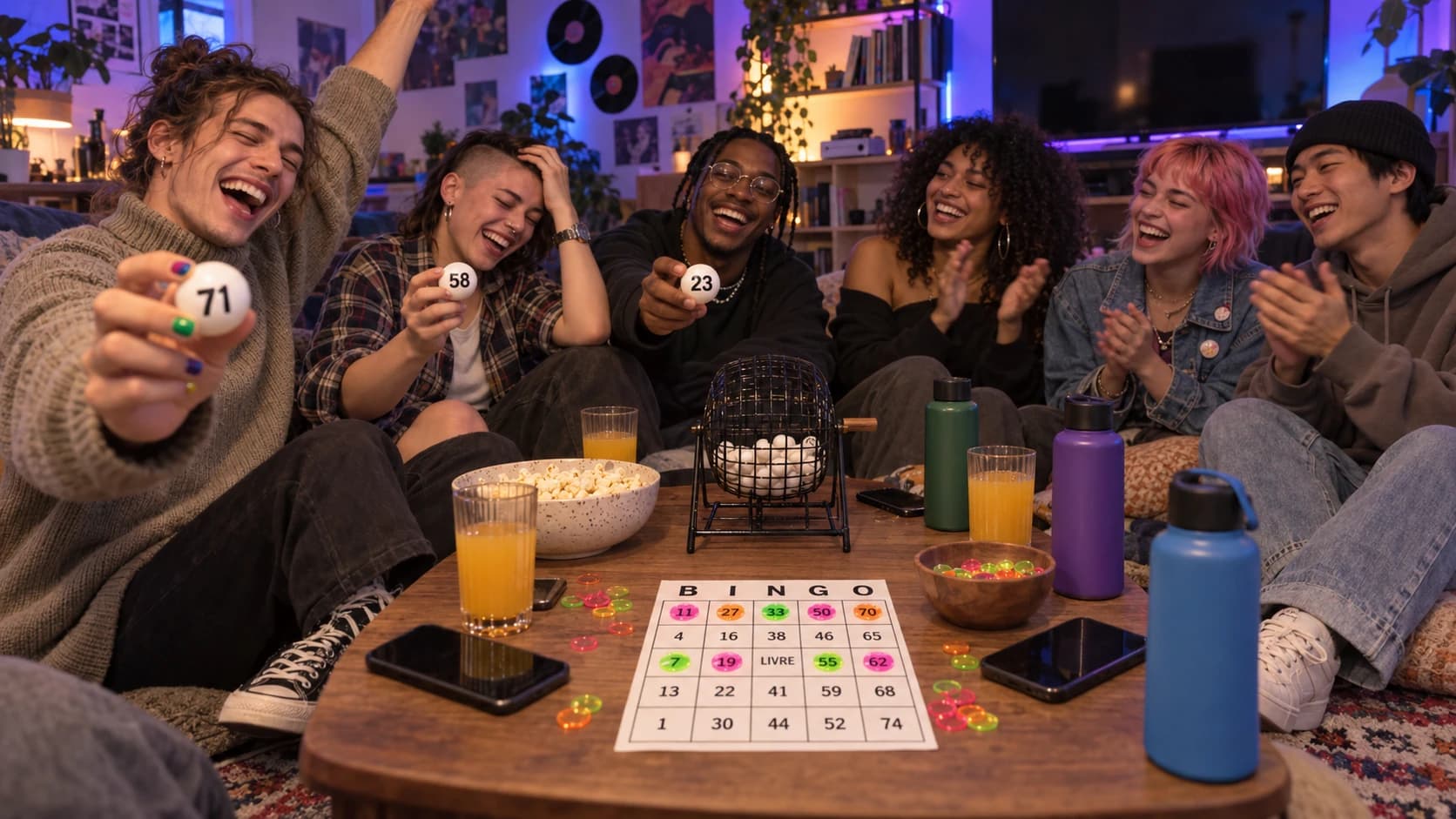
And on the player's side?
Whoever has the card on their phone, on the PLAY tab, sees the question the moment the pattern closes: 'Did anyone win along with you?' If the answer is 'Someone tied with me', the app sends them to the tiebreaker happening in the room and asks when they come back: 'And the tiebreaker?' Three possible answers: 'I won the tiebreaker!' (the celebration comes up and the history records 'Won the tiebreaker'), 'Didn't win, but I'm still in!' or 'Didn't win — end round'.
And here the app makes the decision most regulations leave open — the fourth rule on the list above. Whoever loses the tiebreaker has that sequence burned. The line you closed turns grey on that card and no longer counts for it: you won't call bingo again on the next ball with the same line, holding an advantage over everyone else. Note the exact size of the burn — it belongs to the card, not to the round. The round's pattern stays whole: that same top line still counts on every other card on the table, yours and other people's, and any of them can still close it and call bingo. On the card that lost, the other lines, columns and diagonals still count too. The highest ball decided who took the prize; it doesn't undo the fact that the card closed.
Losing the highest-ball draw doesn't take you out of the game. It only takes the line that was already disputed — and only on the card that disputed it.
What the app doesn't do — on purpose
- It doesn't split prizes. The app doesn't work out 'half for each' and doesn't handle money — the prizes are symbolic, and that's a product decision, not a technical limit.
- It doesn't offer the 'lowest ball' variant, or the dance-off. There is one rule, the highest ball, the same for everybody. If your event breaks ties another way, do it your way and record in the app who won.
- It doesn't decide who shouted first. It doesn't even ask. If two cards closed on the same ball, as far as the app is concerned both closed — as in the regulations on this map.
The TIEBREAK button is available in the free app, with no purchase, alongside the false-bingo check. If you host, it is worth reading how to train the person who calls — a well-run tiebreaker is half the show. If you play, how to know whether you won covers the rest of the check.
Frequently asked questions
- Two people called bingo on the same ball. Who wins? Both closed. What happens next depends on the rule announced: split the prize (the standard in casinos and regulated bingo abroad) or draw among the tied players (the standard at a Brazilian party, usually by the highest ball).
- Does whoever shouted first take it? No. The regulations we read don't measure the shout, they measure the ball: what counts is closing on the last number called. If the same ball closed both cards, it's a tie.
- I called after the next ball came out. Does it still count? At most events, no — and the rule is usually written down. Check fast, check right, and call before the next number.
- What is the 'highest ball'? The tiebreaker in which each tied player draws a ball (or a number) and the highest one wins. It is the Brazilian method and the one Bingo Pé Quente uses, from 1 to 75, with no repeated numbers, for up to 20 people.
- I lost the tiebreaker. Is my card out of the game? In the app, no. Only the sequence that card closed is burned (in grey), and only for it: the other lines on that card still count, so do your other cards, and the burned line is still up for grabs on any other card at the table. What runs out is that card's chance, never the round's pattern.
- Does the app split a cash prize? No. The app is for recreational bingo, with symbolic prizes. Splitting money is what a regulated bingo hall does — and that is another world, with another law.
Bingo Pé Quente: the rule said before the first ball, and the highest ball when there's a tie — in front of everyone.
Sources
- Rules and Regulations Governing BINGO (270-RICR-50-00-2), §2.7(F)(2) "Multiple Winners" — Rhode Island Department of State
- 8 CCR 1505-2-3 Bingo Games — Colorado (Cornell LII)
- Ariz. Admin. Code § R15-7-210 Multiple Winners — Arizona (Cornell LII)
- 316 Neb. Admin. Code ch. 35 § 210.15 Conduct of the Game — Nebraska (Cornell LII)
- 820 KAR 1:042 — Kentucky Legislative Research Commission
- Bingo House Rules — Prairie Band Bingo (Kansas, USA)
- Bingo Rules — Bingo Wednesday Night KC, Finnigan's Hall (USA)
- What happens if more than 1 player calls bingo? — Wizard of Vegas forum
- (14) Rules of Play — Bingo, rule 14.5 — Alcohol and Gaming Commission of Ontario
- Merchandise Bingo Licence at a Designated Fair or Exhibition — AGCO (Ontario)
- Règles sur les bingos (RLRQ c. L-6, r. 5), art. 108 — CanLII (Quebec)
- Multiple Winners in Bingo — Prize Sharing & Tie Breakers — BingoTalks (UK)
- Terms & Conditions (June 2025) — Club 2000 Bingo (UK)
- How To Play — Bongo's Bingo (UK)
- Orden de 9 de enero de 1979, Reglamento del juego del bingo — BOE-A-1979-2188 (Spain)
- Decreto 513/1996, Reglamento del Juego del Bingo — BOJA, Junta de Andalucía (Spain)
- Regulamento n.º 425-A/2015, online bingo rules, art. 30 — Portugal
- Regole della tombola — Associazione Ascolta e Vivi (Italy)
- About Housie — Charity Housie (Australia)
- Tambola Rules: Dividends, Claims & Full House — Party Tambola (India)
- ビンゴゲームの流れと司会トーク例 (bingo MC script) — Keihintora, party prize shop (Japan)
- ビンゴゲームの面白いルール・アレンジアイデア集 (bingo rules and variations for parties) — Sunshine Cruise-Cruise, event venue in Ikebukuro, Tokyo
- ビンゴ (Bingo) — Japanese Wikipedia, on the absence of a formal rule for simultaneous bingos
- Tarde de Prêmios at the Arraiá Solidário in Itapema (SC), event rules, published 31/07/2026 — Portal da Cidade Itapema (Brazil)
- Manual of the '6 em 1' boxed game (bingo rules) — Pais & Filhos (Brazil)