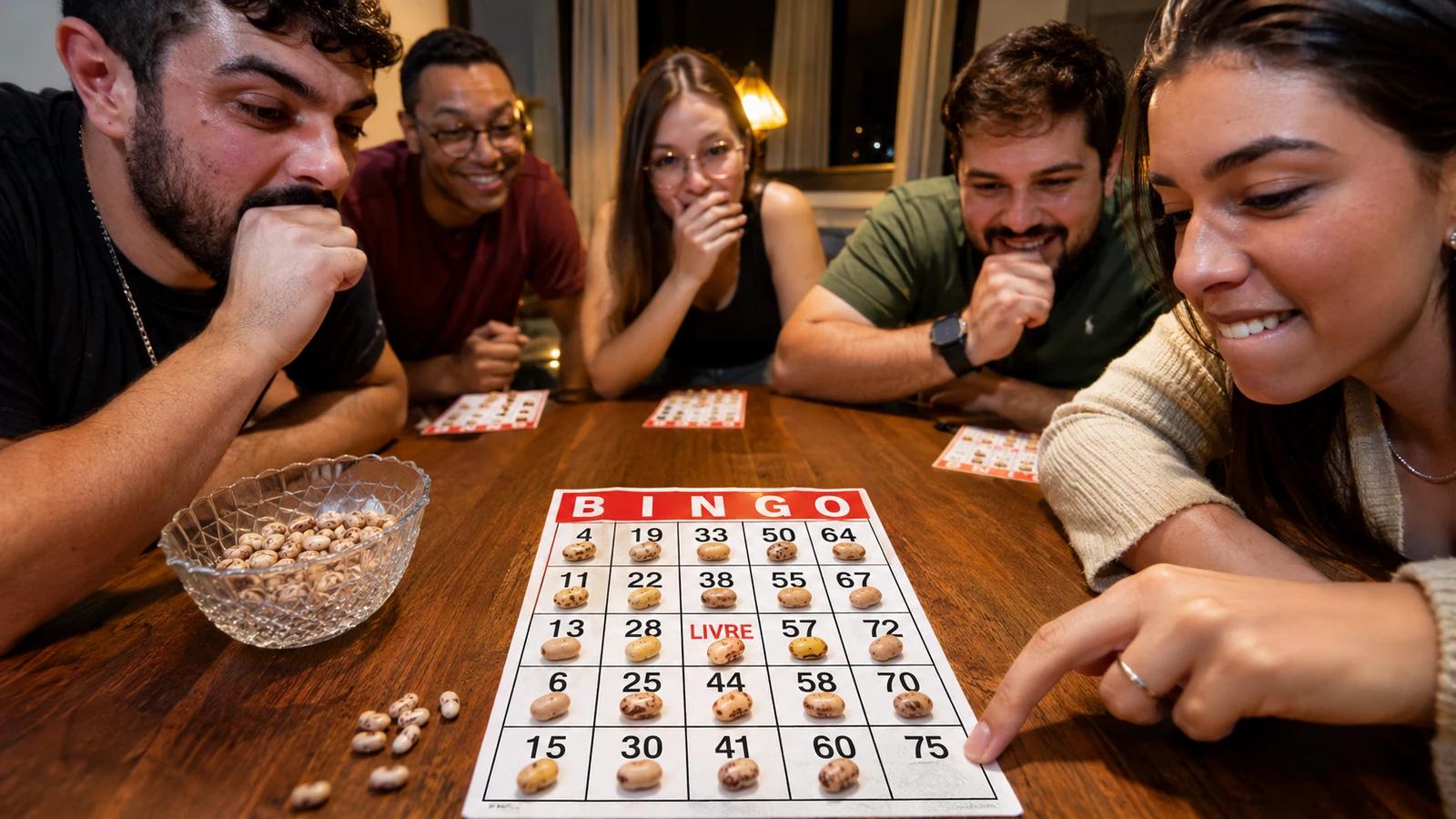
It's the round everyone waits for. The lines are done, the four corners too, the table is covered in beans and someone announces: now it's the blackout. From then on the game changes pace. Nobody celebrates early, and nobody could: a blackout only closes when the number for the last square is called, and that number always takes its time.
For this guide we didn't settle for "it usually takes a while". We simulated 20,000 rounds of 75-ball bingo, with tables of 1 to 100 cards, and measured which ball the blackout lands on, how often it ties and what changes as the table grows. The numbers are all here and, halfway through, there's a simulator: just enter how many cards your table has.
24
number squares to mark (plus the FREE space)
68th
ball it lands on, on average, at a table of 10 cards
1 in 5
blackout rounds ends in a tie
0.7%
of rounds with 10 cards close before the 60th ball
What a blackout is
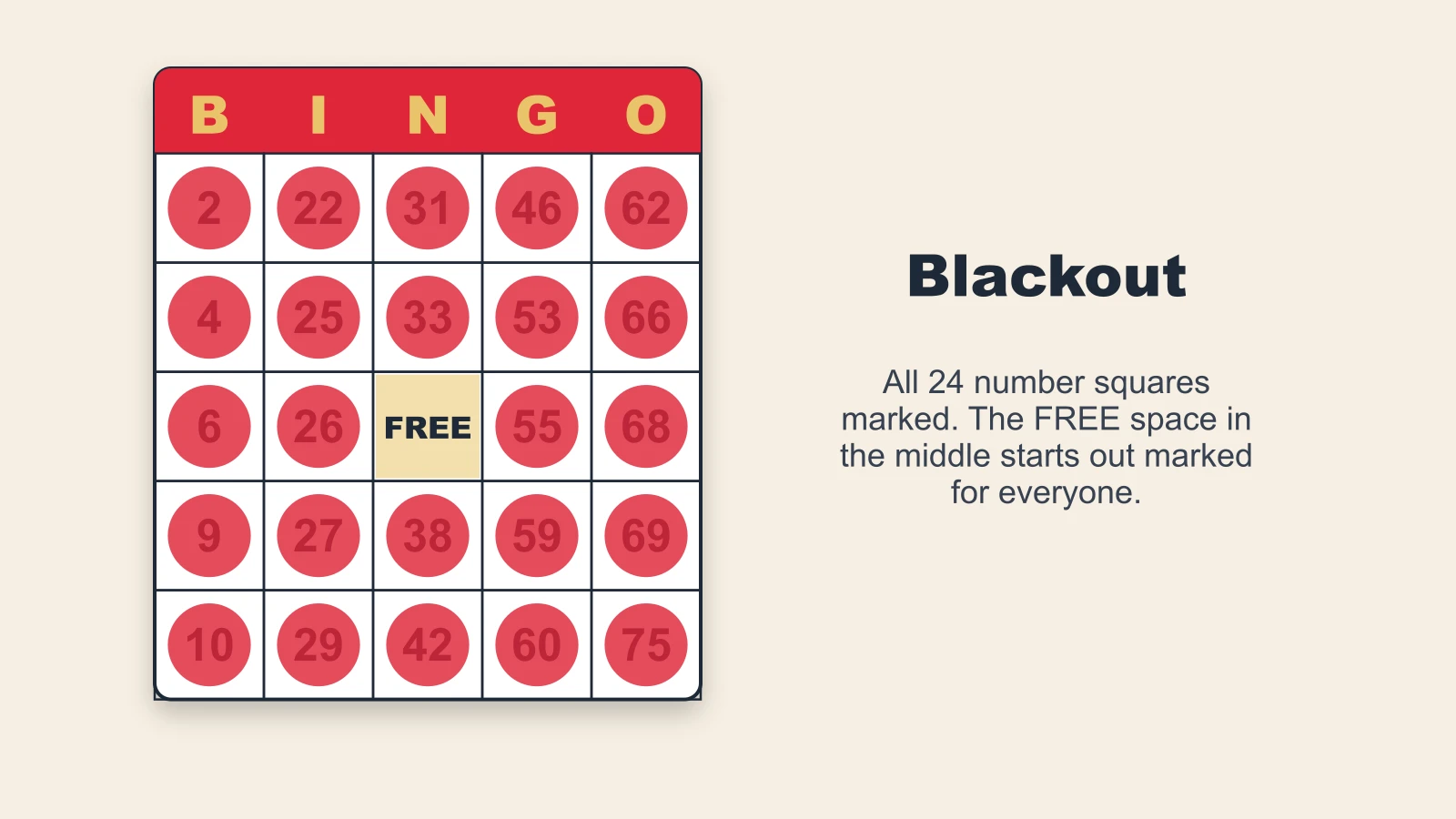
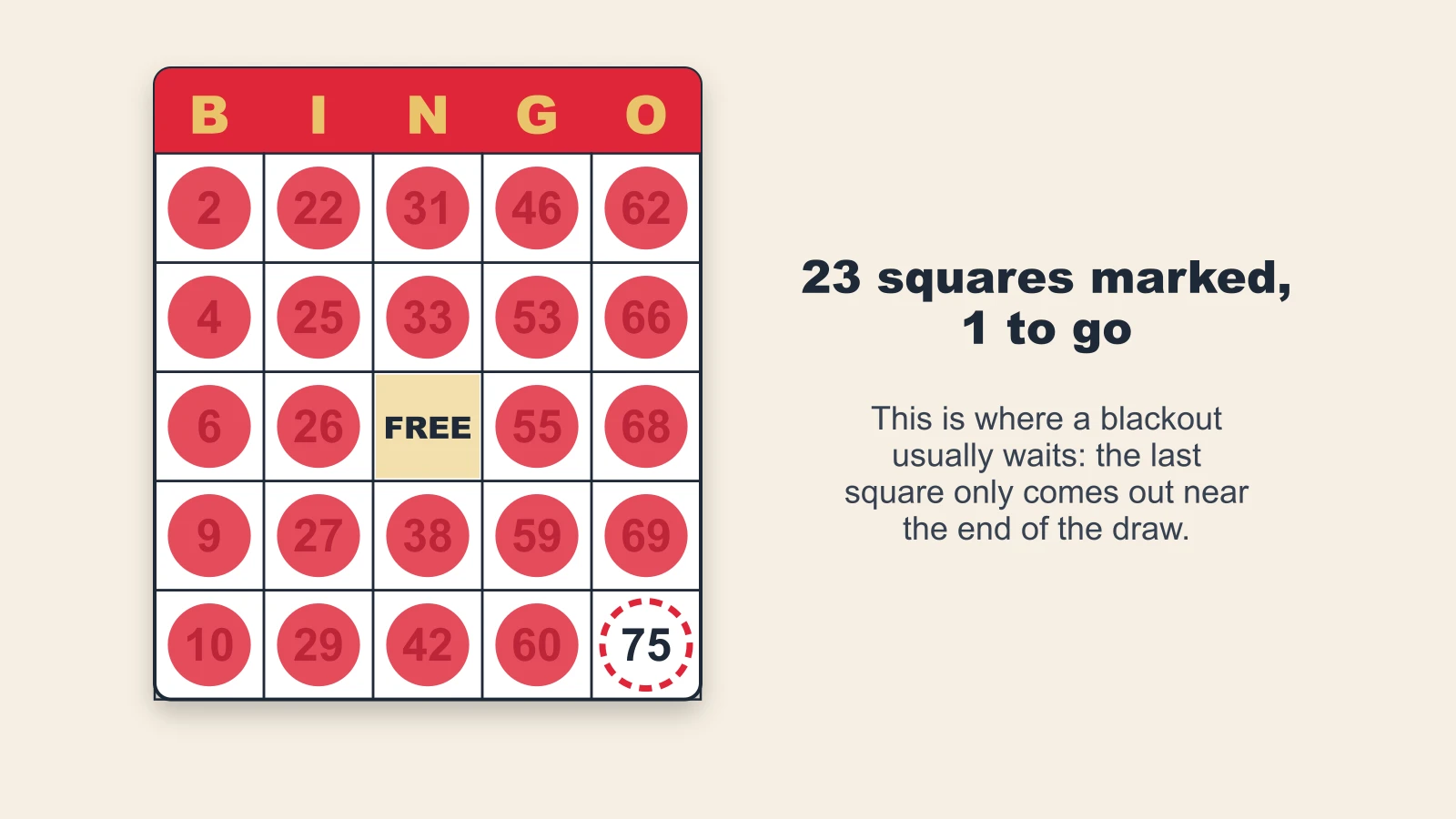
A blackout (also called a coverall) is the pattern in which every square on the card has to be marked. In 75-ball bingo the card has 25 squares: 24 with numbers and the one in the middle, the FREE space, which starts out marked for everyone. So, in practice, 24 numbers need to be called.
It's the easiest pattern to understand, because there's no shape to memorize: order doesn't matter, column doesn't matter. And it's the hardest to complete, because there's no square to spare. That's why it's usually the last prize of the night, and it gets the best gift.
Blackout
All 25 squares lit. The one in the middle is the FREE space: it counts as marked from the first ball.

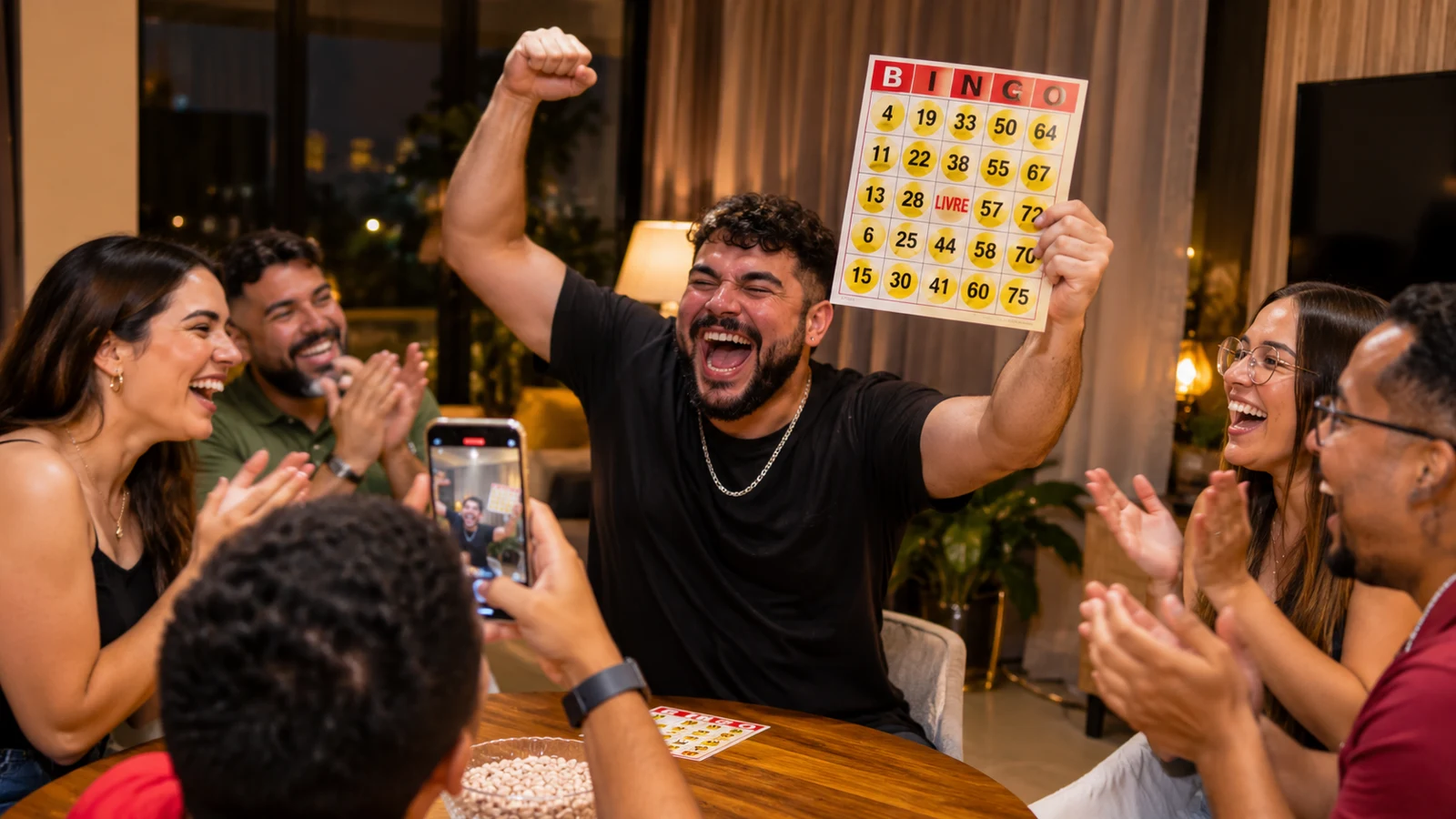
Gather the ones you love for the next Bingo
See how simple it is to play and host with Bingo Pé Quente.

5 stars on Google PlayFree to start, no sign-up
How a blackout is won
- All 24 number squares: every number has to have been called in this round.
- The FREE space counts: nobody has to wait for a ball to cover it.
- No shape and no order: the whole card counts, just as it was printed.
- Shout before the next ball: at most tables, a BINGO only counts if it's shouted before the caller calls the next ball. Agree on this before you start.
- Checked on the spot: the caller checks the card's numbers against the balls already called. If one is missing, the round goes on.
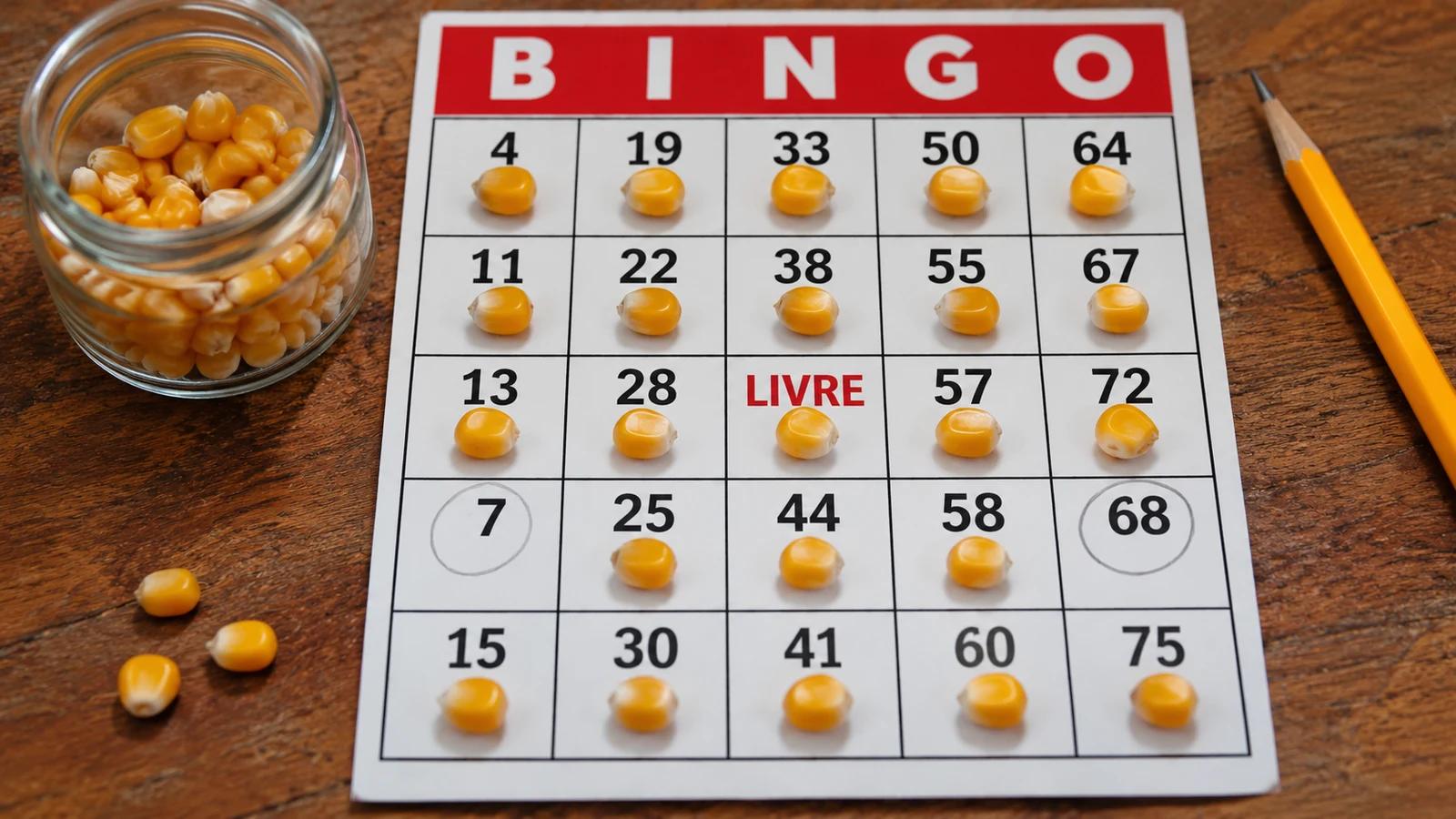
Which ball the blackout usually lands on
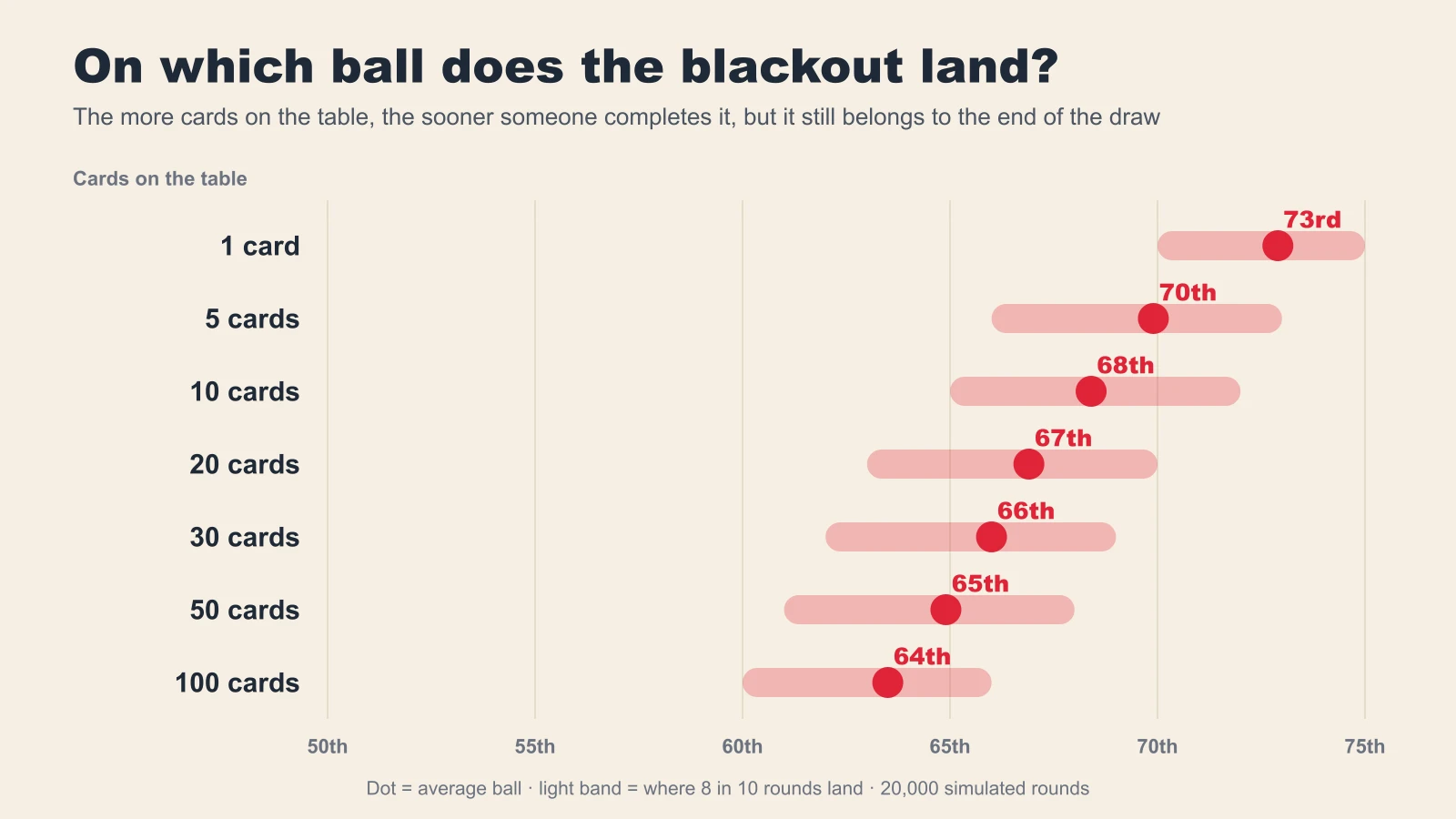
With a single card, a blackout closes on average on the 73rd ball: almost the whole cage has to come out. That makes sense. Your card holds 24 of the 75 numbers and only closes when the last of them is called, and the last of 24 numbers scattered at random tends to fall right near the end.
As the table grows, someone finishes sooner, but not by much: with 10 cards the average drops to the 68th ball; with 30, to the 66th; with 100 cards in the room, to the 64th. Even in a big room, the blackout belongs to the last quarter of the draw.
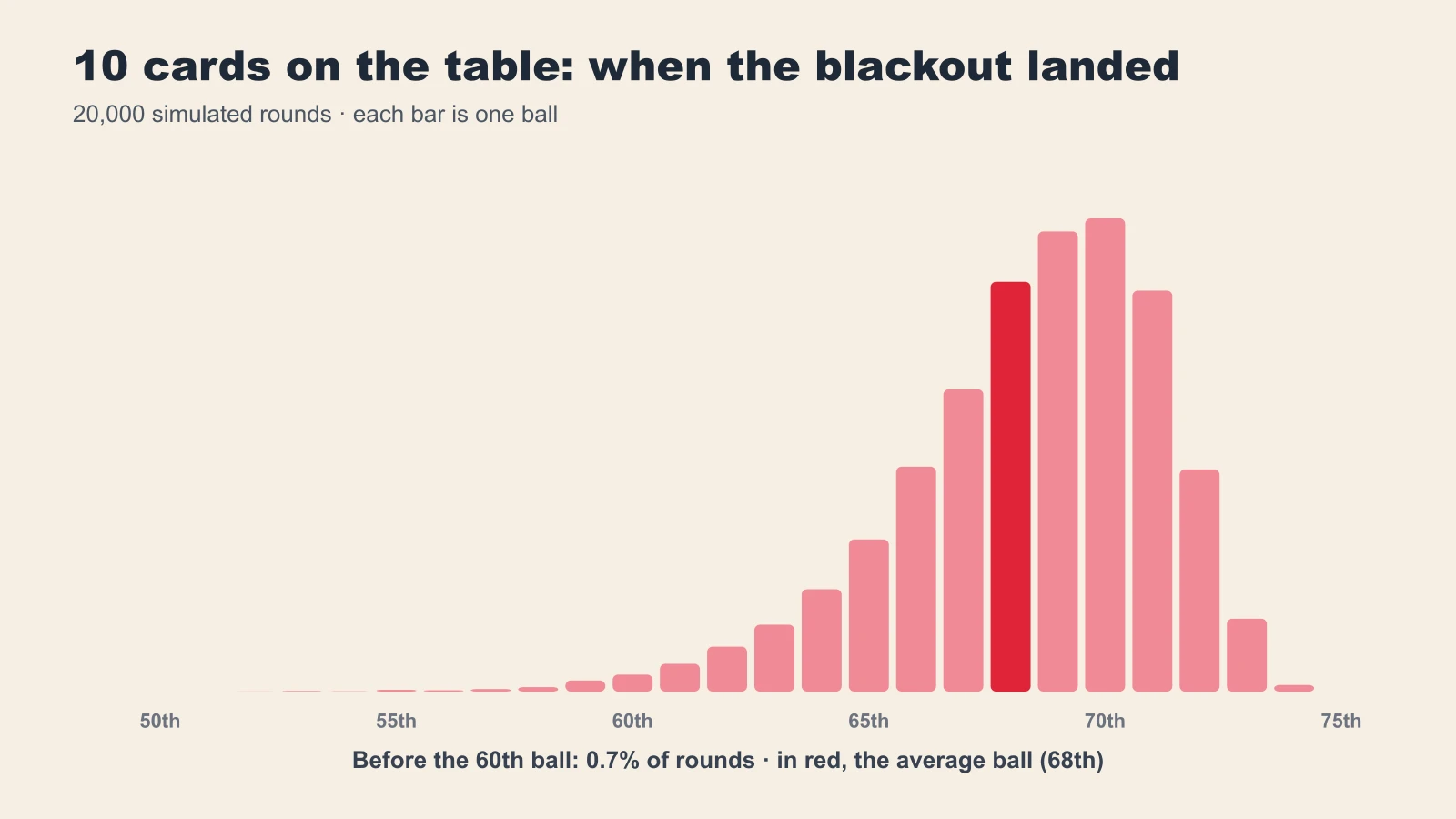
The chart below shows the 20,000 rounds of a 10-card table, ball by ball. Almost everything happens between the 62nd and the 72nd, and the ball it closed on most often was the 70th. Only 0.7% of rounds had a blackout before the 60th ball. If someone at your table closed one on the 50th, hold on to that card: it's genuinely rare.
Blackout simulator
68th
is the ball the blackout lands on, on average, with 10 cards on the table
In 8 out of 10 rounds: between ball 65 and ball 72
18% of rounds end in a tie
In a blackout, 1 round in 5 ends in a tie
This is the number that surprises people most. In a blackout, with 10 cards or more, about 1 round in 5 ends with two cards closing on the same ball: 18.4% of rounds with 10 cards, 19.3% with 30 and 20.2% with 100. For comparison, in a one-line round with 10 cards, ties happen 7% of the time.
The reason is at the end of the draw. When only a few balls are left in the cage, several cards are waiting on the same numbers. The ball that closes one has a good chance of closing another at the same time. And both players shout at once.
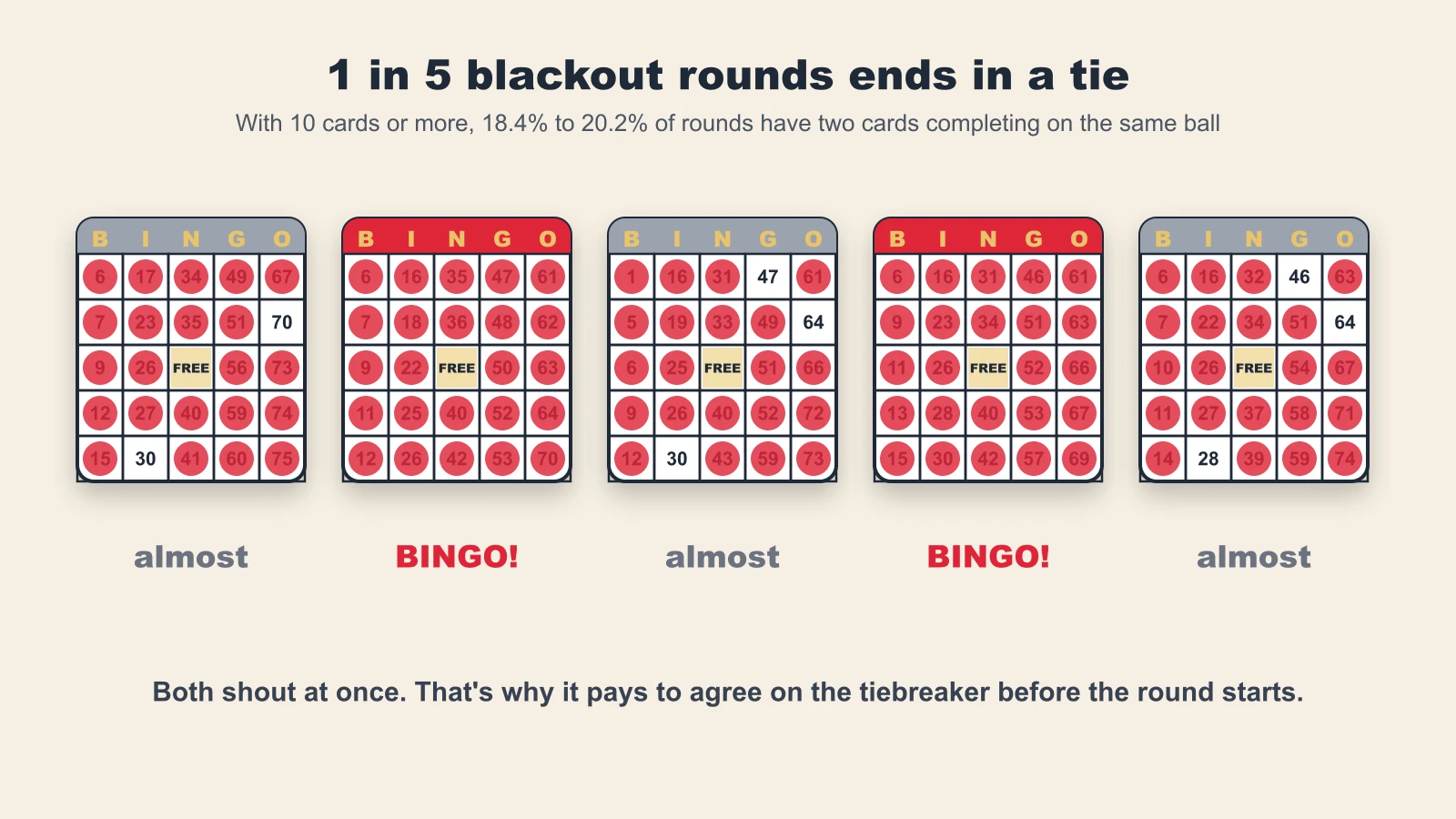
In a blackout round, the tiebreaker isn't a detail: it comes up 1 time in 5.
That's why it pays to agree on the tiebreaker before the round starts: split the prize, have each tied player draw a ball, or keep a second gift in reserve. The bingo tiebreaker guide shows the most common ways and what's good about each one.
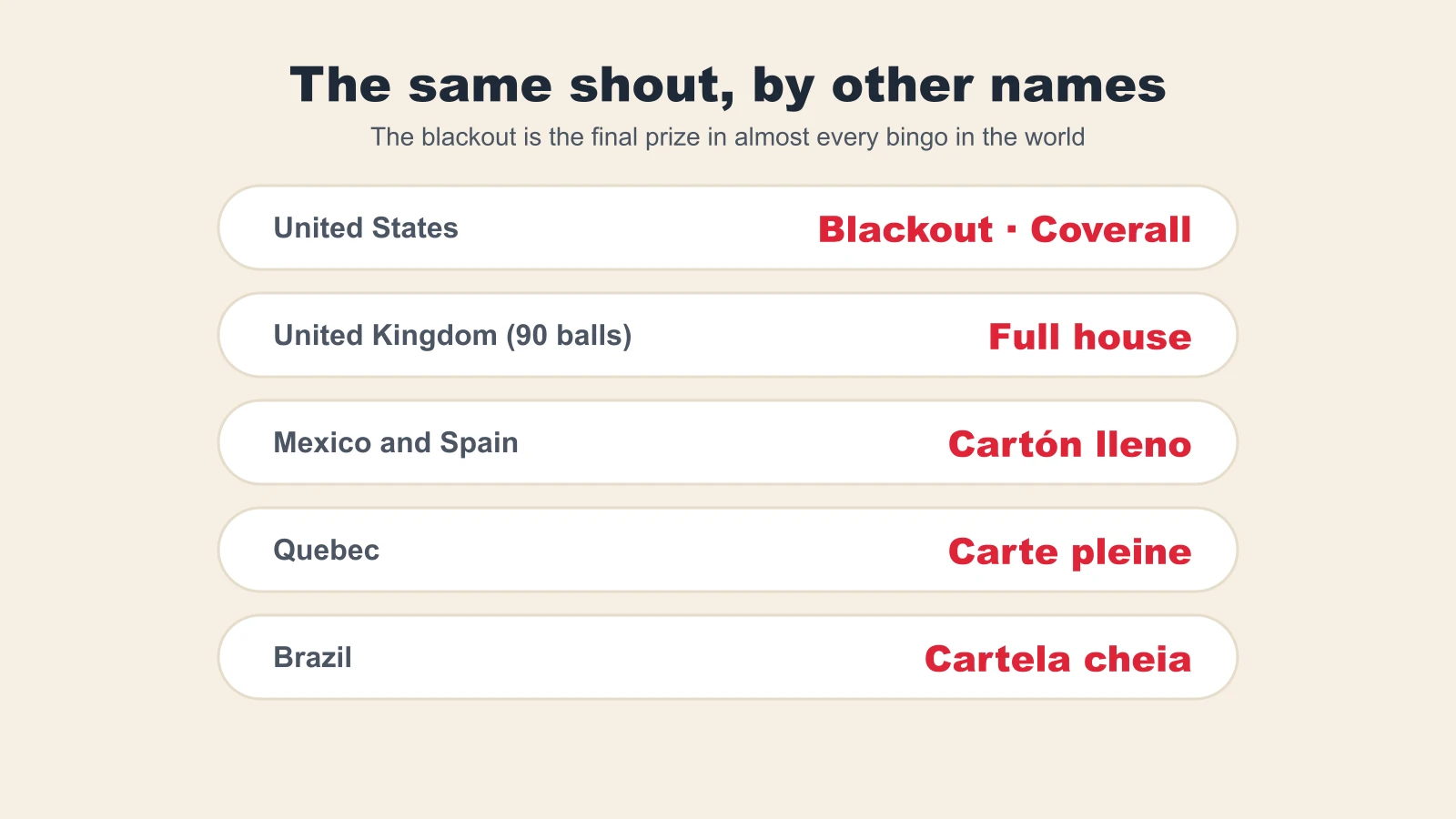
Blackout around the world: coverall, full house, cartón lleno
The blackout closes the night at almost every bingo in the world; only the name changes. In the United States it's a blackout or a coverall. In British 90-ball bingo, where the ticket has 15 numbers, covering them all is a full house. In Spanish it's cartón lleno; in Quebec French, carte pleine; and in Brazil, where this app was born, cartela cheia.
To see how 90-ball bingo climbs to the full house in three steps (one line, two lines, full house), it's all in the types of bingo guide.
How to make the blackout round even better
A prize ladder in the same round
One line wins a gift, two lines win another, and the blackout closes the round with the best one. The same balls count for all three.
An extra gift if it lands early
Agree on a limit: if the blackout lands by the 60th ball, whoever closes it gets an extra gift. Going by the numbers above, it almost never happens, and the whole room roots for it. The bingo variants guide covers the progressive prize.
More cards on the table
The round gets shorter with more cards on the table: from 73 balls, on average, with one card to 68 with ten. You can print as many as you need with the card generator.
An agreed tiebreaker
Say ahead of time what happens if two cards close together. With a tie every 5 rounds, the question will come up.
And save the best prize for it. There's no shortage of ideas in the bingo prize ideas guide, sorted by budget, occasion and age.
Tips for playing the blackout
- Watch the squares you're missing, not the marked ones: in the home stretch, knowing by heart the 2 or 3 numbers each card still needs is what gets you shouting at the right moment.
- With several cards, pull the nearly done ones forward: put the cards that are one or two squares away from closing right in front of you.
- Mark column by column: the caller says the letter before the number (B 7, O 68); checking the called letter's column first keeps you from missing it.
- Shouted? Show your card: the caller reads the numbers back out loud, and the whole table follows along. The how to know if you won guide shows how to check without the awkward moment.
Blackout in Bingo Pé Quente
In the app, Blackout is one of the 18 patterns in the free tier. For players, the paper card gets into the phone through the camera (the reading happens on the device itself) or typed in by hand, and with every ball called you type in the number. The app shows how many squares each card is missing and alerts you when one square is left. The real checking still belongs to you and the table.
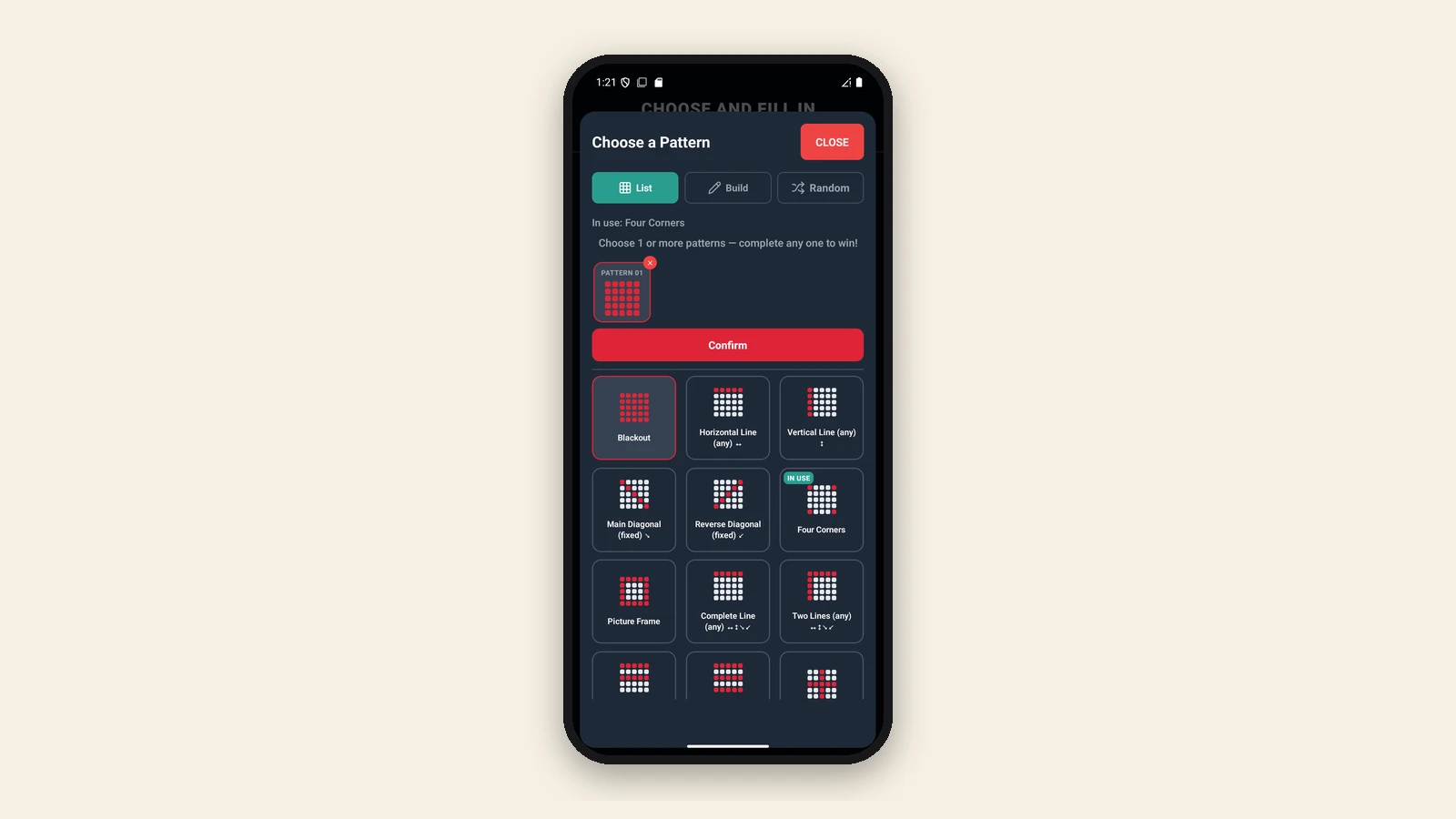
For the caller, the app calls each ball out loud and, if two cards close together, there's the highest-ball tiebreaker: each tied player draws a ball, with no repeated numbers, and the highest one wins. With PARTY, multi-prize mode builds the three-prize ladder in a single round, and the blackout can be Prize 3. With the Main Prize on, whoever closes Prize 3 within a ball limit takes both; if nobody closes it within the limit, the limit goes up in the next round.
Quick questions
- Does the middle square count in a blackout? Yes. The FREE space starts out marked, so 24 numbers need to be called.
- Which ball does the blackout usually land on? With one card, around the 73rd ball. With 10 cards on the table, around the 68th; with 100, around the 64th. Before the 60th it's rare: 0.7% of rounds at a table of 10 cards.
- Why are there so many ties in a blackout? Because it ends late in the draw, when several cards are waiting on the same numbers. With 10 cards or more, about 1 round in 5 has a tie.
- Are blackout and bingo the same thing? BINGO is the shout of whoever completes the round's pattern. When the round's pattern is the blackout, then yes, it's the same thing.
- Can I play blackout on my phone? Yes. In Bingo Pé Quente, Blackout is one of the 18 patterns in the free tier, with an alert when one square is left.
Twenty-four squares, one at a time. The last one always takes its time, and that's why this shout is worth so much.