
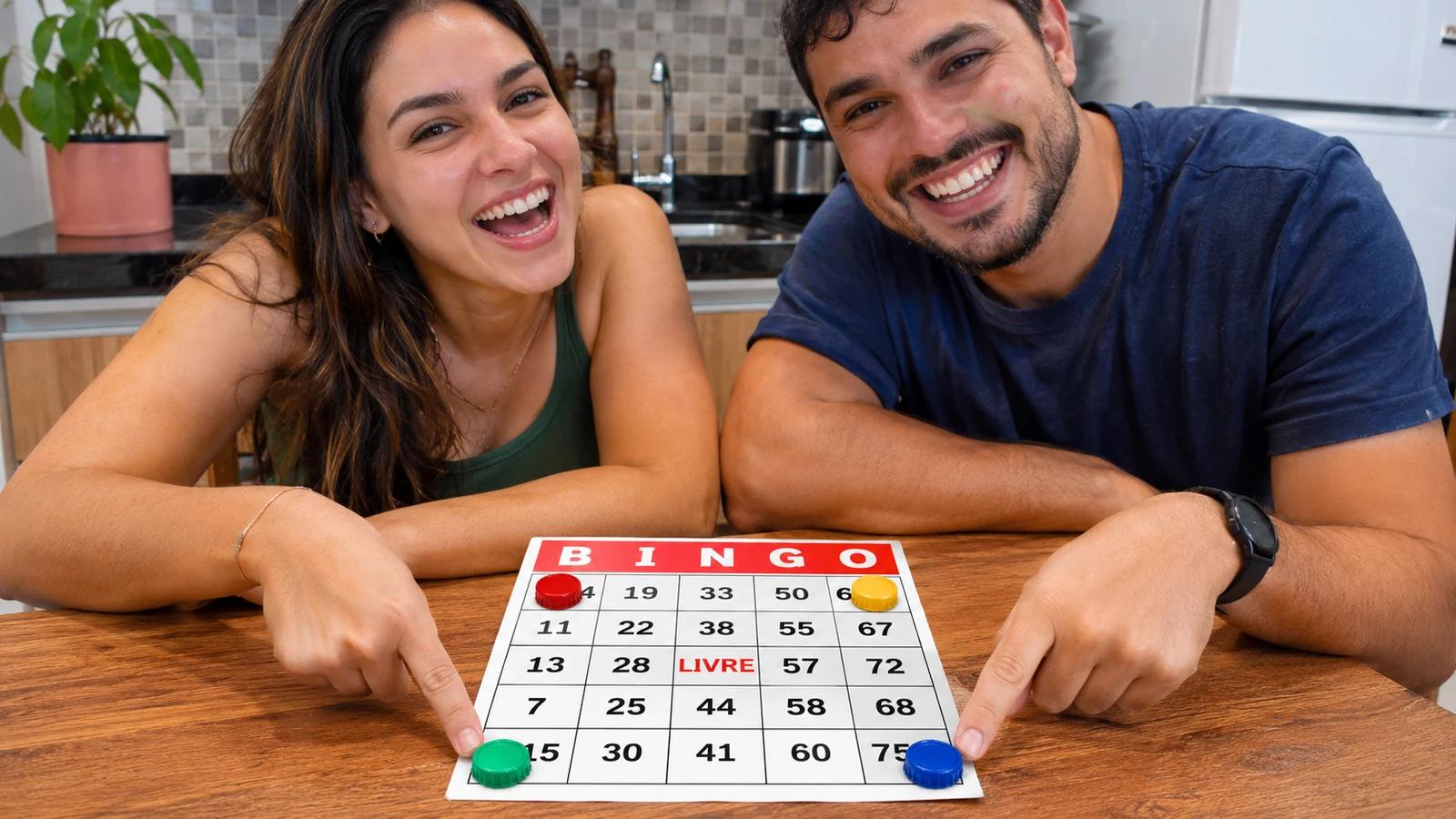
It's the pattern that opens many a bingo night. Just four squares, easy to explain to a kid or to someone who has never played, and quick enough for the first round to warm up the table. But four corners has something few people notice: more than half the balls in the cage are useless for it. That's 45 out of 75.
In this guide: how four corners works, why only the B and O columns matter, which ball it usually lands on (with numbers from 20,000 simulated rounds) and the variations you can use at your table.
4
squares to mark
30
balls in the cage that can mark a corner
40th
ball on average at a table of 10 cards
11%
of rounds with 10 cards end in a tie
How four corners works
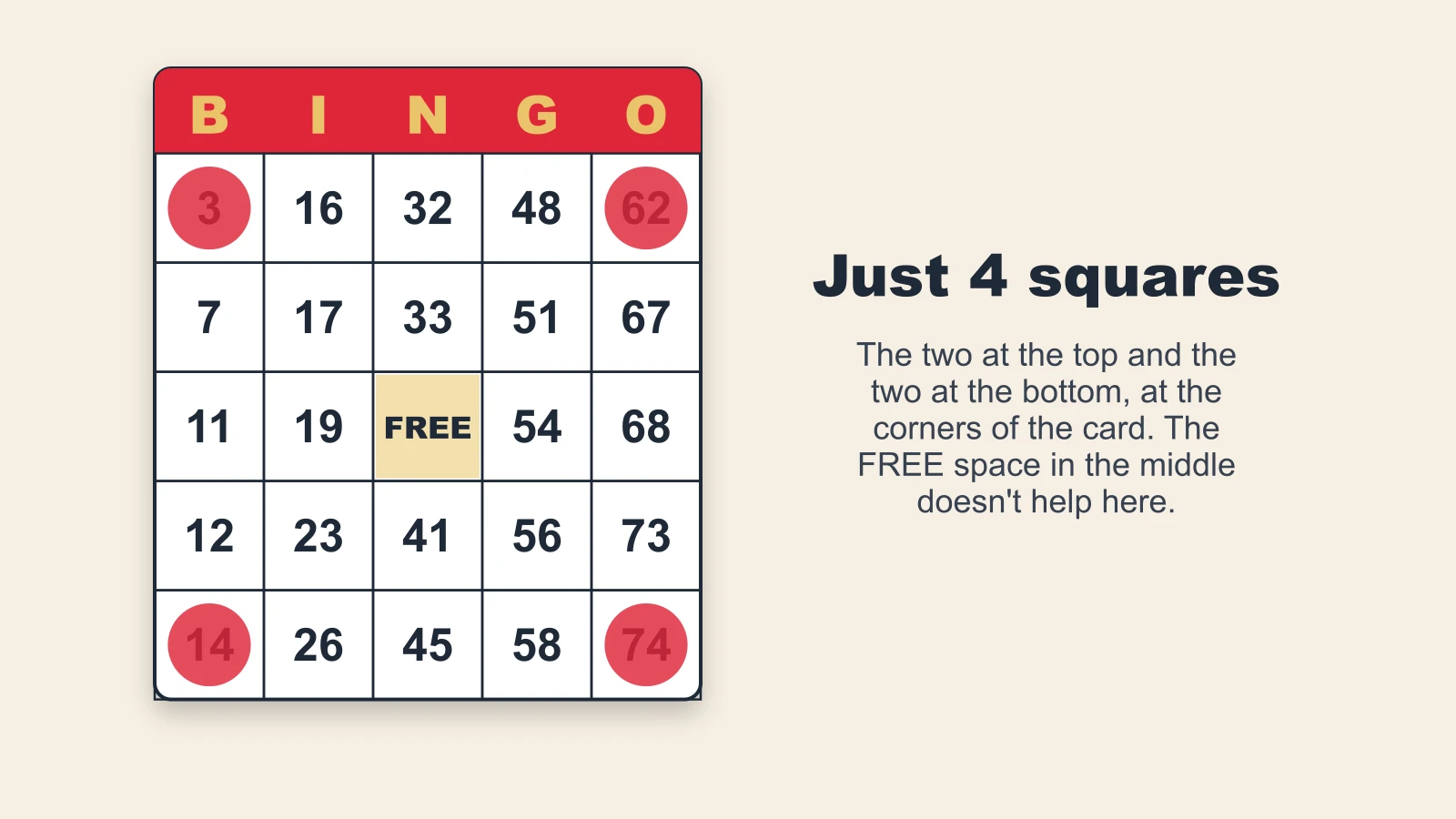
The winner is whoever marks the four corner squares of the card: the two in the top row (the one in column B and the one in column O) and the two in the bottom row. The other 21 squares don't count, not even the FREE space in the middle.

Gather the ones you love for the next Bingo
See how simple it is to play and host with Bingo Pé Quente.

5 stars on Google PlayFree to start, no sign-up
Only the B and O columns decide the round
Look at where the corners are: two in column B and two in column O. In 75-ball bingo, column B only has numbers 1 to 15 and column O, 61 to 75. So in a four corners round, the I, N and G balls (16 to 60) don't mark anyone's corner. Of the 75 balls, only 30 matter.
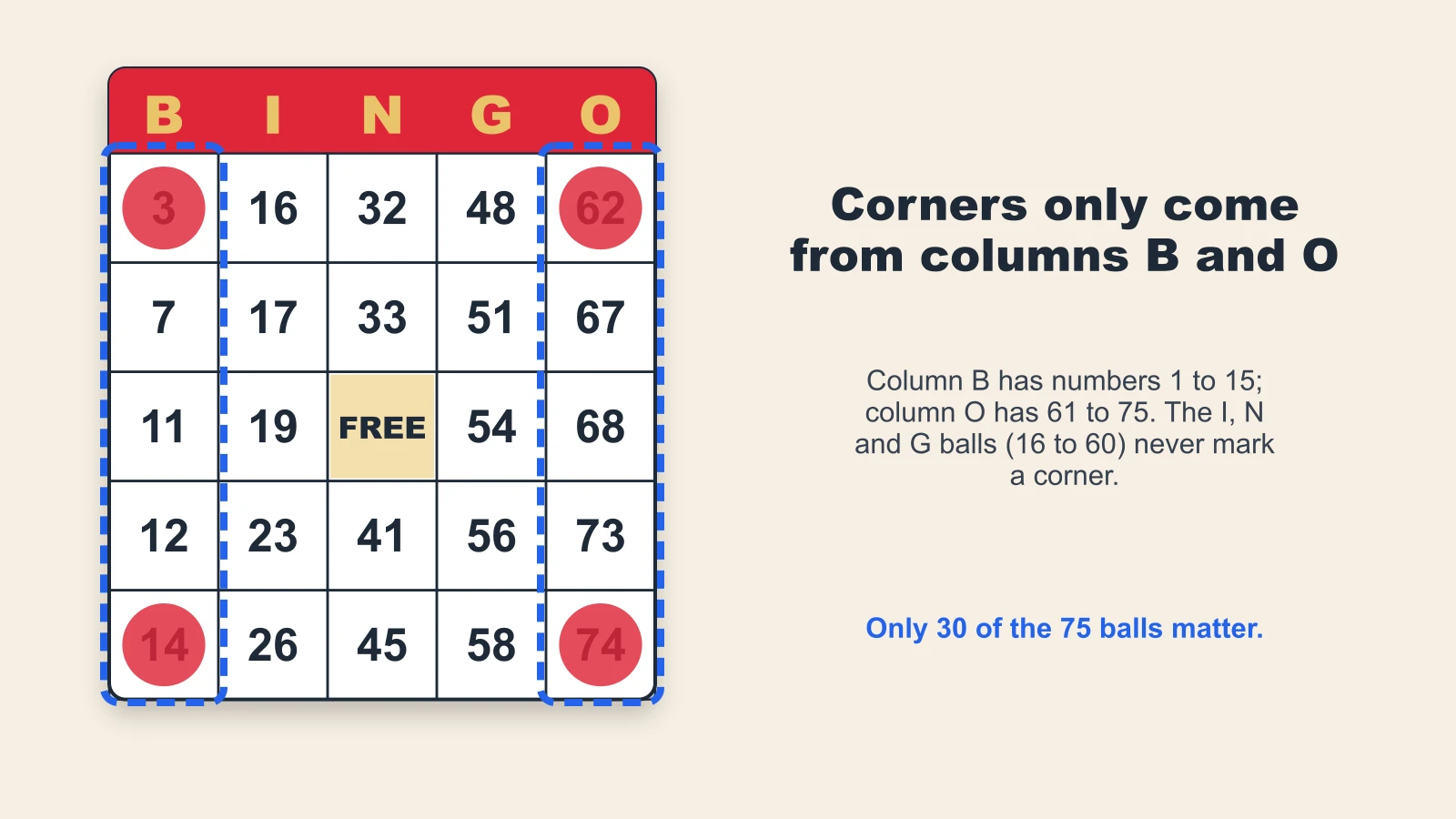
That gives the round a curious rhythm: when the caller says "N 40" or "G 52", the whole room stays still. When a B or O ball comes out, everyone looks at their corners. The caller can play with that: announcing the letter slowly keeps the table in suspense.
Which ball the four corners land on
With a single card, the four corners land on average on the 61st ball: there are only a few squares, but every one of them has to come out, and only 30 balls are any use. As the table fills up, the pattern speeds up: 40th ball with 10 cards, 32nd with 30 and 25th with 100 cards in the room.
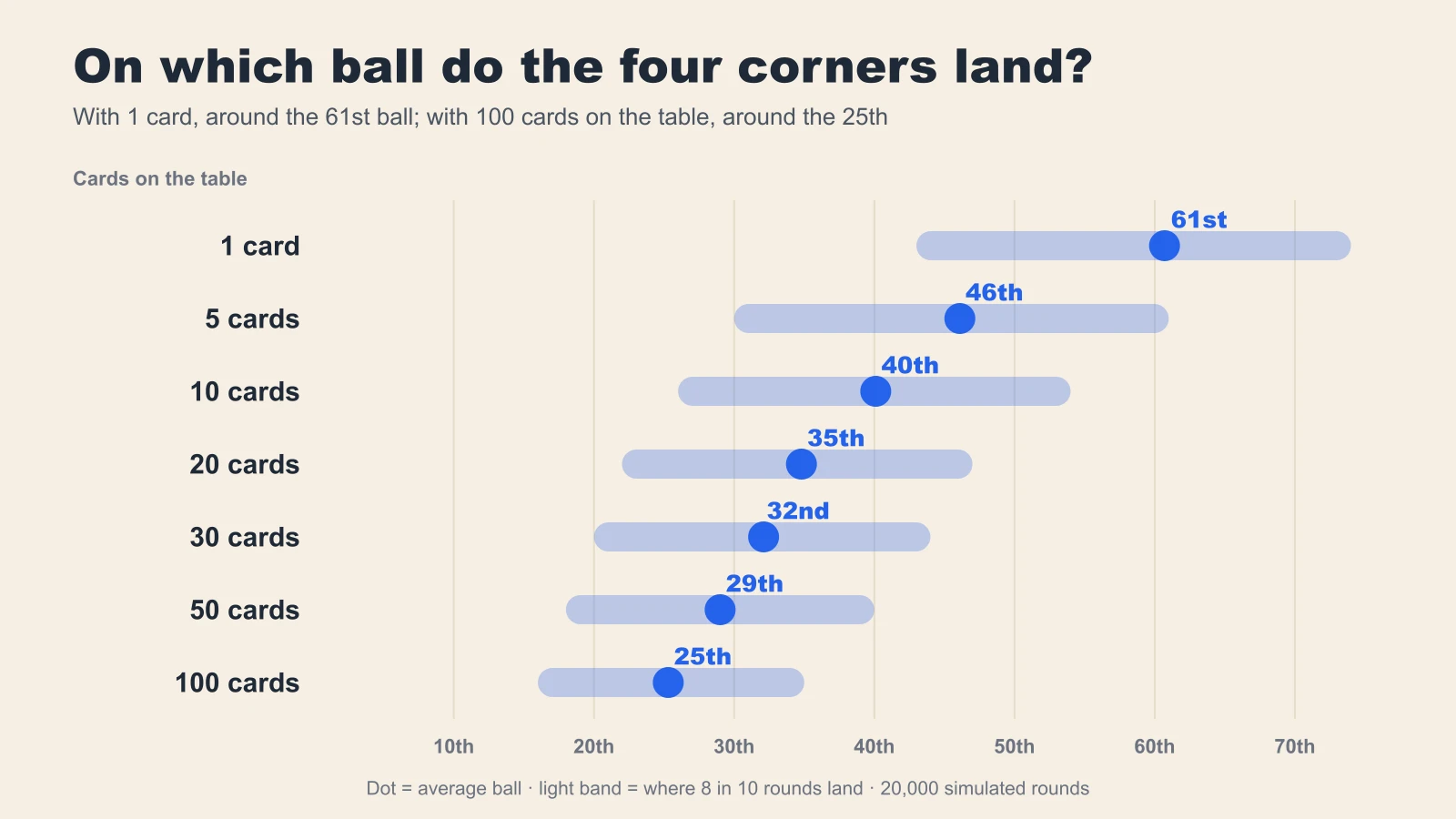
Notice how wide the bands are: with one card, 8 in 10 rounds end somewhere between the 43rd and the 74th ball. It's a pattern with a lot of variation, and that's what makes the round fun: sometimes it comes early, sometimes it goes all the way to the end.
Four corners simulator
40th
is the ball the four corners land on, on average, with 10 cards on the table
In 8 out of 10 rounds: between ball 26 and ball 54
11% of rounds end in a tie
Four corners compared with the other patterns
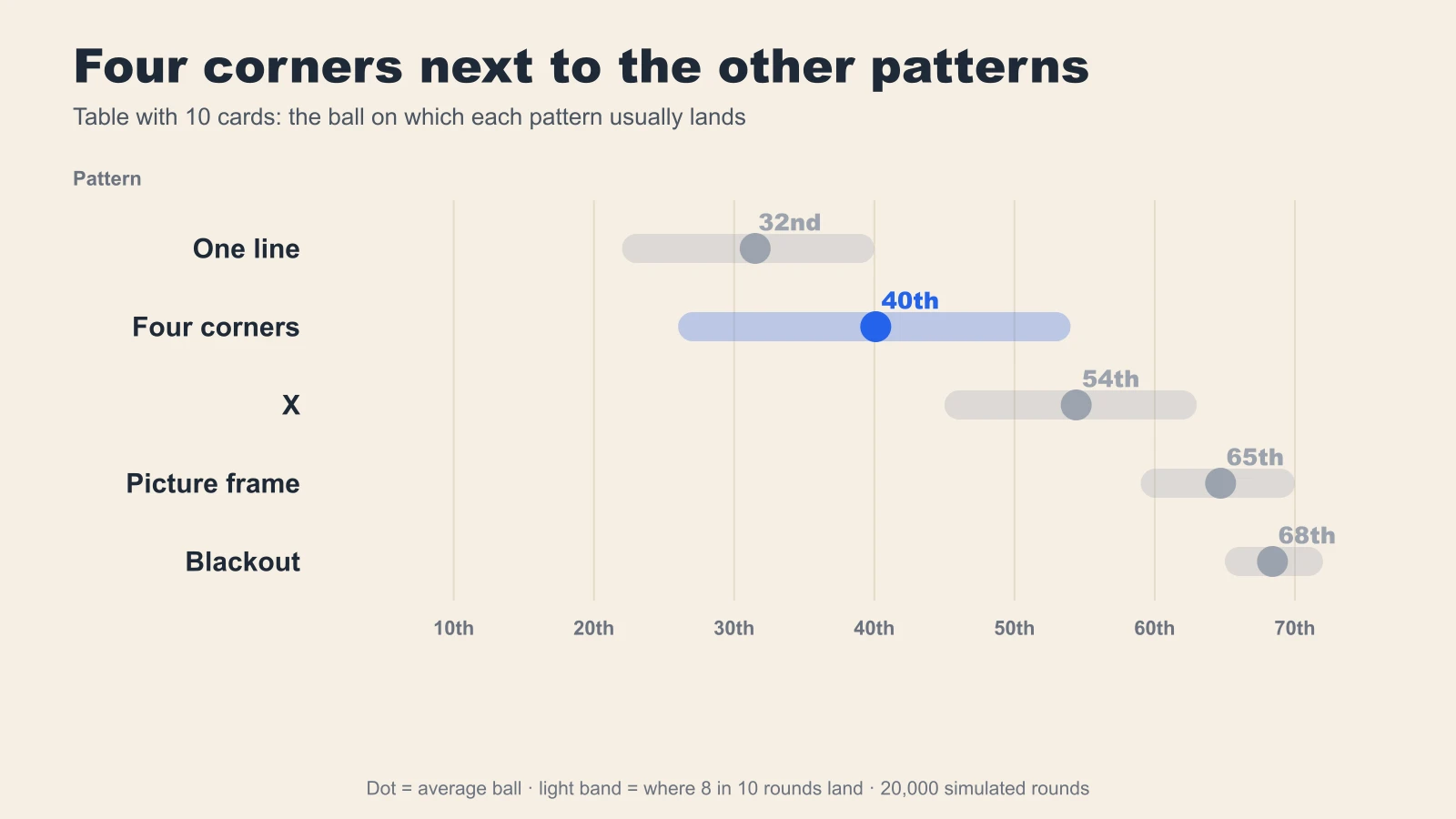
At a table of 10 cards, four corners sits in the middle: it lands after one line (32nd ball) and well before the X (54th), the picture frame (65th) and the blackout (68th). That's why it works so well to open the night or right after the line, and why it goes down well at tables with kids.
Variations on four corners
Four corners
The four corner squares. The classic.
Big corners
A little 4-square block in each corner: 16 squares in all.
Picture frame
The whole border. The four corners are part of it.
X
The corners joined by the diagonals, through the FREE space.
Stamp (any corner)
A 4-square block in any one of the corners, the classic postage stamp. In the app, it's Stamp (any corner).
Corners and center
The four corners plus the FREE space: it plays the same as the corners, but it's how many tables announce it.
They all fit into one night. A sequence that works: four corners to open, the X in the middle of the night and the picture frame before the blackout. The other classic shapes are in the bingo patterns guide.
Ties in four corners: more common than you'd think
With so few balls deciding everything, several cards can be waiting on the same B or O number. At a table of 10 cards, 11% of four corners rounds end with two cards closing together; with 100 cards, almost 20%. It's worth agreeing ahead of time on what happens: the bingo tiebreaker guide has the options.
In four corners, more than half the cage is useless. And that's what keeps the room silent every time a letter is called.
Four corners in Bingo Pé Quente
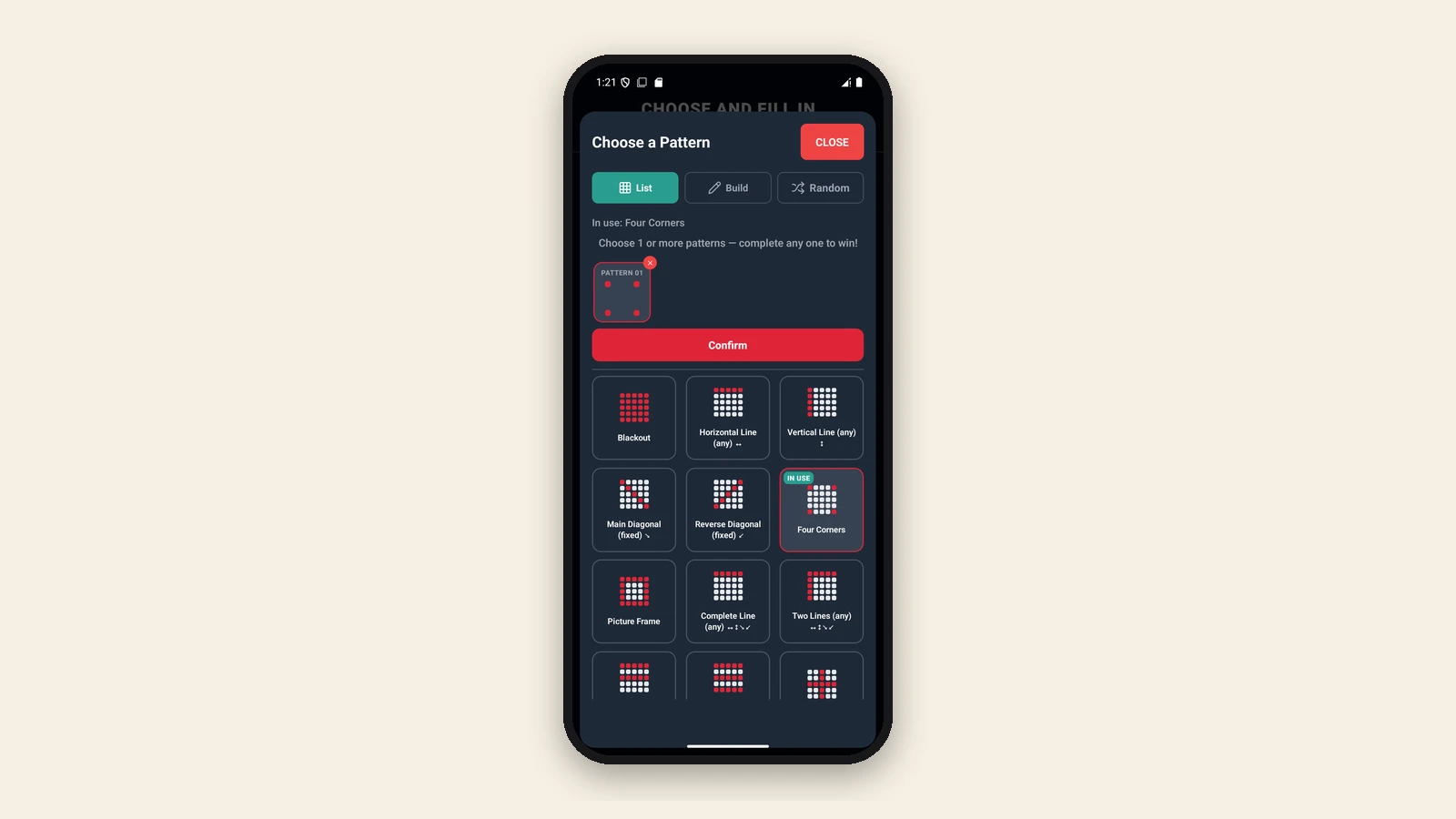
Four Corners is one of the 18 patterns in the free tier. Players choose the round's pattern on PLAY and type in the balls as they're called; the app shows how many squares are missing and alerts you when one corner is left. The caller picks the same pattern on CALLER and, if two cards close together, has the highest-ball tiebreaker. Stamp, which asks for a 4-square block in any corner, is in the app too, among the PARTY patterns.
Quick questions
- How does four corners work in bingo? The winner is whoever marks the four corner squares of the card: the two at the top and the two at the bottom.
- Does the FREE space count in four corners? No. It sits in the middle, and the pattern only uses the corners.
- Why do only the B and O columns matter? Because the corners are in those two columns. B runs from 1 to 15 and O from 61 to 75; the other balls don't mark a corner.
- Which ball do the four corners usually land on? With one card, around the 61st ball. At a table of 10 cards, around the 40th; with 100, around the 25th.
- Is four corners a good way to start the night? Yes. You can explain it in a minute, it lands before the halfway point of the draw when the table has 20 cards or more, and it keeps the room alert at every letter.
Four squares, two columns, thirty balls. The rest of the cage is pure suspense.