
Drag bingo: what changes is who's holding the mic
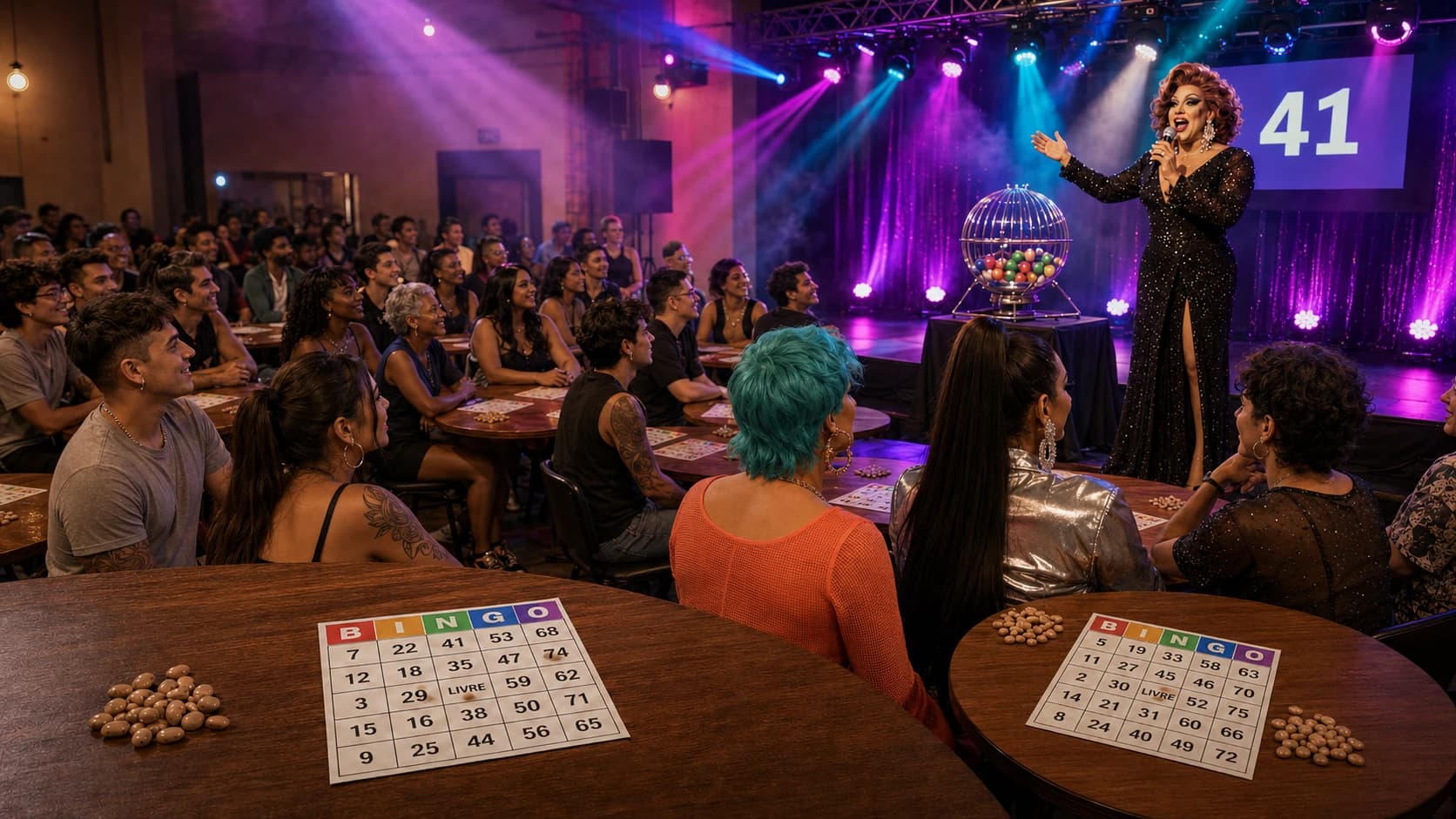
It's Wednesday night at Lips, a drag club in Atlanta. Taejah Thomas calls the numbers and, between them, trades catty remarks and jokes with her co-host. The room draws 40 to 80 people a week. Thomas was asked to host the club's weekly bingo about three years ago.
This is drag bingo — and the first job of whoever holds the mic, Thomas told the Atlanta Journal-Constitution, was translation:
We had to figure out a way to explain to our very seasoned generation that this is not your typical bingo.
1990
the decade the format was born, to raise money
40–80
people a week at Lips, in Atlanta
800
seats in the Durham hall, filled once a month
10
rounds at the Public Counsel benefit night
What changes is who's holding the mic
What sets drag bingo apart is who's on the microphone and the mood of the room. The game underneath is bingo and stays bingo: the hosts pull the balls from the cage and call the numbers, and between one round and the next come the performances, exactly as TIME described it back in 2007. The definition fits in a line — it's the same old bingo, with drag queens hosting.
And whoever hosts is doing two jobs at once: running the night and calling the numbers. That's where the work is, and that's what gives the format its identity.
There's no new rule. What changes is who runs the room — and that's exactly what makes it harder to run.
Where it came from: Seattle, early 1990s
The origin is anything but casual. In the early 1990s, Judy Werle was director of development at the Chicken Soup Brigade, an organization supporting people living with HIV/AIDS, and her job was to invent events that raised money. Her reasoning went straight to the point:
I checked out places where people gathered and spent money, because I figured if you had that, you could redirect the money to a good cause.
The Sisters of Perpetual Indulgence — drag queens dressed as nuns — hosted the Brigade's first event, then called Gay Bingo, the format's original name. The line wrapped around the block. What the format still is today was settled right there: a way to raise money for HIV/AIDS support organizations, with drag queens running the night.
From there it spread — Boston, Chicago, Denver, San Francisco, Atlanta, Dallas, Los Angeles, and later Utah, Alaska, Idaho and Wyoming. By the mid-2000s, groups with no connection to the original cause were using the same format to fundraise, like the Rocky Mountain Multiple Sclerosis Center.
How big the format got
The scale is bigger than you'd think. In 2007, the Durham Armory, in North Carolina, filled its 800 seats once a month with drag bingo nights that were family-friendly and alcohol-free, hosted by Mary K. Mart — whose title in the room was BVD, bingo-verifying diva. A typical night sent about US$ 10,000 to the Alliance of AIDS Services-Carolina.
For scale: when that first night was being organized, the hope was to gather 100 people and raise a thousand dollars.
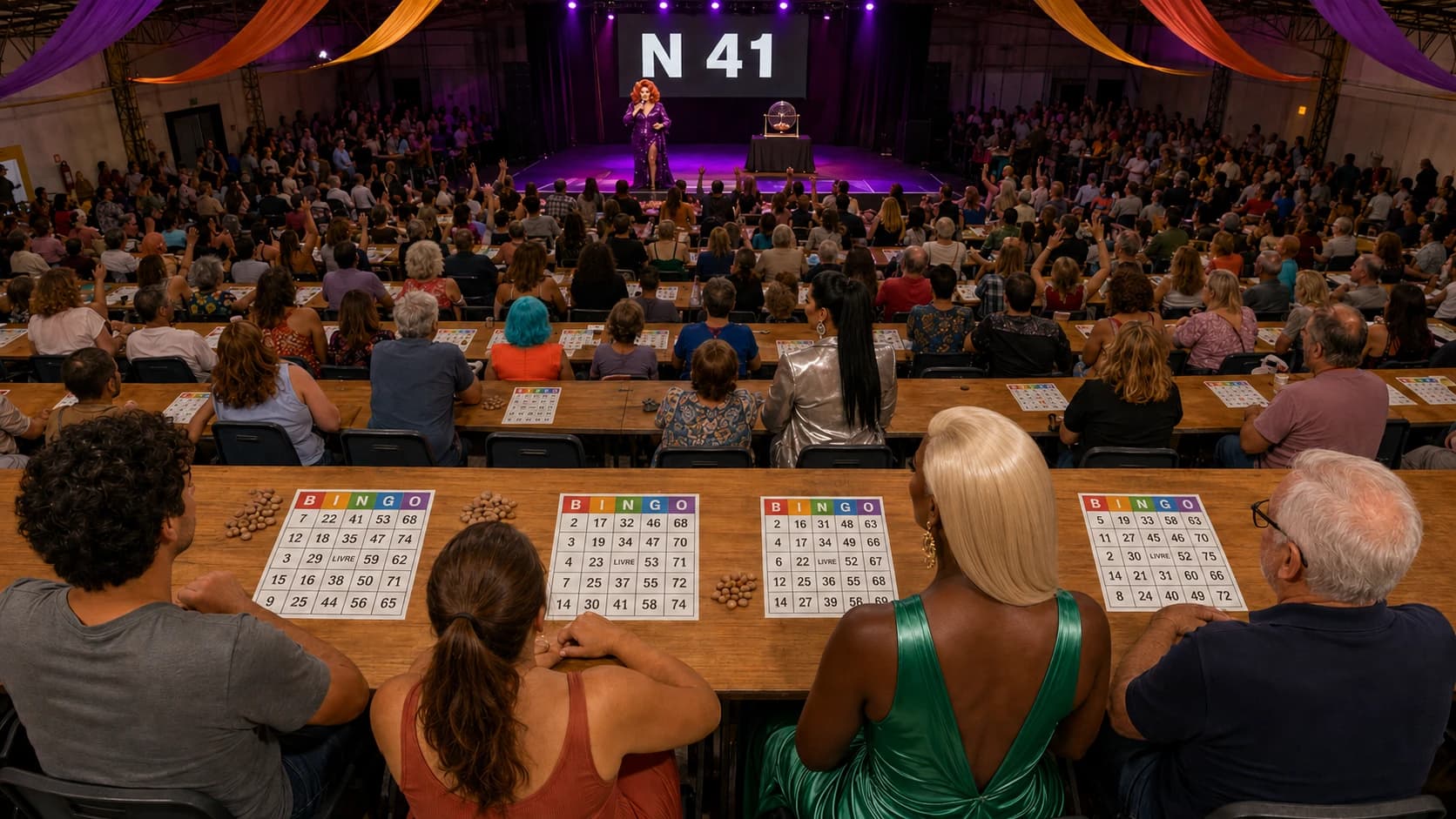
The title of the host in Durham said it all: the diva who verifies the bingo. Verifying is a human job, and always has been.
How the nights are put together
The formats vary from room to room:
- Lips, Atlanta — weekly. The night comes in three parts: dinner, performances by the hosts, and then several rounds of bingo with prizes for whoever fills the card.
- PALS Atlanta — monthly, at the same Lips. Each edition has a theme, and the ticket pays for high-quality pet food and vaccines for the animals of low-income owners served by PALS — people who are disabled, living with HIV or other chronic illnesses, veterans, and people over 65.
- Legendary Bingo, at Hamburger Mary's in West Hollywood. At the June 2026 edition benefiting Public Counsel, there were 10 rounds of bingo plus a live auction, with all proceeds going to the organization's free legal services.
The first two happen at the same address and are different nights: one is the venue's weekly show, the other is the charity's monthly event, with their own teams and their own purposes. Not every drag bingo night is a fundraiser — and the ones that are don't look alike.
One warning before copying the model: in the United States it's common for these nights to award cash — PALS advertises up to US$ 1,100 in cash prizes per edition. In Brazil that isn't possible. Bingo with cash prizes is a criminal misdemeanour there (art. 50 of Decree-Law No. 3,688/1941); recreational bingo is limited to gifts in kind — a basket, a voucher, a keepsake. Check the rules where you are: what travels well from these nights is the engineering, not the prize table.
Why it works: the case made by the hosts
Taylor Alxndr, a drag artist and activist in Atlanta, told the AJC that drag bingo picked up after 2020, alongside drag brunches. Alxndr started hosting Brewhaha Drag Bingo at a café in the West End and, when that location closed, moved the event elsewhere. The daytime and early-evening slots became the 'bread and butter' — in Alxndr's words, because they're 'more accessible, more family-friendly' and don't require being out at a nightclub until 3 a.m.
And there's an argument more interesting than entertainment. Alxndr reckons bingo allows a more genuine connection between host and audience than a nightclub does — because there's room to call the numbers, crack a joke and show more of your own personality along the way.
The connections I've made through bingo have been some of the best connections I've made in drag over the last six or so years. — Taylor Alxndr, to the Atlanta Journal-Constitution
The same format, in other time zones
What began in Seattle didn't stay in the United States — and wherever it landed, it usually landed for the same reason. In Sydney, Bingay has run since 1999, put on by ACON, New South Wales' leading HIV prevention and LGBTQ health organization. It's the second Thursday of every month, at The Beresford in Surry Hills, with Charisma Belle in charge and Naomi Palmer on the cage — the house's barrel babe.
ACON's own definition of the event is the usual one: it works just like ordinary bingo, only cheekier. With one difference worth stealing — there, whoever fills the card doesn't shout BINGO.
— BINGAY!
Prizes run from silly and camp to theatre tickets and restaurant vouchers, and the proceeds sustain ACON's services and programs for LGBTQ+ communities. More than twenty-five years after that first night, it's the same machinery built in Seattle: a full room, a health cause, and someone on the mic who can hold both.
And there's the branch that isn't charitable: bingo turned into a sold-out party. Bingo Lingo was born in Cardiff, Wales, has a permanent home at DEPOT and has sold out tours in more than 50 locations. Bongo's Bingo now runs through Manchester, Newcastle, Glasgow, London, Liverpool, Leeds, Birmingham and Brighton, with dance-offs, rave intervals and deliberately ridiculous prizes. It's a different intention — you buy a ticket, you don't donate — but the core of the night is still someone calling numbers to a whole room.
And in Brazil?
There is one — and the version closest to the original is in São Paulo. Casa 1, an organization that shelters LGBTQ+ people thrown out of home, runs its Drag Bingo in the Leci Brandão Hall, hosted by Paola Di Verona, with performances and lip sync battles between rounds. Entry is free, cards are sold on site and the audience is invited to contribute to the house: the same arrangement as Seattle and Sydney, in Portuguese. As with any cultural venue's programming, check the calendar before heading out — dates vary.
Outside the big cities, the format appears and disappears with the venues that host it — bingos hosted by drag queens have run in bars and clubs in several state capitals, almost always weekly, almost always tied to a single venue's calendar. It's a circuit that lives on scheduling, not on institutions: when the venue closes, the night closes with it.
Taking this to your own night
First, a note on the format: a drag bingo night isn't one long game, it's a sequence of closed games — one ends before the next begins, and each has its own prize. There were ten at the Public Counsel edition; your night may call for fewer. From the first to the last, the shape of the night was already decided when the doors opened.
In Bingo Pé Quente, each of those games is one round in SOCIAL BINGO: one winner, one prize, round closed. Plan Event lines them all up the night before — and what it solves isn't the microphone, which is still human work, but everything else competing for the attention of whoever is holding it.
From the run sheet to the accounts
- The whole sequence. seven rounds, ten, whatever your night calls for — each with its own shape and its own prize, saved beforehand and ready to open on the day. You can group them into moments: the warm-up, the body of the night, the encore.
- The shape of each game. there are more than 50 ready in the list, and nothing stops the same one repeating all night. If you're unsure which to pick, it's worth a look through the bingo patterns.
- The prize, spelled out. exactly as you'll announce it on the mic — and it's that same text that reappears on the poster.
- The poster. comes out of the programme itself. Anyone organizing to raise money has to advertise beforehand, and the artwork is born from the sequence you built.
- The closing round. marked as the one with the top prize, so there's no hesitation in the run sheet at the moment the room is fullest.
- The number on the room's screen. via TV Mode, with the phone mirrored to the room's screen. In a hall with hundreds of seats, whoever sat at the back depends on it to follow along — TV Mode explains what appears on screen.
- The voice that calls. with the traditional nicknames, coming through the room's PA. Whoever hosts spends the whole night talking — sharing your throat with the app isn't a luxury.
- The tie. if more than one person fills the card in the same game, the tiebreaker draws the highest ball among up to 20 players, with no number repeating.
- The accounts. organization, licence number and prize value are recorded alongside the night. A format born to raise money always ends in numbers somebody will want to check.
If you've never built a sequence like this, these three cover a whole night — from the game that comes out fast to the one that holds the room to the end:
Horizontal line
One row across, any of the five. Comes out fast — a good opener for a run of rounds.
Four corners
Just the four tips of the card. Few squares, but at the extremes.
Full card
Every square marked, with the FREE space counting for nothing. The longest shape on the list.
There's one thing the app leaves out on purpose: whoever is on the mic doesn't get the room's cards. The app follows the cards of whoever is holding it — and that's it. It doesn't check anyone else's card, doesn't know who in the crowd is close to filling, and doesn't declare a winner: it calls the numbers, throws them on screen, follows the round, and stops there. The verdict stays human, just as that job title in Durham spelled out.
More than thirty years, the same full room
From an HIV/AIDS support organization in Seattle at the start of the 1990s, to an 800-seat hall in North Carolina, and from there to a Wednesday in Atlanta with 40 to 80 people a week: what crossed more than three decades is a simple thing. Someone calls the numbers, and the whole room pays attention together.
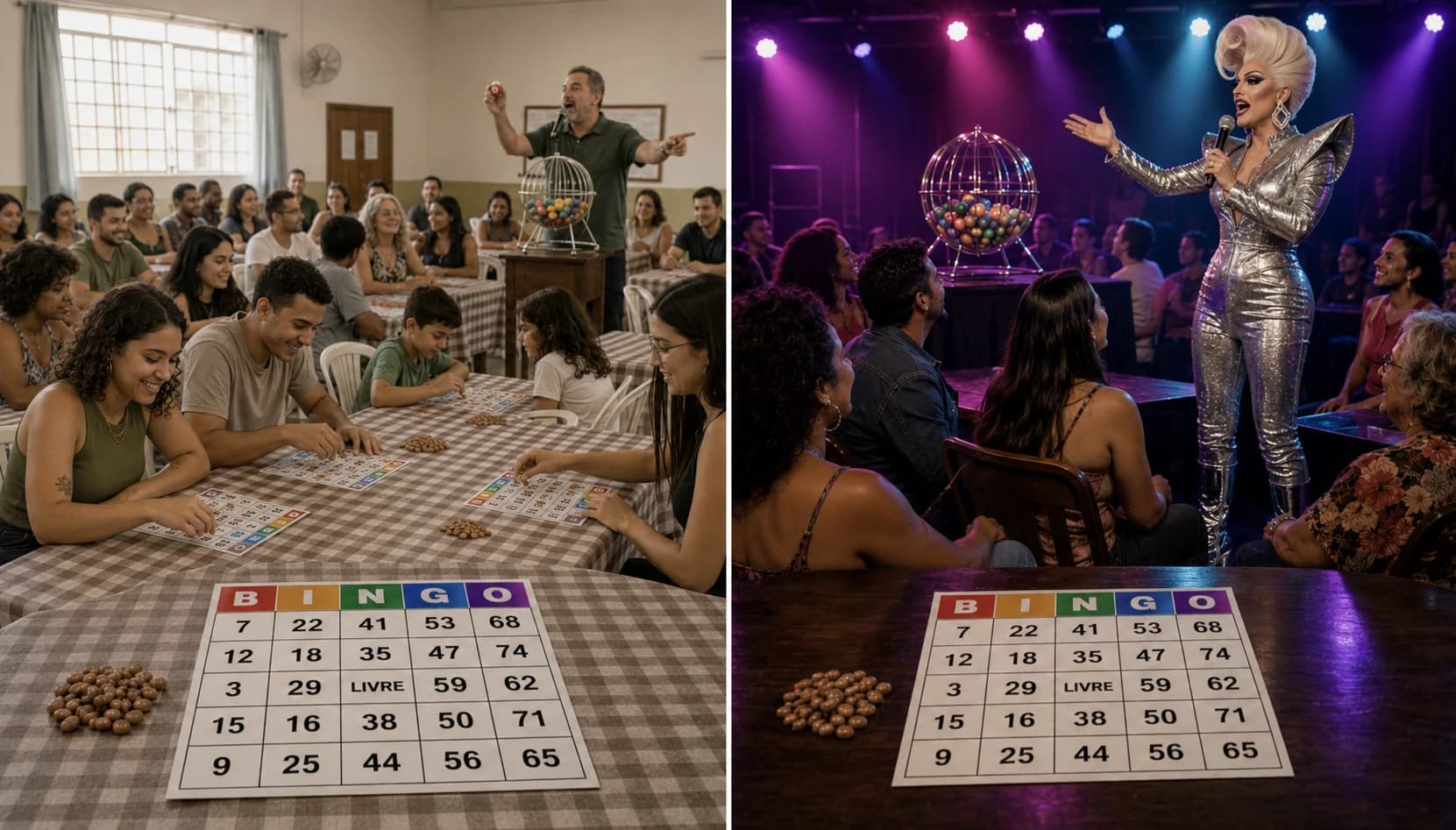
And you don't have to go far to see the same thing happening. The parish fair, the school fête and a drag club aren't wrong versions of one another: the host changes, the soundtrack changes, who's sitting there changes — the game underneath is identical. What doesn't change, where the format was born, is what it's for: a community footing the bill for its own care, first against AIDS, today also with food for the dog of someone who can't cover this month's bag. The room filling up on top of that is a consequence, not the measure.
More than thirty years after that first line at the door in Seattle, drag bingo still does exactly what it was invented to do: fill a room, raise money for someone who needs it, and leave people getting to know each other on the way out.
Sources
- From raves to drag: Classic bingo is finding a new audience in Georgia — The Atlanta Journal-Constitution (27/07/2026)
- How Drag Queens Took Over Bingo — TIME (02/05/2007): the Seattle origin, the Chicken Soup Brigade and the Durham Armory
- PALS Atlanta — official page for the drag bingo events benefiting the organization
- Lips Atlanta — the venue's official schedule
- Public Counsel — Hamburger Mary's Legendary Bingo 2026 (10 rounds and a live auction)
- Bingay — ACON's official page (Sydney): the event since 1999 and the proceeds returned to the organization
- Casa 1 — Drag Bingo, the organization's official programme (São Paulo)
- Bingo Lingo — DEPOT Cardiff, the event's official home
- Bongo's Bingo — official site