
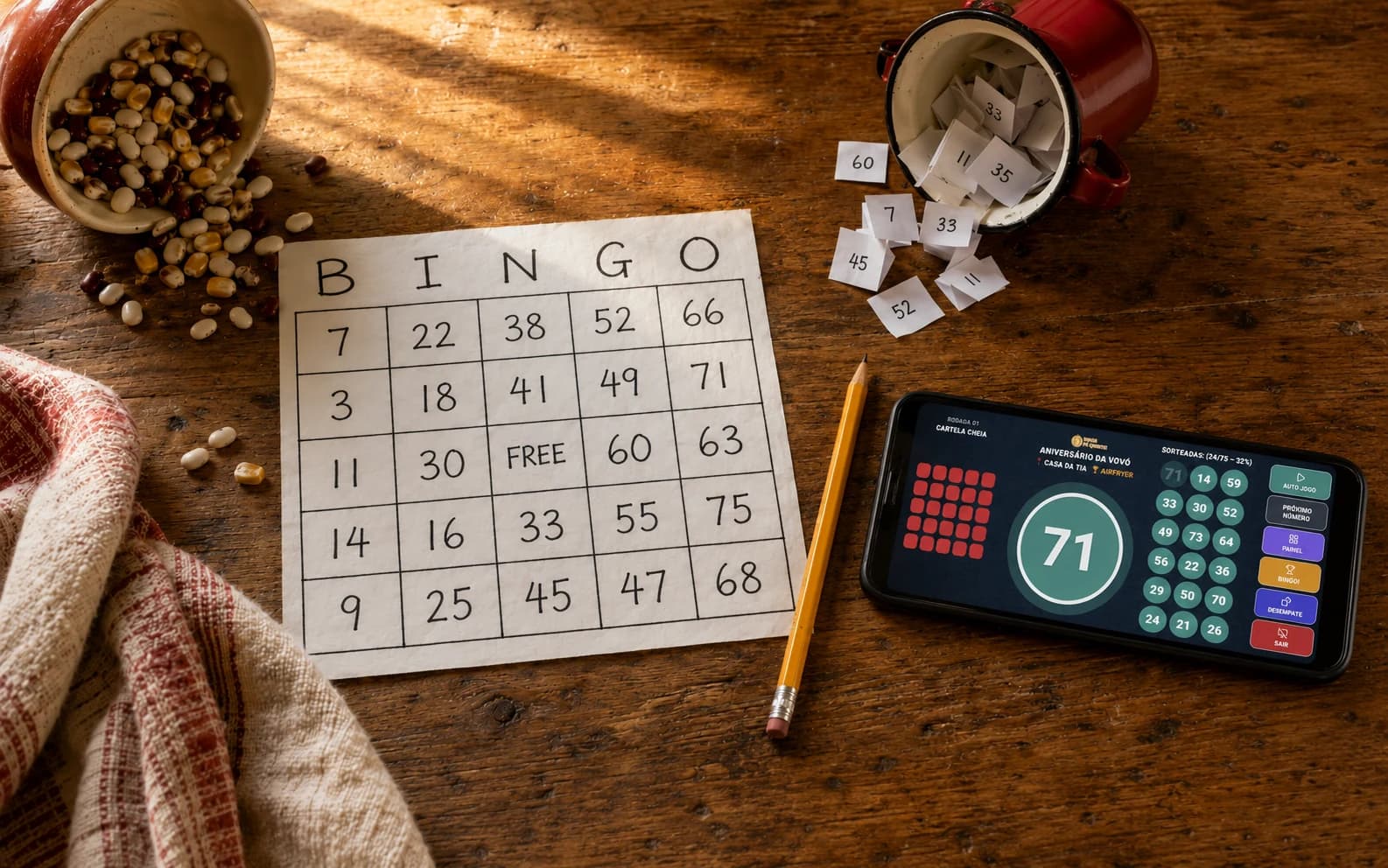
The urge hits to get the family together on a Sunday afternoon and someone blurts out: 'what if we did a bingo?'. The best part is you can set one up from scratch in about fifteen minutes, with stuff that's already lying around the house — no spinning cage and no pricey kit. This guide shows you, in order, how to prepare yours.
You'll see what you need, how to make the cards, where to pull the numbers from and how to run the draw. And at the end, you choose between doing it all by hand or taking a shortcut that lifts the boring work off your shoulders.
What you need (and probably already have)
- Cards. one per player — bought, printed or hand-drawn. We show all three ways below.
- Markers. anything small to cover the numbers: beans, corn, a button, a bottle cap, a coin or even a pen.
- A way to draw numbers. numbered slips of paper in a bag — or your phone drawing them for you.
- Prizes. they don't have to be money: a cake, a mug, a chocolate bar. The fun is in winning.
First: which bingo do you want?
The best-known is 75-ball Bingo: a card with five columns headed B-I-N-G-O and numbers from 1 to 75. That's what we'll use here. Playing with little kids? You can shrink the whole thing — we teach the easy version at the end.
1. The cards: buy, print or make them by hand
You've got three ways to get your cards in hand:
Buy them ready-made. Stationery and dollar stores sell pads of bingo cards for next to nothing — the no-effort route.
Print them free. With our card generator you generate as many as you want, all ready and all different, and print them at home. (You can draw them in Canva too — but then it's on you to make sure the numbers don't repeat; the generator already handles that.)
Make them by hand. Grab paper and a ruler, draw the 5x5 square, write B-I-N-G-O across the top and fill it in. The only rule is respecting each column's number range:
So that's 24 numbers per card (plus the FREE space): five in each column, each within its letter's range. Draw different numbers for each card so no two turn out the same.
2. The markers: what to cover the numbers with
This is the easy part — almost anything in the drawer works. The Brazilian classic is a dried bean or a corn kernel, which you can even scoop back up and reuse next round. Buttons, bottle caps, coins, coffee beans or lentils all work too. If the cards are paper and no one's reusing them, a pen or pencil does the job — and the card becomes a keepsake of the game.
A tip for anyone who doesn't see well: a big, strong-colored marker (a red button, a dark bean) on the light square makes it easy to glance over and see what's already been marked.
3. The draw: how to pull the numbers with no cage
This is the heart of the game — and you need no spinning cage. The homemade way is simple: cut 75 little slips, number them 1 to 75, fold them all and drop them in a bag, a shoebox or a pot. One person pulls one at a time, calls it out loud ('B-7!') and sets it aside so it isn't repeated. That's it — that's bingo.
Want it even easier? Instead of the 75 slips, Bingo Pé Quente runs the draw on your phone: you tap to draw, it calls the ball in a clear, natural voice, keeps a record of everything that's come out, and even throws the giant number up on the TV for the folks in the back to see. Here are the two ways side by side:
On paper, the old-school way
- Cut and number 75 slips (once).
- Fold, mix in the bag and pull one by one.
- One person is stuck just calling numbers.
- Check the BINGO by hand, number by number.
With the app doing the work
- Open it and tap draw — zero prep.
- It calls the ball in a voice and keeps the history.
- Everyone plays (no one has to 'be the cage').
- Checks the BINGO instantly and shows it on the TV.
4. Once the prize is set, it's time to play
Before the first ball, agree on what wins the round: a line (a full row) closes fast and usually opens the game; a full card is the big prize. Then it's calling the numbers, everyone marking their own card, and whoever completes the pattern first shouts BINGO!. The game stops, the card is checked and the next round begins. For the step-by-step of the game itself, it's in how to play bingo from scratch.
Bingo at home with kids: the easy version
With the little ones, shrink everything: a 3x3 card and numbers only from 1 to 30 keep the game quick and frustration-free. Even better for pre-readers — swap the numbers for pictures: animals, fruit, emojis. Then you call 'the cat!' and whoever has it marks it. For many people, it's the first rules-based game of their life.
Prize ideas that fit your budget
The prize is half the fun — and it doesn't have to be money (for a home or community bingo, better if it isn't). A cake, a box of chocolates, a mug, a little plant, a voucher for 'I'll do the dishes for you'. If you want a real list, with dozens of ideas sorted by price and by age, we have a whole piece on just that: bingo prize ideas.
The shortcut: set it all up in minutes
A bit of work? Sure. That's what the shortcut is for: print your cards for free with the generator and play on paper — or let Bingo Pé Quente call and check for you. Your way.
In the end, making a bingo at home is simpler than it looks: a sheet of paper, a handful of beans and the urge to gather everyone. The rest is the joy of hearing someone shout BINGO in your living room.