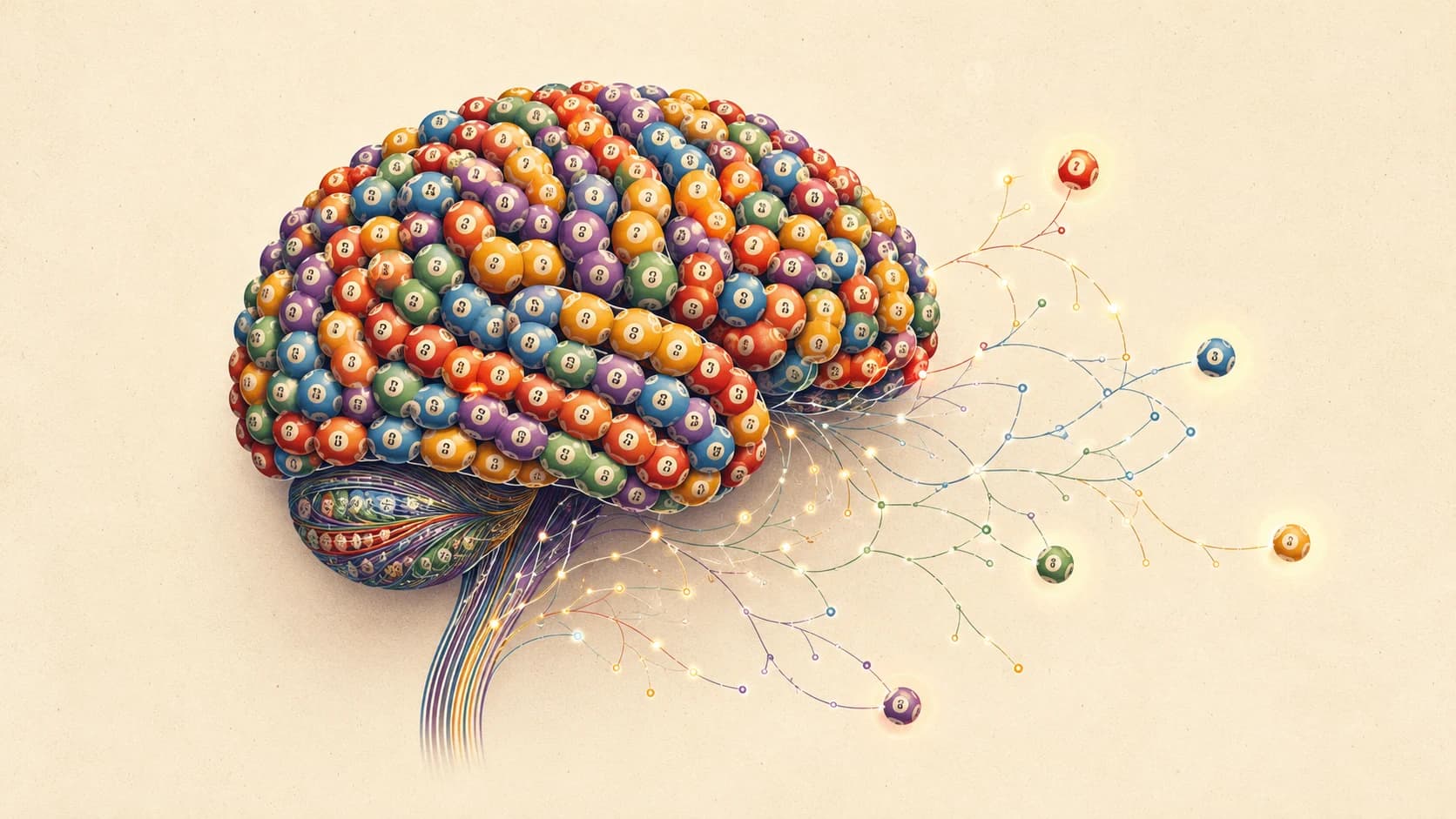
The reputation says bingo is a waiting-room pastime — something for people with time to spare. But once you look at what the game demands of your brain, the conversation changes. Hear a number, scan the card, compare, mark, repeat — and do all of it fast, several times a minute, often across more than one card at once. That isn't mental rest: it's training in attention and processing speed.
The honest question is: does it actually do you good, or is it just friendly marketing? We went looking for what scientific research really shows about playing bingo — what's well established, what's promising, and what still can't be claimed. Without exaggeration, because real science doesn't exaggerate either.
Listen, search, compare and mark in seconds — bingo is, at heart, a timed exercise in attention.
What your brain does while you play
A single round fires up, all at once, several cognitive functions that scientists usually measure separately:
- Sustained and selective attention — holding focus on the caller for 45 to 75 minutes, tuning out the chatter at the next table.
- Processing speed — the gap between one ball and the next is short; you have only seconds to react.
- Working memory — holding the number in your head while your eyes search for where (or whether) it's on the card.
- Visual search and recognition — scanning a grid of 25 squares and locating the target, a skill tied to perception and contrast vision.
- Hand-eye coordination — found it, marked it. Simple, but repeated hundreds of times a night.
Add what happens off the card — laughing, chatting, cheering together — and you have an activity that blends mental challenge with social connection. Hold on to that combination: it's exactly where the science points to the greatest value.
What the science really shows
Here it's worth separating what is direct evidence about bingo from what is broader evidence about similar activities. Both count — but it's honest to say which is which.
1. Bingo and cognitive performance: the most-cited study
The work most remembered when it comes to 'bingo and the brain' was published by Laudate, Gilmore, Cronin-Golomb and colleagues in the journal Aging, Neuropsychology, and Cognition (2012) — a collaboration involving researchers from Boston University and Case Western Reserve University. They used an adapted bingo game to test the visual search of distinct groups — healthy young adults, people with Alzheimer's and people with Parkinson's — varying the contrast, size and complexity of the cards. The result: increasing size and reducing complexity improved the performance of every group, and those with Alzheimer's got an extra boost from higher contrast, which offset their lower sensitivity to differences in tone. The authors read bingo as a valuable cognitive and visual task — and small design tweaks (contrast, size) as a simple support to improve performance.
2. Staying mentally active and cognitive decline
Here the evidence is robust, though not specific to bingo. The Rush Memory and Aging Project, tied to Rush University in Chicago, follows more than a thousand older adults without dementia over two decades. The researchers (with names like Bennett and Wilson leading the way) link frequent participation in mentally stimulating activities (games, reading, puzzles) to a slower rate of cognitive decline — and observed that greater 'cognitive reserve' was tied to slower decline even in the presence of signs of Alzheimer's in the brain. Bingo fits into that category of mentally engaging activity. Important: this is an association observed across large groups, not an individual promise — no one can guarantee that 'playing bingo prevents dementia'.
3. The secret ingredient: social connection
Perhaps bingo's most underrated benefit isn't on the card, but at the table. An extensive report from the National Academies of Sciences, Engineering, and Medicine (USA, 2020) concluded that social isolation and loneliness are associated with worse health outcomes in older adults — including a higher risk of cognitive decline and dementia. The flip side is direct: keeping up frequent social contact is protective. Bingo is, by nature, a collective activity — it brings people together, creates routine, gives a reason to leave the house and talk. In that sense, part of the 'bingo effect' probably comes less from the numbers and more from being together.
Much of the good bingo does isn't on the card — it's at the table, in the people around it.
So does bingo 'make you smarter'? Be honest
No — and be wary of anyone who promises that. What the science supports is more modest and more interesting: bingo is an activity that stimulates attention and processing speed, requires social connection, and is accessible at practically any age and condition. It doesn't cure or prevent disease on its own, but it brings together, in a single game, two ingredients that research links to brain health: mental challenge and connection with other people. For a cheap, fun pastime, that's a lot.
Why this matters at EVERY age
If bingo trains attention, memory and connection, there's no reason to reserve it for a single age group:
- Children — numbers, matching and concentration, in the form of play. It even becomes a literacy and math tool in the classroom.
- Adults — a real social break, away from the solitary screen, with that flutter in your stomach on the last ball.
- Older adults — cognitive stimulation and, above all, connection — the most accessible antidote to isolation.
- Everyone together — few activities put grandchild, parents and grandparents at the same table, in the same game, on equal footing. That's the magic of bingo.
Frequently asked questions
- Is playing bingo good for your brain? Research suggests it is, in a modest way: bingo stimulates attention, processing speed and working memory, and — being a social activity — it ties into connection-related benefits associated with cognitive health. What can't be claimed is that it alone prevents disease; the studies speak of association, not guarantee.
- Does bingo help prevent dementia or Alzheimer's? There's no proof that any game, on its own, prevents dementia. What long-term studies show is that mentally and socially active older adults tend to show slower cognitive decline. Bingo is one of those activities — part of an active lifestyle, not a cure.
- Is bingo only for older people? No. That's a reputation, not a fact. Bingo demands attention and connection that do good at any age — from children in the classroom to adults on a night out with friends. The 'old folks' home' stigma says more about where it tends to be played than about the game itself.
- Is there a real scientific study on bingo and cognition? Yes. The most cited is by Laudate, Gilmore, Cronin-Golomb and colleagues (Aging, Neuropsychology, and Cognition, 2012), who used an adapted bingo to test young and older adults — including those with Alzheimer's and Parkinson's — and showed that higher-contrast, lower-complexity cards improve performance. Beyond it, there's a vast literature on the role of mental activity and social connection in healthy aging, which bingo fits into.
- What's bingo's biggest benefit, in the end? Probably the social one. Frequent connection is one of the factors most consistently linked to good cognitive health in later life — and bingo is, by nature, a game that brings people together. Part of the good it does comes less from the numbers and more from the people around the table.
And you can have all of this without giving up convenience: with Bingo Pé Quente, you play traditional 75-ball bingo on your phone or TV, with the calling, marking and checking on autopilot — the technology handles the boring part so you can enjoy what matters, which is the circle of people around you. Prefer paper? You can print bingo cards for free with our card generator and gather the family at the table.
Bingo isn't about passing the time — it's about occupying the head and the heart at once. Science is still measuring how much; you just need the card and good company to feel it.
Sources
- Laudate, Gilmore, Cronin-Golomb et al. (2012) — 'Bingo! Externally supported performance intervention for deficient visual search…' (Aging, Neuropsychology, and Cognition), via PubMed
- Bennett, Schneider, Wilson et al. (2012) — Overview and Findings from the Rush Memory and Aging Project (Current Alzheimer's Research), via PMC
- National Academies of Sciences, Engineering, and Medicine (2020) — Social Isolation and Loneliness in Older Adults